Why Your Air Con Smells Like Feet: Mould, Bacteria, and the Evaporator Nobody Cleaned
That wave of damp, sour, faintly-footy air the moment you hit the cold button isn't your imagination — and it isn't going away on its own. It's a cocktail of bacteria and mould that have colonised your evaporator coil and, very often, a cabin filter so blocked it could be mistaken for a felt mat. The good news: it's fixable. The bad news: if you bought an antibacterial spray from a petrol station forecourt and pointed it at a vent, you've temporarily masked the smell rather than dealt with it. SOSCarFix comes to you — driveway, car park, office — kills the source properly, fits a fresh filter, and clears the blocked drain that's been growing the problem in the first place.
See our upfront pricingYour air con smells like a wet dog's gym bag — that's bacteria on the evaporator. We kill it, fit a fresh filter, and come to you. Book online.
How it actually works
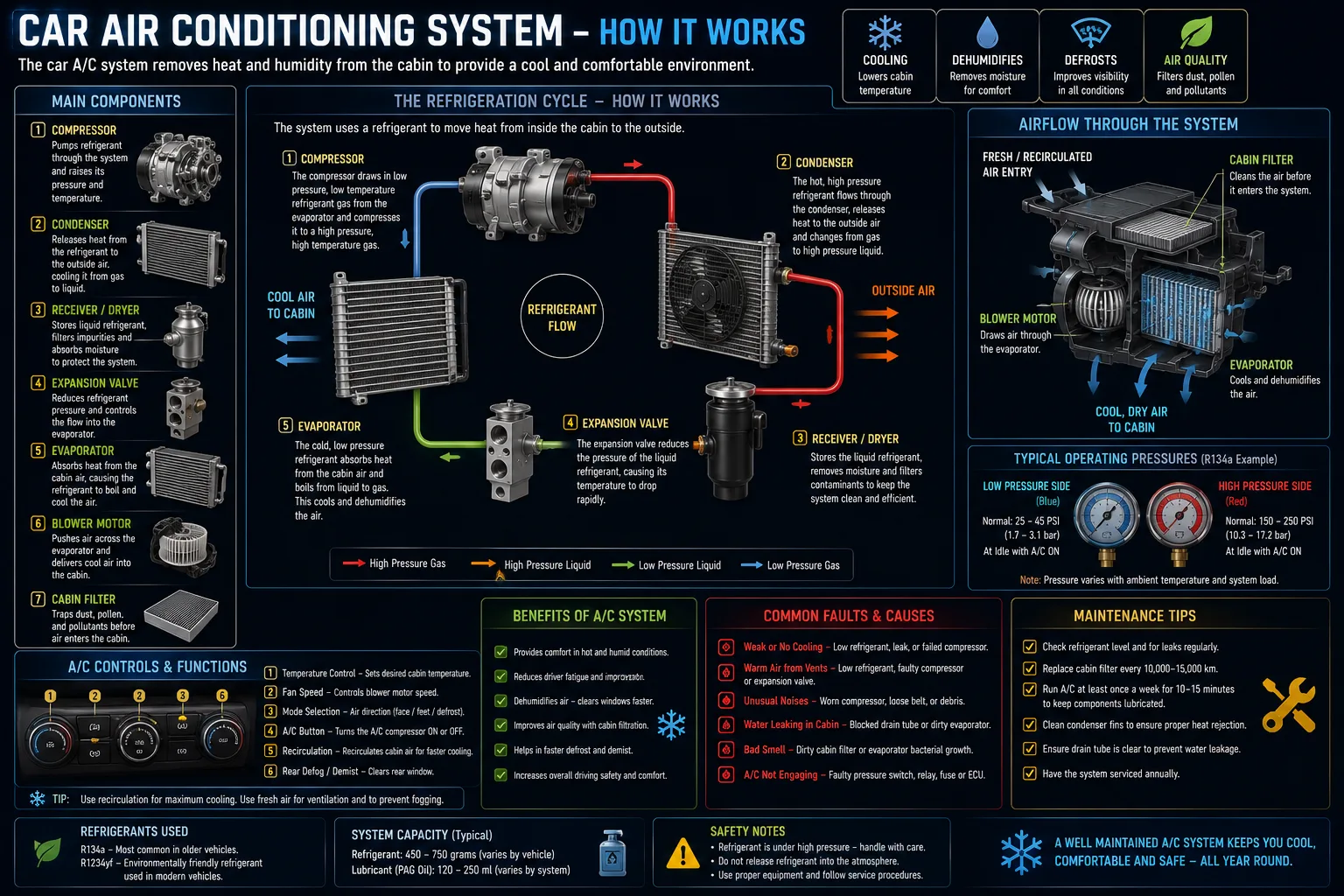
Your air conditioning system works by chilling a refrigerant under pressure, then passing cabin air over an evaporator coil — a dense, fin-covered heat exchanger tucked behind your dashboard. As warm, humid UK air crosses that cold coil, moisture condenses on it and drips into a drain tray, then out through a rubber drain tube to the outside of the car. It's essentially a dehumidifier, and like all dehumidifiers, the damp surfaces it creates are prime real estate for bacteria and mould spores to set up shop. The evaporator sits in the dark, rarely dries out completely between uses, and accumulates airborne dust, pollen and dead skin cells from the cabin. Over months, bacterial colonies form on the fins. When you fire up the AC, the fan blasts air directly across those colonies and straight into your face — hence the smell that hits hardest in the first 30 seconds, then fades as the system settles. Your cabin filter (sometimes called a pollen filter or air filter) sits upstream of the evaporator, catching most of the debris before it reaches the coil. When it's overdue for replacement — and they typically should be changed every 12,000–15,000 miles or annually — it becomes part of the problem rather than the solution: a moist, debris-laden mat that feeds exactly the growth you're trying to prevent. A blocked drain makes the whole situation worse by letting water pool in the drain tray instead of escaping.
“The good news: it's fixable.”
Sound familiar?
So what's behind it?
What we do — at your door
We come to wherever your car is parked — your home, your workplace, a car park — so you're not sat in a waiting room. We start by pulling the cabin filter out (nine times out of ten this is worse than expected) and replacing it with the correct OEM-spec filter for your car. Then we run a professional antibacterial evaporator treatment: this isn't a two-quid aerosol aimed at a vent — it's a fogging treatment or a direct-application cleaner introduced into the HVAC intake with the AC and fan running, reaching the evaporator fins properly and killing the bacteria at the source. We also check and clear the evaporator drain tube, because there's no point killing the bacteria if the pooling water just re-seeds the problem. We run the system through its cycles to confirm airflow, check the cooling performance, and if there's any evidence of a deeper issue (poor cooling, a refrigerant shortfall) we'll tell you honestly rather than just hand the car back smelling better than it did.
What affects the price
Cost depends on what's actually needed. Cabin filter replacement is a straightforward job; the filter itself varies by car make and model, and some are more accessible than others (a few are an absolute ordeal to reach — thanks, VAG group). Professional antibacterial evaporator treatment adds to the cost but is the part that actually deals with the source. If the drain tube is blocked and needs clearing, that's additional time. If the AC system also has a refrigerant shortfall (common with smelly, infrequently-used systems) and needs a regas, that's a separate cost. We'll quote each element before starting — you'll never be hit with an unexpected bill.
Random knowledge you didn't ask for
Questions you're probably asking
Will the smell come back after treatment?
Possibly, if the root causes aren't fixed. If the cabin filter is still old, the drain is still blocked, and you're running the system on recirculation all the time, the bacteria will re-establish. We address the filter and drain as part of the job. Running the AC on fresh air (not recirculation) periodically and turning it off a minute or two before parking both help keep it at bay long-term.
Can I just use an antibacterial spray from a supermarket?
You can, and it'll probably smell better for a week or two. The problem is that aerosols aimed at the exterior vent grilles don't reliably reach the evaporator fins where the bacteria actually live — they coat the duct surfaces up front. Professional treatment introduces the cleaner into the system's intake with the fan drawing it across the whole evaporator. It's the difference between spraying your worktop and actually cleaning inside the fridge.
How often should the cabin filter be replaced?
Most manufacturers recommend every 12,000–15,000 miles or once a year, whichever comes first — and sooner if you drive on dusty roads or notice reduced airflow. In practice, plenty of cars come to us with filters that haven't been touched in three or four years and look exactly as grim as you'd expect. It's one of the most commonly skipped service items.
Could the smell be something other than bacteria on the evaporator?
Yes — other causes include a mouldy fresh-air intake (check the bulkhead under the bonnet near the windscreen for accumulated leaves and damp debris), a leaking heater matrix which can give a sweet, slightly chemical smell rather than musty, or occasionally a dead rodent that's found the warm HVAC ducting an ideal place to expire. If the smell is sweet and you're losing coolant, get the heater matrix checked rather than an antibacterial treatment.
My car is only two years old. Why does it already smell?
Age is less relevant than usage pattern. Running on recirculation regularly, parking in a hot garage (moisture condenses heavily when a warm car cools down), or using the car infrequently with long gaps between AC runs can all cause bacterial growth on a relatively new system. Newer cars aren't immune — some owners report the problem within 18 months.
Why Your Air Con Smells Like Feet — sorted at your door
Stop procrastinating. Get a transparent quote and we'll come to you.