Air Con Regas & Repair: Because Britain's One Hot Week Deserves Better
Every year, without fail, Britain serves up approximately six days of actual summer. And every year, without fail, roughly half the cars on the road spend those six days blasting air that's somewhere between "room temperature" and "mild disappointment". Your refrigerant has been quietly making a break for it — a slow, invisible escape through ageing seals and perishing hoses — for years. By the time you actually need the AC, it's running on fumes. Literally. SOSCarFix comes to you, sorts the regas or hunts down whatever's leaking, and makes sure you're ready to enjoy all six days of sunshine in properly chilled comfort.
See our upfront pricingYour car's AC wheezing out lukewarm disappointment? SOSCarFix mobile air con regas & repair comes to you — no garage needed. R134a & R1234yf. Get a quote today.
How it actually works
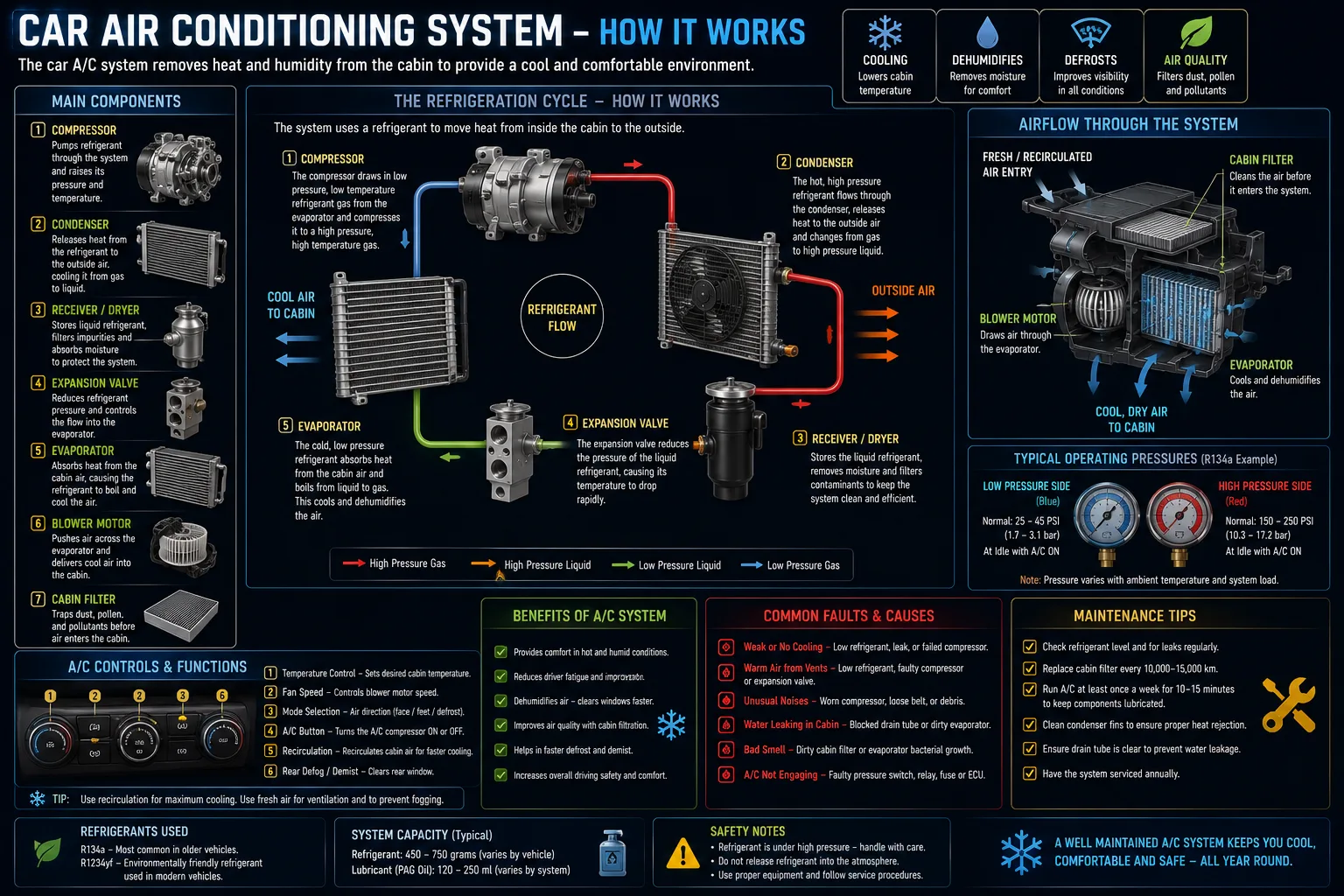
Your car's air con is a sealed loop that uses refrigerant — either R134a (pre-2017 cars) or the newer R1234yf (2017 onwards) — to shift heat out of the cabin. The compressor squeezes the refrigerant gas, which heats it up; it then flows to the condenser at the front of the car, sheds that heat to the outside air, cools down into a liquid, passes through an expansion valve (pressure drop = rapid cooling), and finally evaporates through the evaporator inside the dash — pulling heat out of the cabin air in the process. Cold air: achieved. The problem is that even a perfectly healthy system loses around 10–15% of its refrigerant per year through natural permeation — rubber hoses and seals being what they are. After two or three years, you've quietly lost enough that the system starts struggling. A regas involves recovering whatever's left in the system, pulling a vacuum to check for leaks and remove moisture, then recharging it to the exact manufacturer spec. If there's an actual leak — a faulty seal, a corroded pipe, a weeping compressor — we find it and fix it, because pumping fresh refrigerant into a leaking system is just an expensive way of refilling a sieve.
“Every year, without fail, Britain serves up approximately six days of actual summer.”
Sound familiar?
So what's behind it?
What we do — at your door
We come to you — home, work, wherever the car happens to be sitting doing nothing useful. We connect a fully calibrated AC service machine, recover whatever refrigerant is left in the system, and pull a vacuum. That vacuum stage matters: it checks the system holds pressure (no leaks) and boils off any moisture that's crept in (water and refrigerant do not get along). Then we recharge to the manufacturer's exact spec — you'll find the correct refrigerant type and charge weight on a sticker under the bonnet. If there's a leak we'll trace it, UV dye and all, and quote you for the fix rather than just sending you on your way with a full system that'll be half-empty in six weeks. We carry equipment for both R134a and R1234yf, so we're not going to tell you we can't touch your car because it's post-2017.
What affects the price
The type of refrigerant in your car makes a significant difference — R1234yf (found in most cars built from 2017 onwards) is considerably more expensive than the older R134a, so what's in your system affects the quote. The charge weight varies by vehicle too — some cars need a relatively small amount, others take a much larger fill. If there's an underlying fault — a leaking seal, a damaged condenser, a tired compressor — that repair sits on top of the regas itself. And if we find a leak, there's the diagnostic time involved in tracing it properly rather than guessing. The regas on a car with a straightforward healthy system costs noticeably less than one with a leak that needs finding and fixing — which is exactly why we quote per vehicle rather than plucking a number from thin air.
Random knowledge you didn't ask for
Questions you're probably asking
How often does a car air con regas need doing?
Every two to three years is the standard recommendation, because even a perfectly sealed system loses around 10–15% of its refrigerant annually through normal permeation. Most people don't bother until the AC stops working, which usually means they're well past due. A system that's losing gas faster than that has a leak that needs addressing — a regas on its own will just buy you a few weeks.
How do I know if my car uses R134a or R1234yf?
There's a sticker under your bonnet — usually on the slam panel or strut tower — that lists the refrigerant type and the exact charge weight in grams. As a rule of thumb: if your car was registered before 2017, it almost certainly runs on R134a. From 2017 onwards, it's R1234yf. The two systems use deliberately different fittings so they can't be cross-contaminated, which is helpful.
Can't I just top it up myself with one of those DIY cans?
Technically you can, but you're flying blind. Those cans top up without recovering or weighing what's already in the system — and an overcharged AC system is just as problematic as an undercharged one, with the added bonus of potential compressor damage. They also don't tell you whether there's a leak that'll see your fresh refrigerant gone within weeks. A proper regas recovers, weighs, vacuums, and recharges to spec. It's not the same job.
Why does my air con smell when I first turn it on?
That's the evaporator — the heat exchanger that sits inside your dashboard — hosting a collection of mould, bacteria, and general dampness that's built up from condensation. It's a warm, dark, occasionally moist place, so things grow. The fix is an evaporator cleaner treatment, not a regas, though it's sensible to have both done together while we're already in the system.
Air Con Regas & Repair — sorted at your door
Stop procrastinating. Get a transparent quote and we'll come to you.