Your Engine's Lost Its Rhythm: Camshaft & Crankshaft Position Sensor Faults Diagnosed and Fixed at Your Door
The camshaft and crankshaft position sensors are the two tattletales your ECU relies on most. Without them, it has absolutely no idea where your engine is in its four-stroke cycle — no idea when to inject fuel, no idea when to fire a spark, no idea about anything useful whatsoever. The crankshaft sensor tracks the rotation and position of the crank (your engine's main spinning shaft), while the camshaft sensor monitors the camshaft's position so the ECU can distinguish compression strokes from exhaust strokes. Together they're the engine's internal GPS. When either goes faulty — or when the ECU detects a mismatch between them (charmingly called a "correlation code") — the results range from mildly annoying intermittent stalling to a completely dead car that cranks perfectly but refuses to start. SOSCarFix comes to you, diagnoses the actual fault rather than guessing at it, and replaces what needs replacing. On your driveway. While you have a brew.
See our upfront pricingStalling, no-start or engine cutting out? Camshaft/crankshaft sensor faults love ruining your day. Mobile diagnosis & replacement — get a quote from SOSCarFix.
How it actually works
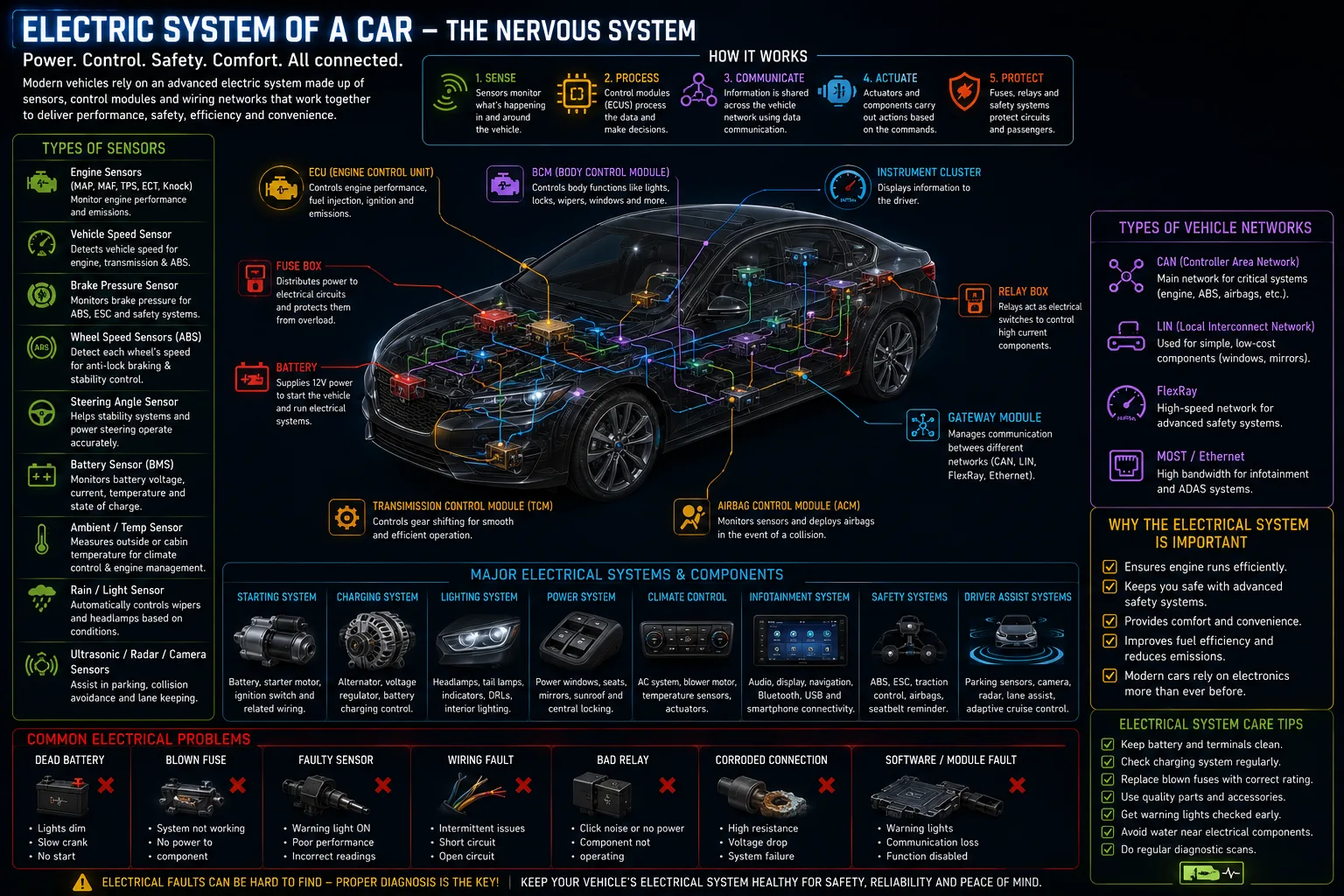
Both sensors work on the same basic principle: they read a toothed reluctor ring (a metal wheel with precisely spaced teeth and one deliberate gap) as it spins past. The sensor — typically a Hall-effect or variable-reluctance type — generates a pulsed signal every time a tooth passes, and the ECU counts those pulses with extraordinary precision. The deliberate missing tooth tells the ECU exactly where the engine is in its cycle — a bit like a clock face with one number filed off so you always know where twelve o'clock is. The crankshaft sensor sits near the bottom of the engine block, reading the flywheel or a reluctor ring pressed onto the crank. The camshaft sensor is mounted near the cam cover, reading a smaller trigger wheel on the camshaft itself. The ECU cross-references both signals constantly. If the signals agree, everything's fine. If one goes missing, goes noisy, or the two fall out of sync (correlation fault, typically P0016 or P0017 family codes), the ECU either limps the engine along on reduced information or switches off fuelling entirely. At that point your engine either misbehaves badly or simply stops. Neither is ideal when you're trying to get somewhere.
“SOSCarFix comes to you, diagnoses the actual fault rather than guessing at it, and replaces what needs replacing.”
Sound familiar?
So what's behind it?
What we do — at your door
We rock up to wherever your car has decided to stop cooperating — driveway, car park, office forecourt, the layby of broken dreams on the A-road — with professional diagnostic equipment that goes considerably further than reading a fault code and guessing. We carry a proper oscilloscope to capture the actual sensor waveform in real time, which is the only reliable way to distinguish a failing sensor from a duff connector, a damaged reluctor ring, or a correlation fault caused by timing chain stretch. That distinction matters enormously: replacing a perfectly good crankshaft sensor when the real problem is a worn timing chain is an expensive waste of everyone's time. Once we've confirmed the fault we carry a wide range of camshaft and crankshaft position sensors to suit common UK vehicles — VAG group cars, Ford, Vauxhall, BMW, Mercedes, Renault, Peugeot, Citroen, Hyundai, Kia — and we fit quality OE-specification parts rather than the bargain-bin sensors that fail again inside six months. Connector cleaned or replaced, sensor torqued correctly, codes cleared, engine verified running cleanly, and you're back on the road without ever having set foot near a garage waiting room.
What affects the price
The sensor itself is rarely the expensive part of this job — a camshaft or crankshaft position sensor for most mainstream UK cars costs anywhere from about £15 for a pattern part to £80–£120 for an OE or OE-equivalent unit on German marques, and we use quality parts rather than whatever fell off the bottom of the eBay listing. Labour varies by vehicle because access differs wildly: some crank sensors unbolt in ten minutes, others hide behind the flywheel housing or under the inlet manifold and take rather longer. Connector repair, if the plug has corroded beyond cleaning, adds a small amount for materials. Where we earn our fee is the diagnosis — correctly identifying whether you need a sensor, a wiring repair, a connector, or actually a timing chain job (which is a very different conversation and a very different invoice). Misdiagnosis is free until it isn't, and throwing parts at a fault code without verifying the waveform is how people end up replacing three sensors and still breaking down. We diagnose first, quote accurately, then fix.
Random knowledge you didn't ask for
Questions you're probably asking
My car won't start but it cranks fine — could it be the crankshaft sensor?
Absolutely, yes. If the ECU has no crankshaft position signal it won't trigger fuel injection or ignition, so the engine cranks healthily but never fires. That said, a no-start has multiple possible causes — fuel pump, immobiliser, spark, or crank sensor among them. A diagnostic scan and waveform check will confirm it quickly rather than you buying parts and guessing.
The fault code says P0340 — do I just replace the camshaft sensor?
Not necessarily. P0340 means the ECU detected no signal or an implausible signal from the camshaft sensor circuit — but the fault could be in the sensor itself, the wiring, the connector, or the reluctor wheel. Replacing the sensor on a wiring fault wastes money and leaves the fault in place. Proper diagnosis checks the waveform and circuit before condemning the part.
Why does my car start fine when cold but struggle to start when warm?
Classic heat-soak failure. The sensor's internals or the connector expand as the engine reaches operating temperature, opening up a crack or corroded contact that breaks the signal. Park up for an hour and let everything cool down, and it starts fine again — which is how people drive around with this fault for months convincing themselves it's 'fixed'. It isn't. It'll get worse.
Can I drive with a camshaft or crankshaft sensor fault?
With a partially failing sensor, sometimes yes — but you're rolling dice on when it decides to cut out completely. A car that stalls at a junction or refuses to restart in a car park is a nuisance; one that cuts out at 70mph on a motorway is a safety hazard. If you're getting intermittent stalls or a no-start, get it diagnosed promptly rather than hoping for the best.
I've been quoted for both sensors at once — is that necessary?
If one sensor has definitively failed due to age or heat, replacing its counterpart at the same time is reasonable insurance since they've both done the same mileage in the same conditions. But it's not always necessary, and we'll tell you honestly which approach makes sense for your car's age and mileage rather than just doubling the parts bill for the sake of it.
P0335 crankshaft position sensor circuit code — will my car still start?
P0335 means the ECU is getting no usable signal from the crankshaft position sensor — it literally can't tell where the engine is in its firing cycle. Some cars will still crank and limp into life; others will refuse to start entirely, because without that signal there's nothing to trigger fuel injection or ignition. Common culprits are a dead sensor, corroded wiring, or a damaged reluctor ring. Don't gamble on it — this one can strand you without warning.
Your Engine's Lost Its Rhythm — sorted at your door
Stop procrastinating. Get a transparent quote and we'll come to you.