Your Brake Warning Light Is On: Now Let's Work Out If It's the Pads, the Sensor, or Both
The brake pad wear sensor is the automotive equivalent of a smoke alarm battery warning — a deliberately annoying alert designed to make you deal with something before the far more expensive consequence arrives uninvited. It's a simple device: a small loop of wire embedded in or clipped to your brake pad that, once the friction material wears thin enough, gets ground against the disc and breaks the circuit. The ECU notices the break, illuminates the brake warning light on your dash, and waits for you to do something about it. The problem is that this wire-loop mechanism is also the bit that corrodes, snags, gets pinched during a dodgy brake job, or snaps entirely on its own — so that warning light can mean "your pads are genuinely worn" or it can mean "the sensor wire gave up the ghost at 70 mph for reasons entirely unrelated to pad thickness." SOSCarFix comes to your driveway, diagnoses which situation you're actually in, and fixes it — no guessing, no reflexive parts-ordering, no garage waiting room.
See our upfront pricingBrake pad warning light on? Could be the pads, could be a snapped sensor wire. SOSCarFix diagnoses it properly and sorts it on your driveway. Get a quote.
How it actually works
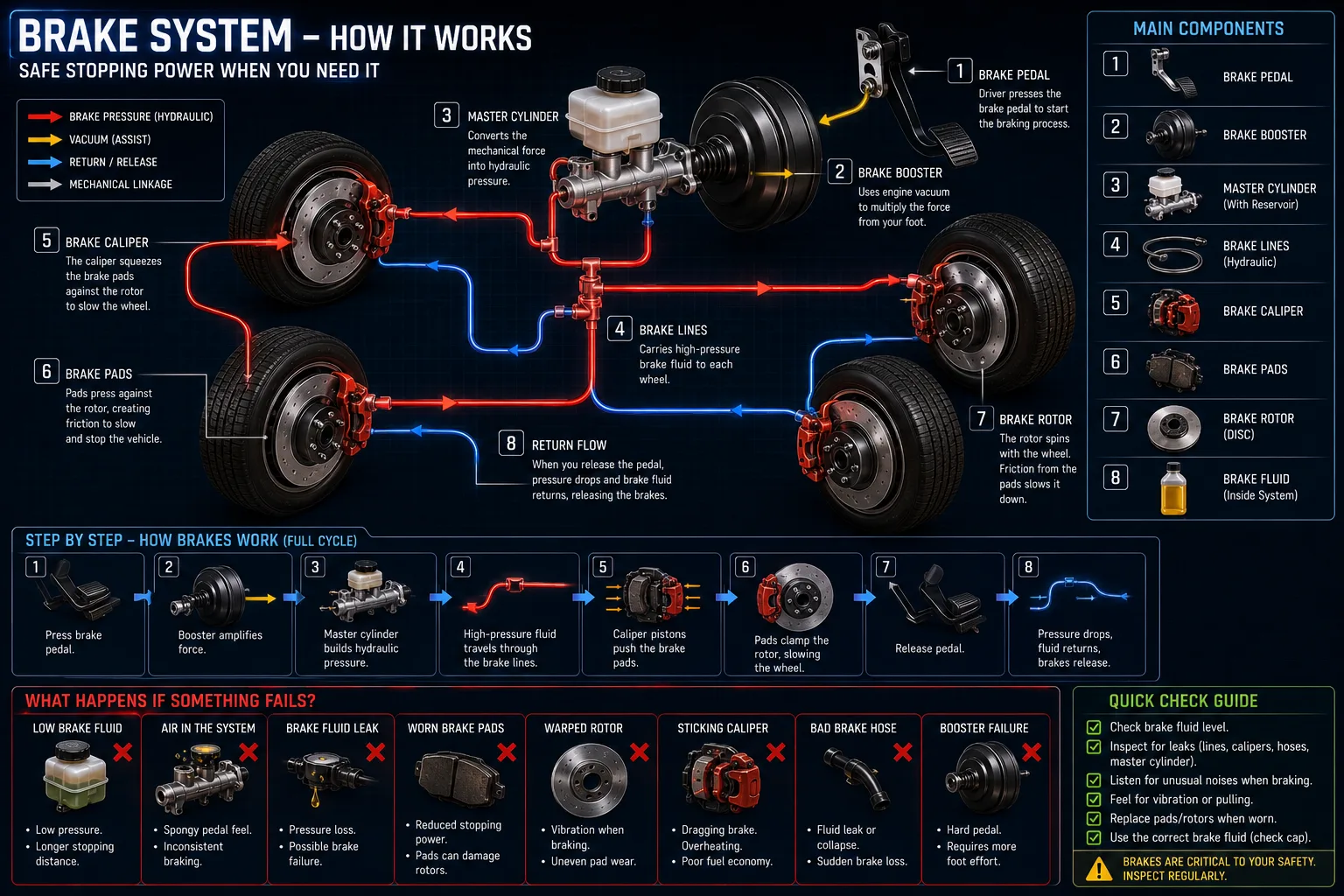
The brake pad wear sensor works on a beautifully low-tech principle: it's a circuit that's designed to fail in a controlled way. A thin wire loop — usually embedded in a small plastic housing — sits at a predetermined depth within the brake pad's friction material. The wire is connected to the car's body wiring harness via a small plug near the wheel hub, and as long as the wire is intact and connected, the circuit is closed and the ECU is satisfied. Nothing lights up. Everything is calm. When the friction material wears down to the legal or recommended minimum — typically around 2–3 mm, depending on the manufacturer's threshold and the sensor's position within the pad — the wire loop contacts the spinning brake disc. Within a few rotations, the disc grinds through the wire, breaks the circuit, and the ECU interprets the open circuit as its cue to illuminate the brake warning light, often combined with a dashboard symbol resembling an exclamation mark inside a circle or a specific "BRAKE" text warning. Here's where it gets nuanced. The ECU cannot tell the difference between a wire broken by wear and a wire broken by corrosion, mechanical damage, or a previous technician who trapped it under a brake caliper bolt. An open circuit is an open circuit. This is why proper diagnosis matters: if the sensor wire has snapped due to damage rather than actual pad wear, fitting new sensors without checking the pads still gives you pads of unknown thickness. Equally, if the pads are fine but an old sensor wire from a previous brake job was never replaced, you're replacing perfectly good pads unnecessarily. A scan tool showing live sensor circuit status, combined with actually pulling the wheel off and measuring pad thickness with a proper gauge, is how you establish which situation you have.
“The ECU notices the break, illuminates the brake warning light on your dash, and waits for you to do something about it.”
Sound familiar?
So what's behind it?
What we do — at your door
SOSCarFix comes to you — driveway, office car park, layby where the brake warning light appeared and you decided not to push your luck — and starts with a proper diagnosis rather than a reflexive "new pads all round." We connect a scan tool and pull live data from the brake wear sensor circuit, which tells us immediately whether we're looking at a genuine open circuit on a specific corner or a more complex electrical fault. Then we get the wheels off and physically measure the remaining pad thickness with a gauge — because the only honest answer to "do these pads need replacing" is a millimetre reading, not a visual squint or an assumption. If the pads are worn and the sensors have done their job, we fit quality replacement pads and new sensor wires at the same time, correctly routed and properly connected so the light goes out and stays out. If the pads have plenty of material left but the sensor wire has failed due to damage or corrosion, we replace the sensor, clear the fault, and send you on your way without charging you for pads you don't need yet. No parts thrown at it speculatively, no upselling brake fluid and disc skimming unless the diagnosis actually supports it. Just an honest assessment and the correct fix, at your location, on your schedule.
What affects the price
The cost of brake pad wear sensor work in the UK depends on what the diagnosis actually reveals, which is precisely why diagnosis comes before quoting a fixed price. If the pads are worn and need replacing, the sensor wires are replaced as part of the same job — the sensor cost is a small add-on to the pad replacement rather than a separate visit. The main cost driver in a pad and sensor replacement is the pads themselves, which vary considerably between a budget pattern part and a quality OE-equivalent for different car makes and whether you're doing fronts, rears, or both axles. If the pads still have life in them and the sensor wire alone has failed, you're looking at a straightforward sensor replacement job — a modest repair rather than a significant expense, but one that genuinely requires the wheel to come off and the circuit to be verified with a scan tool rather than guessed at. Connectors showing heavy corrosion may also need attention if the new sensor won't make a clean connection in a corroded socket. On some vehicles — particularly German makes — rear brake sensors can be integrated into more complex pad designs that cost more than a simple wire loop, so your specific registration matters more than any ballpark figure.
Random knowledge you didn't ask for
Questions you're probably asking
Can I just clear the brake warning light and ignore the sensor?
You can clear the fault code, yes. The light will return immediately if the sensor circuit is still open, which it will be, because clearing a code doesn't repair a wire. More importantly, if the light came on because your pads are actually worn, clearing the code and ignoring it means driving on pads that are at or beyond minimum thickness — which is how metal backing plates meet brake discs, ruining both and significantly extending your stopping distances. Clearing and ignoring is the automotive equivalent of removing a smoke alarm battery.
Why is the brake warning light on after I've just had new pads fitted?
Almost certainly because the technician didn't replace the wear sensor wire when they replaced the pads. The old sensor — which was designed to break at the end of pad life and has often been sitting in that environment for years — gets reused to save a few pounds on parts, and then fails within days or weeks. The fix is fitting a new sensor, plugging it in correctly, and clearing the fault. It's a cheap repair and a frustrating consequence of cutting corners on the original job.
Do I need to replace brake pad sensors on all four wheels at once?
Only if sensors are fitted to all four wheels and the fault affects multiple corners. Many cars only have wear sensors on the front axle. If the fault is on one specific corner, one sensor is the correct fix — you don't need to replace all four sensors any more than you'd replace all four tyres because one got a puncture. The diagnostic step of identifying which circuit is open tells you exactly which sensor or sensors need attention.
How do I know if it's a sensor fault or my pads are genuinely worn?
You don't, without checking — and that's the whole point. A scan tool reading the sensor circuit state tells you which corner has an open circuit. Removing the wheel and measuring pad thickness with a gauge tells you whether friction material remains or whether the pad is at or past minimum. The combination of both pieces of information gives you a definitive answer. Anyone telling you with certainty which it is based solely on a dashboard light is guessing.
Will a faulty brake pad sensor cause an MOT failure?
Not directly — there's no specific MOT test item for sensor circuit continuity. However, if the brake warning light is illuminated during the MOT test, the tester is required to investigate it as a potential brake system defect. A lit brake warning light is an MOT failure for a malfunction indicator that cannot be explained and resolved. So yes, a broken sensor wire with the light on will fail your MOT — not because of the sensor itself, but because of the warning light it's caused.
Your Brake Warning Light Is On — sorted at your door
Stop procrastinating. Get a transparent quote and we'll come to you.