Your Boost Pressure Sensor Is Gaslighting the ECU: Limp Mode, Lost Power, and the Fix That Comes to You
Turbocharged engines are, at their core, an exercise in controlled aggression — forcing more air into the cylinders than atmospheric pressure would naturally allow, burning more fuel with it, and extracting considerably more power than the engine's capacity would otherwise suggest is reasonable. The boost pressure sensor is the component tasked with telling the ECU exactly how much of that compressed air is actually arriving in the intake manifold. When it fails — or starts producing readings that drift, spike, or simply stop making sense — the ECU is left trying to manage a turbocharged engine with corrupted data. Its response to this situation is not to soldier on optimistically. It's to activate limp mode, choke the boost, log a fault code, and illuminate the engine management light while it waits for someone to sort it out. That someone is SOSCarFix, who will come to your driveway, your car park, or the hard shoulder of the A1 where things went spectacularly wrong, and fix this without making you tow the car anywhere.
See our upfront pricingTurbo in limp mode, lost power, boost deviation codes? Your boost pressure sensor is lying to the ECU. SOSCarFix diagnoses and fixes it at your door. Get a quote.
How it actually works
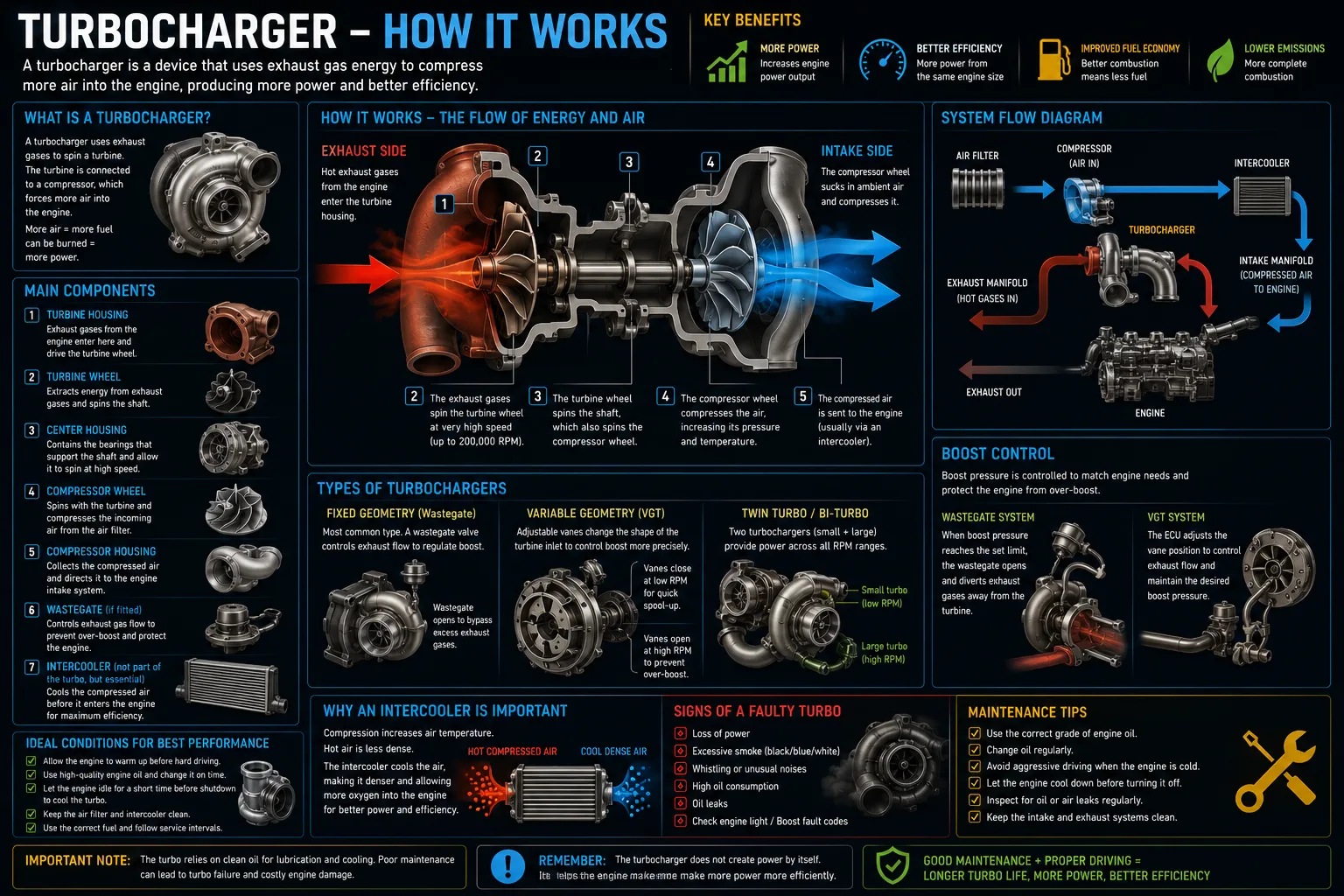
The boost pressure sensor — sometimes called a MAP sensor (Manifold Absolute Pressure) or turbo boost sensor depending on where it sits — measures the absolute or relative pressure of air in the intake manifold downstream of the turbocharger. It's typically a small brass or plastic threaded unit screwed into the intake pipe or manifold, with a three or four-wire connector carrying a reference voltage, an earth, and a signal wire back to the ECU. As boost pressure rises, the sensor's output voltage changes in a predictable, calibrated curve. The ECU reads that voltage, cross-references it against engine speed and throttle position, and uses it to decide how much fuel to inject and how hard to push the wastegate or variable-geometry vanes controlling boost output. On a healthy system running, say, 1.2 bar of boost, the ECU knows what signal voltage to expect. If the sensor reports 0.5 bar when the ECU calculates the turbo should be making 1.2 bar, that's a boost deviation fault. If the sensor reports a fixed, unchanging voltage — stuck high or stuck low — the ECU loses its closed-loop boost control entirely. If it reports a voltage that oscillates erratically, the ECU can't make coherent fuelling decisions. In all three scenarios the ECU does the same thing: it declares a fault, triggers the engine management light, and activates limp mode to protect the engine from over-boosting into oblivion or running dangerously lean. It's not being dramatic. It genuinely cannot manage boost safely without accurate pressure data, and it knows it. Diagnosis requires a scan tool reading live sensor output alongside boost target values — not guessing, not swapping parts, and definitely not clearing the code and hoping it doesn't come back.
“Its response to this situation is not to soldier on optimistically.”
Sound familiar?
So what's behind it?
What we do — at your door
SOSCarFix comes to you — driveway, car park, or wherever the turbo's dignity went — with a professional scan tool capable of reading live data properly, not just harvesting fault codes and handing you a printout that tells you approximately nothing useful. We start with a live data session: boost target versus actual boost reading, sensor voltage at idle and under load, MAP values across the rev range. This tells us almost immediately whether the sensor is lying, whether there's a boost leak somewhere in the plumbing making the sensor report accurately but look like it isn't, or whether the boost control solenoid is the actual culprit. We inspect the sensor wiring and connector for corrosion or damage, check the intake system for splits and leaks that would cause genuine boost loss, and examine the sensor port for oil contamination — because if the intake is soaked in turbo oil, a new sensor will develop the same fault within months if the underlying cause isn't addressed. Once we've confirmed the sensor is the problem (and not a red herring in front of a different problem), we replace it with the correct specification part for your engine, clear the fault codes, and verify live data confirms normal boost pressure tracking before packing up. The limp mode clears. The engine management light goes off. The turbo actually works again. All of this happens at your postcode, not a garage you had to tow to.
What affects the price
Boost pressure sensor replacement cost in the UK varies by vehicle rather than by the size of the problem — the sensor itself is not an expensive component on most mainstream turbo cars, but the range between a sensor for a Ford Fiesta ST and one for a BMW M140i or a Porsche is quite wide. Quality aftermarket sensors from manufacturers like Bosch, Hella, or Delphi — who supply the OEMs in the first place — are typically the sensible choice over no-name units that may drift out of calibration again within a year. Labour time is generally modest since the sensor is usually accessible, though on some turbocharged engines with complex intake arrangements or tight engine bays, access can add time. If diagnosis reveals the actual cause is a boost control solenoid rather than the sensor, that's a different part at a different price. If the intake system has boost leaks that need addressing — split hoses, failing intercooler end-tanks — that's additional work worth knowing about before rather than after. Connector and wiring repairs, if corrosion has reached the loom, add variable cost depending on how far the damage has spread. The honest answer is always: get a quote based on your registration, because the number that applies to someone else's car may have essentially nothing to do with the number that applies to yours.
Random knowledge you didn't ask for
Questions you're probably asking
What fault codes does a failing boost pressure sensor produce?
The most common are P0234 (turbocharger overboost condition), P0299 (turbocharger underboost), and the P0235–P0245 range covering boost pressure sensor circuit faults — covering high, low, and intermittent signal problems. Manufacturer-specific codes vary: VAG group cars often produce boost deviation codes in their own numbering, and diesels tend to produce charge pressure deviation faults rather than generic P-codes. The code tells you which parameter is out of range; live data tells you whether the sensor or something else is causing it.
Can a boost pressure sensor fault clear itself and go away?
Yes, and that's exactly why intermittent faults are so frustrating. A sensor that's marginal — drifting at temperature but within spec when cold — will trigger a fault during a hard run, the ECU will log it and illuminate the management light, and then when the car cools down the sensor output returns to something acceptable and the light might even extinguish. The code stays stored until cleared, but the symptom vanishes. Intermittent boost faults need live data capture during the conditions that trigger the fault, which is why turning the car off and reading codes doesn't always tell the whole story.
Could it be a boost leak rather than the sensor itself?
Very possibly, and this is the most common misdiagnosis in boost pressure faults. If a hose between the turbo and the intake manifold has split — intercooler pipe, charge pipe, a vacuum hose on the wastegate — actual boost pressure is lower than the turbo is generating, the sensor reports that real pressure accurately, and the ECU sees a deviation from its target. The sensor has done its job perfectly and is about to be replaced for it. A proper diagnosis checks for boost leaks before condemning the sensor. Smoke testing the intake system is the thorough way to find leaks that aren't visible.
Is it safe to drive in limp mode?
Safe in the sense that the ECU has restricted boost to protect the engine from running dangerously lean or over-boosting into failure — so the car is actively defending itself. Inadvisable in the sense that you are driving a turbocharged car without its turbo doing meaningful work, which was rather the point of the engine. Limp mode is also not a static protection: sustained driving with a fuelling or boost issue that put you in limp mode in the first place can cause additional damage if the root cause is something other than the sensor. Diagnose it promptly rather than using limp mode as an indefinite workaround.
Will clearing the fault code fix the limp mode?
Temporarily, sometimes. If the fault conditions that triggered limp mode are no longer present when you clear the code, the ECU will exit limp mode and the car will drive normally — right up until the sensor produces the problematic reading again, which could be the next cold start, the next hard acceleration, or the next motorway run. Clearing codes is a diagnostic step, not a repair. If the code returns within one or two drive cycles, the cause is genuine and still there.
Your Boost Pressure Sensor Is Gaslighting the ECU — sorted at your door
Stop procrastinating. Get a transparent quote and we'll come to you.