Black Smoke from the Exhaust: Your Engine Is Eating More Fuel Than It Should
Black smoke from your exhaust is your engine doing the automotive equivalent of chain-smoking — burning more fuel than it can actually use, sending the unburnt excess out the back as a thick, sooty cloud. It looks dramatic. It smells unpleasant. And it is, without exception, your engine running rich: too much fuel, not enough air, or both at once. Left alone it will fail an MOT emissions test, clog an already-unhappy DPF, and — if you're diesel — accelerate wear on components that really don't want carbon deposits for neighbours. The good news is it's diagnosable on the spot, and the causes range from a filthy air filter (cheap) to injectors that have given up the ghost (less cheap). SOSCarFix comes to you with proper scan tools, reads the live data, and tells you exactly what's causing it before anyone quotes you for parts.
See our upfront pricingBlack smoke from your exhaust means your engine is over-fuelling. Find out why — and get a proper mobile diagnosis at your door. Get a quote from SOSCarFix.
How it actually works
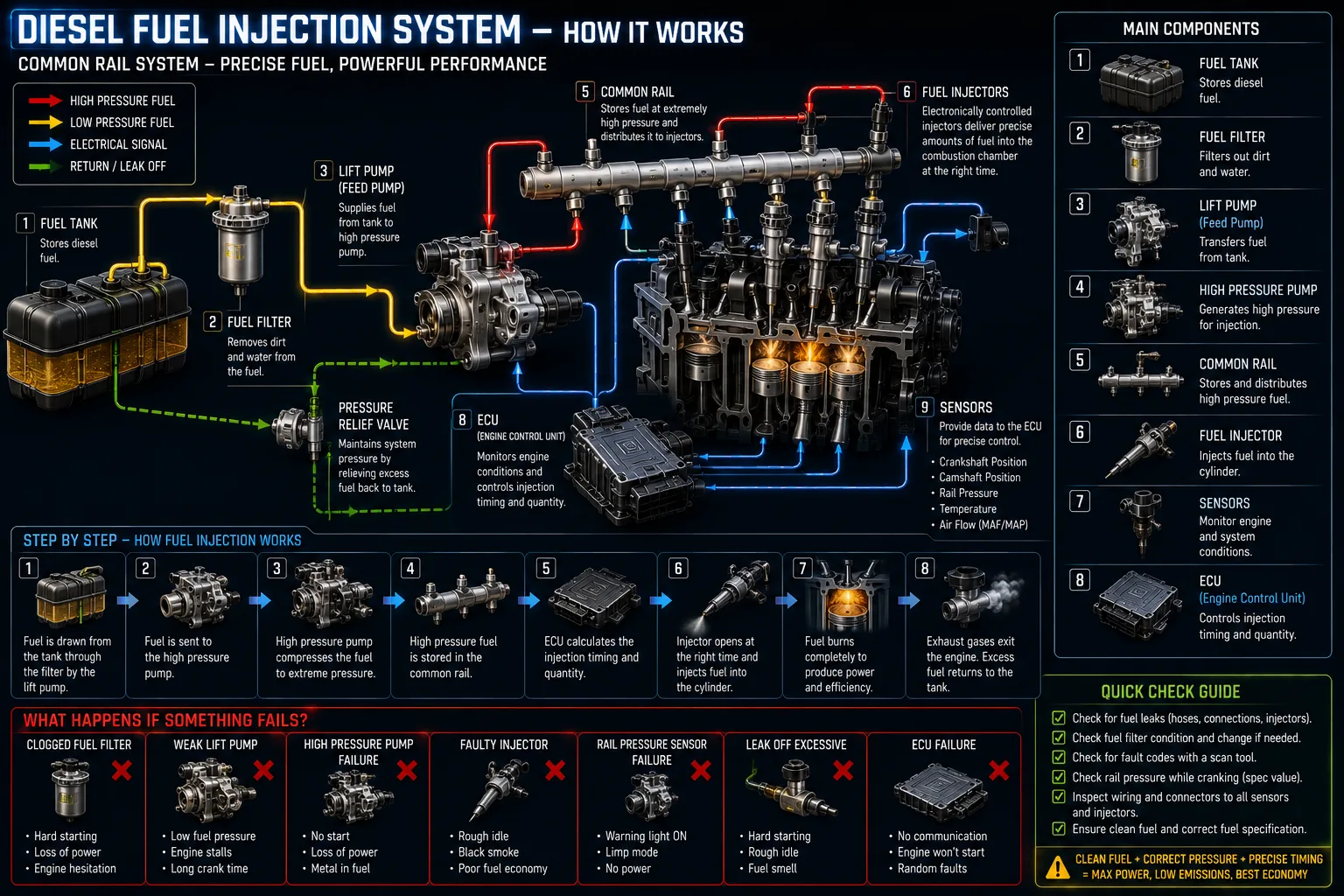
Combustion is a precision balancing act. Your engine mixes air and fuel in a specific ratio — roughly 14.7 parts air to 1 part fuel for petrol, slightly different for diesel — and ignites it. When that ratio tips too far towards fuel (the 'rich' side), there isn't enough oxygen to burn everything cleanly. The unburnt hydrocarbons and soot exit as black smoke. On a diesel, this happens constantly in small amounts under hard acceleration — you may have seen a lorry put out a puff on a steep hill. What you shouldn't be seeing is sustained black smoke at idle or normal driving, because that means something is wrong with how fuel is delivered, how air gets in, or how the engine manages its own emissions. Your engine has multiple systems working together to keep the mixture right: the mass airflow (MAF) sensor measures incoming air, the ECU uses that data to set injector timing and duration, the EGR (exhaust gas recirculation) valve recirculates a measured amount of exhaust gas back in to reduce NOx emissions, the turbo (on diesels and many modern petrols) boosts air pressure into the intake, and the DPF catches the soot that gets through anyway. When any one of those systems misbehaves, the mixture tilts rich and the smoke signals start. A proper diagnosis reads live data from all of them — not just whatever code happened to pop up first.
“And it is, without exception, your engine running rich: too much fuel, not enough air, or both at once.”
Sound familiar?
So what's behind it?
What we do — at your door
We come to you — driveway, car park, wherever the car is — with professional-grade diagnostic equipment, not a £30 Bluetooth dongle from the internet. We connect to all modules (engine, transmission, emissions), read active and stored fault codes, and pull the live data that actually matters: MAF readings versus expected values for your engine, fuel trim figures (short and long term), boost pressure versus map, EGR position and duty cycle, injector energising times. If live data points at injectors or fuel pressure we'll pressure-test the fuel rail; if it points at a boost leak we'll smoke-test the intake. The goal is to confirm the actual cause before anyone talks about parts — because sticking a new MAF sensor on a car with leaking injectors achieves precisely nothing except a lighter wallet. You get a plain-English explanation of what's causing the smoke, what it'll take to fix, and a clear quote. Then it's your call.
What affects the price
What it costs to fix black smoke varies enormously depending on what's actually causing it. An air filter is a few pounds in parts and twenty minutes of labour. A MAF sensor on a common diesel is typically in the range of £80–£200 fitted. EGR valves range from a straightforward clean (labour only) to replacement of the valve and cooler, which can reach several hundred pounds on some makes. Injectors are where costs get serious: a single diesel injector can be £150–£400+ for the part alone, and getting them out, flow-tested or replaced, and recoded to the ECU is skilled work. A turbo replacement ranges widely by vehicle — budget £600–£1,500+ on most common diesels. DPF cleaning (a forced regeneration via software) is relatively low cost; DPF replacement is not. The diagnostic itself is a fixed charge and is the only way to know which of these you're dealing with — which is why guessing without one tends to cost more in the end.
Random knowledge you didn't ask for
Questions you're probably asking
Is black smoke from my exhaust dangerous to drive with?
It depends on severity and cause. Mild black smoke on hard acceleration from a dirty EGR or a marginal air filter — annoying, not an emergency. Sustained heavy smoke at idle or part throttle is a different matter: it can indicate injector failure or a boost issue that will worsen, potentially leading to damage or a sudden loss of power. It will also fail an MOT emissions test, so there's no ignoring it indefinitely. Get it diagnosed before it escalates.
My diesel only smokes on hard acceleration — is that normal?
A brief puff on full-throttle demand is not unusual on older or high-mileage diesels — the turbo momentarily can't supply enough air to match the fuel the ECU demands. Ongoing or heavy smoke even in that scenario isn't normal. If it's getting worse, or you're seeing smoke at cruise or idle, something is failing. 'Normal for a diesel' is used to explain away a lot of faults that are actually diagnosable.
Can a blocked DPF cause black smoke?
Yes. A severely blocked DPF increases exhaust back-pressure, which disrupts combustion and pushes the mixture rich. It can also cause the ECU to attempt a forced regeneration (burning the soot off at high temperature), and if that fails repeatedly, fuelling and smoke get worse. If someone has removed the DPF entirely, that's both an MOT failure and the likely reason the smoke is so bad — a car without a DPF has nothing catching the soot.
The garage said it's injectors but just cleaned them — will that fix it?
An injector clean (whether ultrasonic bench clean or on-car flush) can help if the injectors are merely contaminated. If they're mechanically worn — the needle or spray holes are damaged — cleaning buys time at best. The only way to know which you're dealing with is to flow-test the injectors off the car or check live injector quantity data on the car. We check the data first so you're not paying to clean something that needs replacing.
Will this fail my MOT?
Almost certainly, yes. The MOT diesel smoke test measures exhaust opacity directly. Heavy sustained black smoke will exceed the legal limit for your car's year and fuel system — it's listed as a Category S (seriously advisable to fix) defect. Some borderline cases scrape through on a marginal day and fail the next; a properly fixed over-fuelling problem passes cleanly. Don't book your MOT hoping it holds together — get the diagnosis first.
Black Smoke from the Exhaust — sorted at your door
Stop procrastinating. Get a transparent quote and we'll come to you.