Your Intelligent Battery Sensor Has Stopped Being Intelligent: Symptoms, Faults, and Why Battery Changes Need More Than a Spanner
There was a time when changing a car battery meant disconnecting two terminals, swapping the battery, reconnecting two terminals, and getting on with your life. That time has largely gone. On most modern cars — anything with stop-start, regenerative charging, or an advanced battery management system — there is a small, frequently overlooked sensor clamped to the negative terminal of the battery. It is called the Intelligent Battery Sensor, or IBS, and it quietly measures everything: current flowing in and out, voltage, temperature, the battery's state of charge and state of health. The engine management system uses that data to decide when to charge, how hard, and whether to bother running the stop-start system at all. When the IBS packs up, the car starts making a series of baffling, seemingly unrelated complaints — and unless you know the sensor exists, you can spend a lot of money fixing things that were never broken. SOSCarFix comes to you, plugs in proper diagnostic kit, reads live data from the sensor, and deals with it on your driveway before the problem compounds into something worse.
See our upfront pricingStop-start not stopping or starting? Battery warning with no obvious cause? Your IBS is lying to your car. SOSCarFix diagnoses and sorts it — get a quote.
How it actually works
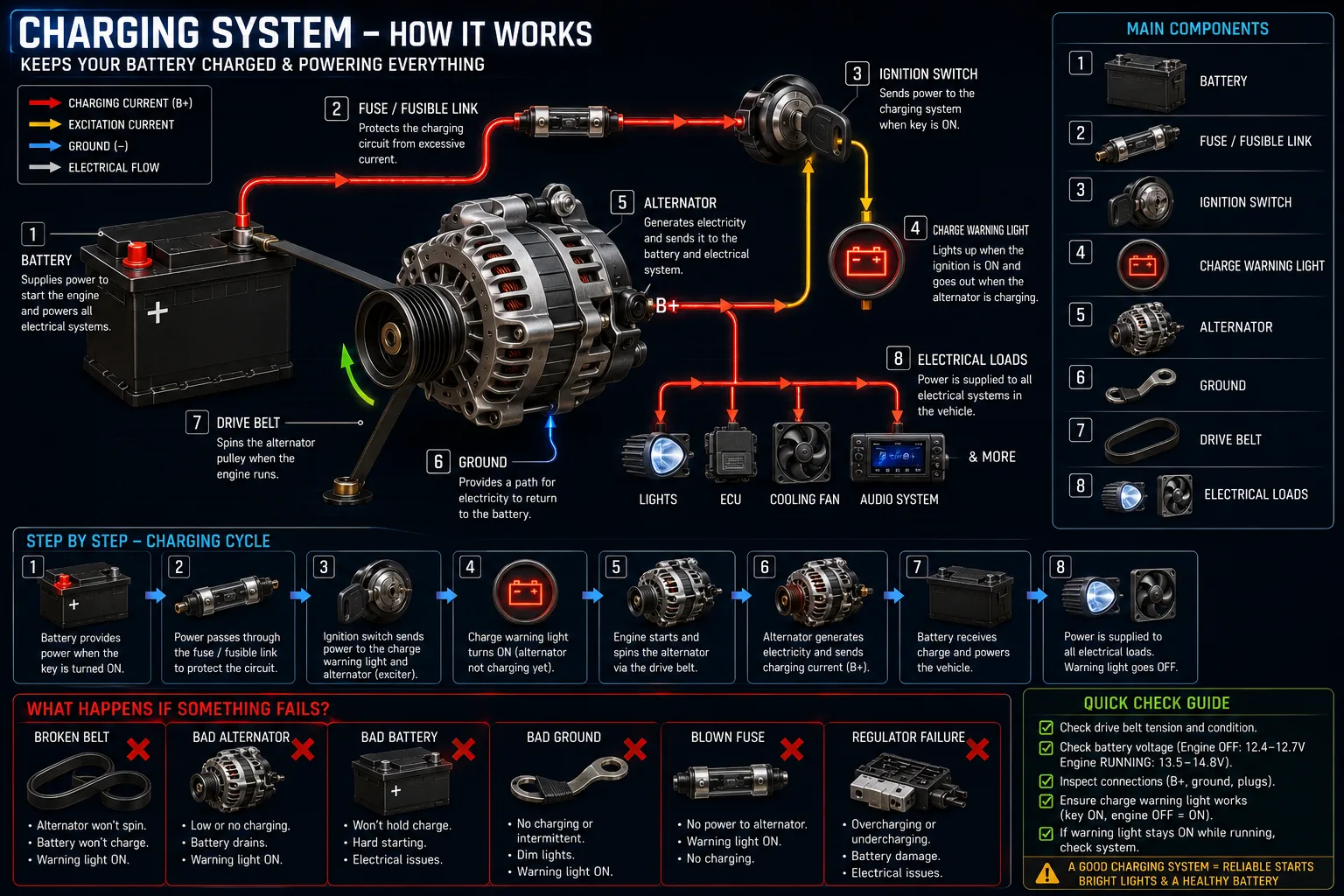
The Intelligent Battery Sensor sits permanently bolted to the negative battery terminal — it is not a separate add-on, it is part of the system. Inside the sensor body is a shunt resistor, a temperature probe, and a small electronics module that converts raw measurements into data. That data travels via a LIN-bus (a simple one-wire serial network used widely for sensors and ancillaries) to the Body Control Module or Battery Management ECU, which uses it to build a real-time picture of battery condition. The ECU tracks two key figures: State of Charge (SoC) — how much energy is currently in the battery, roughly analogous to a fuel gauge — and State of Health (SoH) — how capable the battery is of delivering its rated performance compared to when it was new. From those figures, the ECU controls variable-voltage charging, where the alternator does not just pump out 14.4 V continuously but varies its output based on what the battery actually needs. Under light loads on a warm day with a healthy battery, the alternator may drop back to reduce engine load and improve fuel economy. Under heavier demands or cold conditions, it increases output. The stop-start system consults the IBS before every engine-off event — if the battery cannot reliably restart the engine, stop-start silently stays inactive rather than stranding you at a junction with a warm engine and no will to continue. When the IBS feeds the ECU wrong data — because the sensor itself has failed, corroded, developed an open circuit, or simply drifted — the entire charging and energy management strategy falls apart. The ECU is still making decisions, just based on nonsense. That is where your problems start.
“That time has largely gone.”
Sound familiar?
So what's behind it?
What we do — at your door
We come to your driveway, car park, or office — wherever the car is sitting complaining — and start with a proper scan rather than a guess. That means connecting to the vehicle's diagnostic network and pulling live data from the IBS itself: current readings, voltage, temperature, state of charge, state of health, and any fault codes stored against the battery management system. Live data beats guessing every time — a sensor that tests fine under a static volt check can still be sending the ECU completely wrong dynamic readings, and you only see that when you watch it in real time while switching electrical loads. Once we have confirmed whether the IBS is the actual fault (rather than a wiring issue, a genuine alternator problem, or an unhappy battery masquerading as a sensor fault), we replace the sensor with the correct unit for your vehicle — the IBS is car-specific, and fitting a generic one is not a thing that works. After fitting, we register and reset the battery sensor via the diagnostic tool, confirm the ECU has accepted the new values, and verify that charging voltage and stop-start behaviour are back to where they should be. No garage drop-off. No collecting the car tomorrow. No surprise add-ons.
What affects the price
Battery sensor replacement cost in the UK varies and anyone quoting you a single flat number for all makes and models is being optimistic. The sensor itself ranges considerably depending on your car — an IBS for a high-volume Ford or Vauxhall is a different proposition to one for a BMW, Mercedes, Audi, or any premium German car where the sensor integrates more deeply into the vehicle's battery management architecture and the part costs reflect that. Labour is relatively modest because the sensor is bolted to the negative terminal and physically accessible, but the time cost of proper live-data diagnosis and post-fit registration is real and is what separates a job done properly from a sensor swapped in blind. If the diagnosis reveals that the actual problem is the wiring or a BCM communication fault rather than the sensor itself, that changes the scope and cost — which is exactly why you want diagnosis before anyone orders parts. Battery registration after replacement (without touching the sensor at all) is a separate, quicker job; ask about that specifically if you have recently fitted a new battery and things have been odd ever since.
Random knowledge you didn't ask for
Questions you're probably asking
Can I just disconnect and reconnect the IBS to reset it?
You can try, and sometimes a corroded connection that you clean up in the process does improve things — but a mechanical reconnect is not the same as a software registration reset. If the sensor itself has failed, nothing you do at the terminal changes that. And if the issue is that the ECU has not been told about a new battery, only a diagnostic tool writing the correct values to the battery management system will resolve it. Disconnecting and reconnecting is a reasonable first check, not a fix.
My battery was replaced recently and now the stop-start does not work. Why?
Almost certainly because the new battery was not registered to the car. When you fit a new battery without telling the ECU via a diagnostic tool, the car carries on using the old battery's charge profile — assuming a tired, partially degraded unit — and the stop-start system decides the battery cannot safely restart the engine, so it opts out entirely. This is one of the most common outcomes of a battery change done without the registration step, and it is completely fixable with the right tool and a few minutes.
How do I know if it is the battery sensor at fault or the battery itself?
This is exactly where live diagnostic data earns its keep. A battery load test tells you if the battery can deliver sufficient current; live IBS data tells you whether the sensor is reporting that current accurately. A battery can fail a load test independently of the sensor, and a sensor can give wrong readings with a perfectly healthy battery. The two tests are different and both matter. We do both before recommending anything, because replacing the sensor on a battery that is also failing is a waste of everyone's time and money.
Does a new IBS need to be programmed to the car?
On most vehicles with a proper battery management system, yes — or at minimum the battery management system needs to be reset and re-initialised after the sensor is fitted, so the ECU starts from a known baseline rather than inheriting corrupted historical data from the old sensor. On some makes the sensor itself carries a calibration value that must be confirmed via the diagnostic tool. We handle this as part of the job — fitting the sensor and walking away without the reset is how you get a new sensor that still causes old problems.
Can a faulty battery sensor cause the car not to start?
Not directly — the IBS does not control the starter motor. But a sensor that is reporting critically incorrect state-of-charge data can cause the ECU to think the battery is incapable of cranking the engine and disable stop-start at inopportune moments, or in rare cases trigger fault conditions that affect other systems. The more common no-start scenario is a battery that has been systematically mismanaged because of a long-running IBS fault — undercharged because the ECU thought it was already full, or overcharged until its life was shortened. The sensor kills the battery slowly rather than immediately.
Your Intelligent Battery Sensor Has Stopped Being Intelligent — sorted at your door
Stop procrastinating. Get a transparent quote and we'll come to you.