Automatic Gearbox Repair: When Your Car Decides to Pick Its Own Gears and Gets It Very, Very Wrong
The automatic gearbox was supposed to make driving effortless — no clutch, no faff, just point and go. And for most of its life it does exactly that, invisibly, competently, without demanding anything in return except the occasional fluid change that most owners conveniently forget to book. Then one day there's a jolt. Or a shudder. Or the gearbox hunts between ratios like it's lost the plot on the motorway. Or — worst of all — the car has a quiet existential crisis and limps home in third gear refusing to discuss it. This is your automatic transmission telling you it has opinions, and those opinions are expensive if you ignore them. SOSCarFix comes to you, reads the fault codes, checks the fluid, and gives you an honest assessment of whether this is a quick fix or a proper workshop job — because we'd rather tell you the truth than string you along.
See our upfront pricingSlipping shifts, limp mode, burnt fluid or a gearbox that's started making opinions known? SOSCarFix diagnoses your auto 'box wherever you're parked. Get a quote.
How it actually works
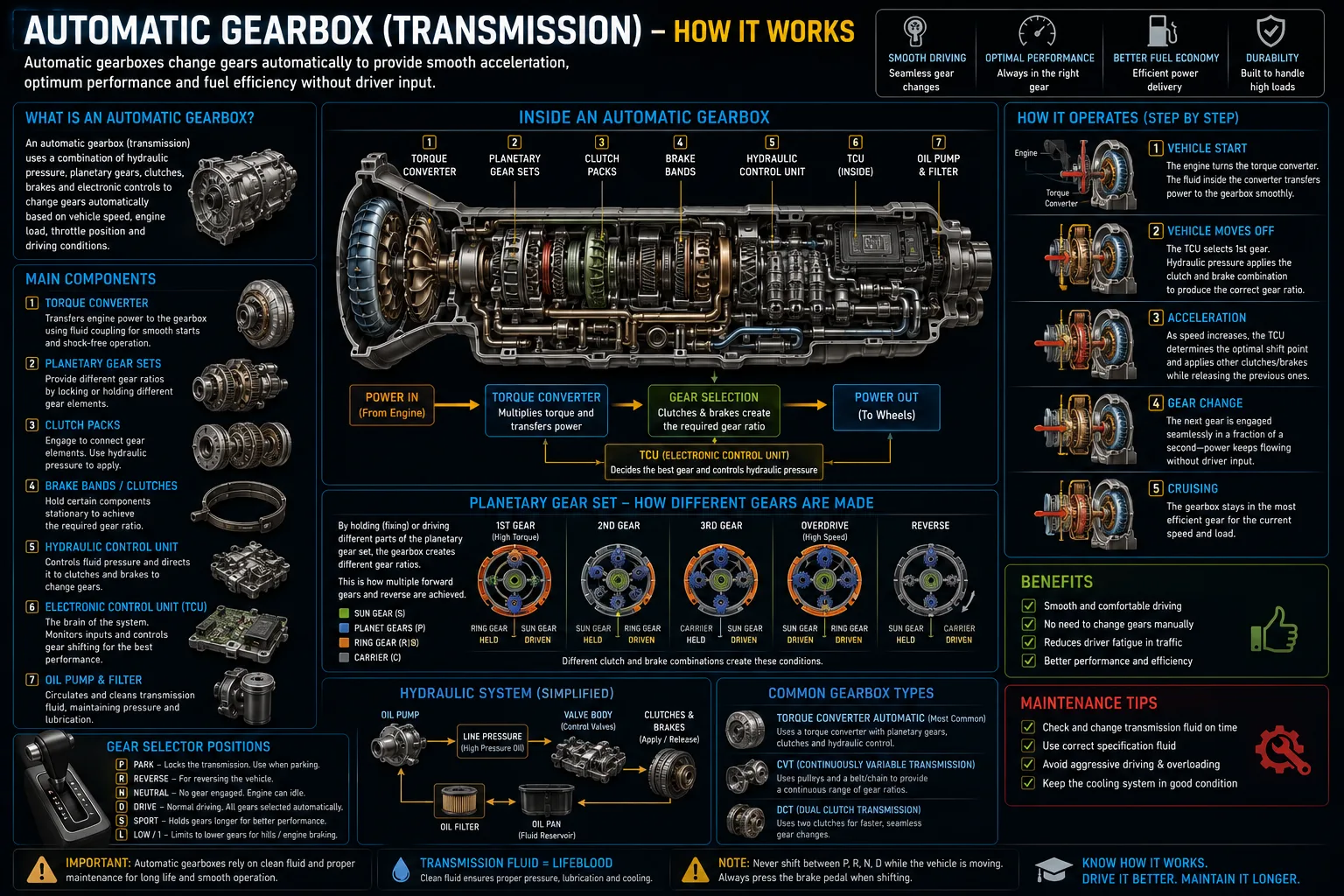
A conventional automatic gearbox is a masterpiece of hydraulic engineering that somehow works despite being almost incomprehensibly complicated. Inside, a torque converter replaces the clutch — it uses fluid coupling to transmit power from the engine, and a lock-up clutch that engages at cruising speed to stop it slipping and wasting fuel. A valve body (essentially a hydraulic computer made of precisely machined channels and solenoids) directs transmission fluid under pressure to the right clutch packs and brake bands, which engage different planetary gear sets to give you your drive ratios. An electronic control unit (TCU or part of the ECU) tells the valve body what to do based on throttle position, road speed and a small army of sensors. More modern vehicles use dual-clutch transmissions (DCT) — two automated manual gearboxes sharing one housing, each handling alternate gears — or continuously variable transmissions (CVT), which use a belt between two variable-width pulleys and technically have infinite ratios. They're all different under the skin, but they share the same weakness: they depend on clean, correctly pressurised hydraulic fluid for everything. Neglect the fluid and you're slowly starving the whole system. Most manufacturers specify an ATF change interval somewhere between 40,000 and 60,000 miles, yet it's astonishing how many cars arrive at 100,000 miles with the original brown, burnt fluid still in there. The gearbox has, understandably, taken this personally.
“This is your automatic transmission telling you it has opinions, and those opinions are expensive if you ignore them.”
Sound familiar?
So what's behind it?
What we do — at your door
We come to you — driveway, workplace car park, or wherever the car has staged its protest — and start with what every gearbox diagnosis should start with: plugging in and reading the fault codes properly, not just clearing them and hoping. We check the ATF level and condition (colour and smell tell you a lot, and a burnt, dark fluid that smells like regret is a story in itself), inspect for leaks around the pan and cooler lines, and do a road test to map out exactly when and how the fault occurs. If the issue is a fluid service, solenoid replacement, valve body clean or sensor swap, we can often sort it there and then or come back with parts. Where the job requires a full gearbox rebuild, replacement unit or torque converter swap — work that demands a workshop lift, specialist tools and a bench — we'll tell you straight, write up our findings, and point you in the right direction rather than pretend mobile magic can cure everything. We're mechanics, not miracle workers, though we have our moments.
What affects the price
Automatic gearbox work spans an enormous range in the UK and the cost depends almost entirely on what's actually wrong. An ATF drain-and-refill is a straightforward, relatively modest job; a solenoid or sensor replacement steps up in parts cost but is often still reasonable labour-wise when done on your driveway. Valve body work occupies the middle ground — complex, fiddly, but repairable without removing the gearbox. At the top end, a torque converter replacement or a full gearbox rebuild means workshop time, specialist equipment and either a remanufactured unit or a reconditioned original. The vehicle also matters enormously: ATF for a common family hatch is very different in price from the specific fluid required by a premium German automatic, which will absolutely require its own proprietary fluid or it will find a way to be unhappy about it. The honest summary: mobile diagnosis and fluid work is cost-effective anywhere; major internal work is a specialist workshop job and quoting a number without knowing what's inside would be dishonest. We'll always tell you which category you're in before you commit to anything.
Random knowledge you didn't ask for
Questions you're probably asking
Can I just top up the ATF myself if it's low?
You can, but you need the exact correct fluid specification for your gearbox — not whatever's cheapest on the shelf. Automatic transmissions are sensitive to fluid chemistry in a way engines simply aren't. Using the wrong ATF can damage seals and clutch friction material in ways that are slow, expensive and easily avoidable. Check the handbook, use the specified fluid, and if the level was low, find out why — it shouldn't be losing fluid.
Is limp mode always a gearbox fault?
Not always. Limp mode is a catch-all safe state the car enters when it detects something serious — it can be triggered by engine faults, sensor failures or even a flat auxiliary battery in some cars, not just the transmission. Reading the fault codes is the essential first step. Don't assume the gearbox is wrecked just because it's stuck in one gear — sometimes it's a £30 sensor being dramatic.
My auto gearbox shudders between 40 and 50mph but otherwise seems fine. What is that?
Almost certainly the torque converter lock-up clutch engaging and slipping. At light throttle in that speed range, the TCU tries to lock the converter for efficiency, and if the clutch material is worn or the fluid has degraded, it shudders instead of locking cleanly. Caught early, a fresh ATF service with the correct fluid — sometimes with a friction modifier additive — can sort it. Left alone, you'll eventually need a converter replacement, which is a different conversation entirely.
How often should I change the automatic transmission fluid?
Most manufacturers recommend between 40,000 and 60,000 miles, though some claim 'lifetime fill' — a phrase that means 'the lifetime of the warranty, not the car'. In real-world UK driving with stop-start traffic, the fluid works harder than the lab test assumed. If you've bought a used car and have no service history for the gearbox, getting the ATF changed is cheap insurance against inheriting someone else's neglect.
My gearbox fault code came back after clearing it. Do I need a new gearbox?
Almost certainly not — not yet, anyway. A returning fault code means the underlying cause is still present; clearing codes doesn't fix the fault, it just turns off the light temporarily. Common culprits are a sticking solenoid, a failing speed sensor or a pressue regulation issue — all diagnosable, all repairable short of a full replacement. A proper diagnosis first, gearbox replacement as a last resort, not a first guess.
My automatic gearbox warning light is on / PRND is flashing / car's stuck in limp mode — what's going on?
The gearbox has thrown a fault code and locked itself into a single safe gear to protect itself from further damage — that's limp mode doing its job. Flashing PRND indicators usually mean the transmission control module has detected a slip ratio, temperature, or solenoid fault. Driving on it risks turning a recoverable electrical fault into a very unrecoverable mechanical rebuild. Get the codes read before anything else — a mobile mechanic can pull transmission-specific codes on your driveway and tell you whether you're looking at a sensor, a solenoid, or something far worse.
Automatic Gearbox Repair — sorted at your door
Stop procrastinating. Get a transparent quote and we'll come to you.