Your Accelerator Pedal Has Stopped Talking to Your Engine: And the ECU Is Not Taking It Well
Somewhere along the way, car manufacturers decided that a simple mechanical cable connecting your right foot to the throttle body was too straightforward — too honest, too direct, too lacking in opportunities for expensive electronic faults. So they replaced it with a drive-by-wire system: you push the pedal, a sensor measures how far, sends that information to the ECU as a voltage signal, and the ECU decides what to do with your request. It's clever engineering with genuine advantages in fuel economy, emissions, and traction control integration. It also means that a sensor the size of a fist, buried inside or behind your accelerator pedal, is now the sole messenger between your right foot and your engine. When that sensor starts lying — or stops sending anything coherent at all — the ECU's response is swift and entirely reasonable from an engineering standpoint: it does not trust you. Limp mode. Flat throttle response. An engine management light staring at you like a disappointed driving instructor. SOSCarFix comes to you, plugs in, and tells you exactly what's actually happening before anyone reaches for a parts catalogue.
See our upfront pricingThrottle by wire gone rogue? Limp mode, sluggish response, or a twitchy EML? SOSCarFix diagnoses and replaces your pedal sensor on your driveway. Get a quote.
How it actually works
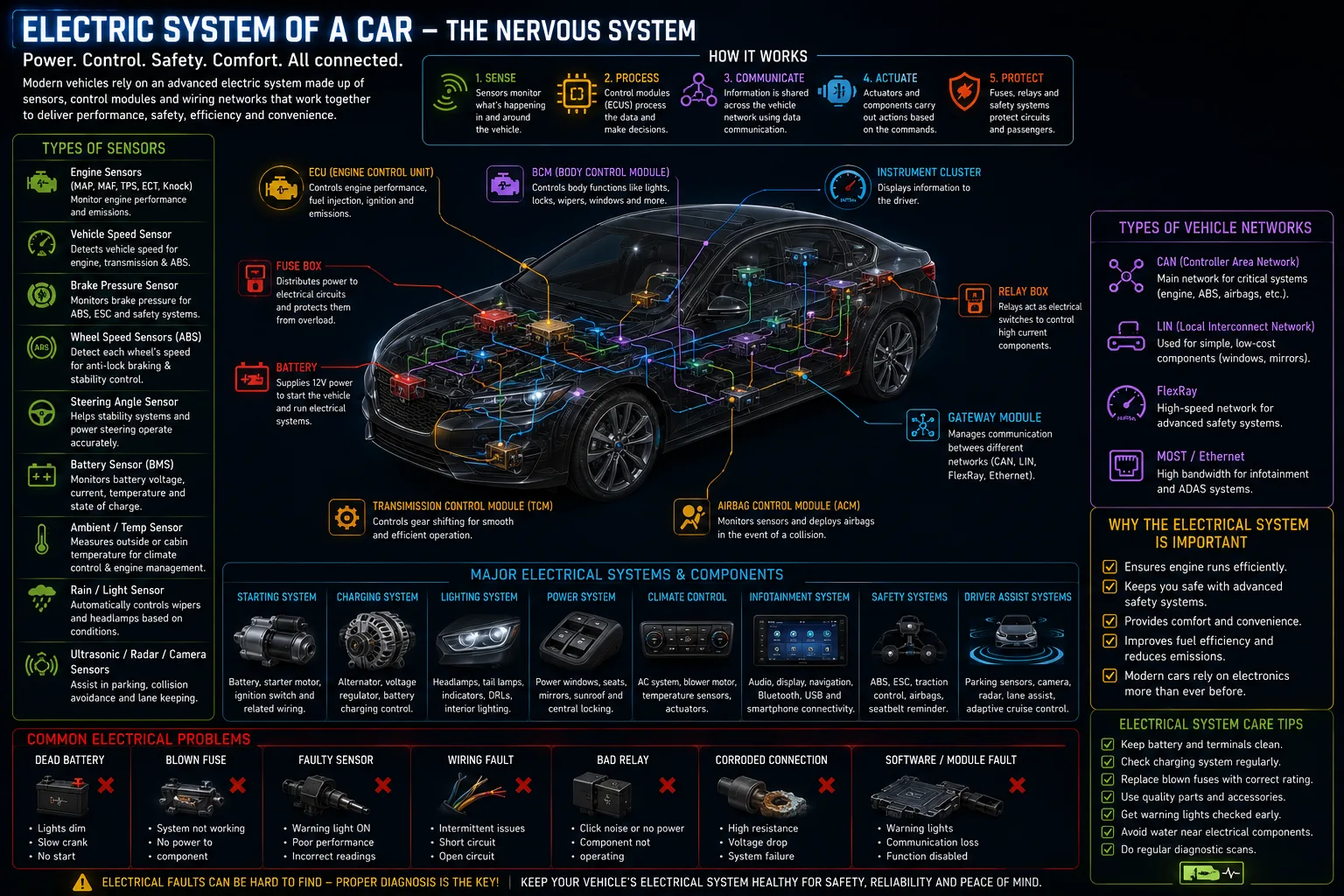
The accelerator pedal position (APP) sensor is mounted directly on the pedal assembly — in most modern cars it's physically built into the pedal unit itself rather than being a separate component you can swap in isolation. As you depress the pedal, a rotating element inside the sensor sweeps across a resistive track (in a traditional potentiometer-type sensor) or past a hall-effect magnetic field (in newer contactless designs), generating a voltage signal that varies linearly from roughly 0.5 volts at rest to around 4.5 volts at full throttle. That signal travels along a dedicated wiring harness to the engine control unit. Here's where it gets genuinely interesting: the APP sensor almost always runs two independent tracks simultaneously. Track one and track two produce different voltages for the same pedal position, offset by a fixed ratio — typically one signal runs at half the value of the other. The ECU monitors both channels in real time and cross-references them constantly. If the two signals agree (within tolerance), everything proceeds normally. If they diverge — one track failing, a break in the wiring, a voltage that doesn't correspond to any plausible pedal position — the ECU concludes that someone is feeding it nonsense, raises a fault code (usually a P0120-series), and defaults to a safe operating mode. That safe mode is limp mode, and it is emphatically not designed for your convenience. The dual-track redundancy is a deliberate safety feature inherited from aircraft fly-by-wire philosophy. An unintended sudden acceleration event because a single sensor track failed high would be considerably worse than an annoying limp-mode journey to the garage. The engineers were not being dramatic — they were being correct.
“SOSCarFix comes to you, plugs in, and tells you exactly what's actually happening before anyone reaches for a parts catalogue.”
Sound familiar?
So what's behind it?
What we do — at your door
We come to you — driveway, office car park, or layby if things have deteriorated to that point — and the first thing we do is not reach for a new pedal. We plug in a proper bi-directional scan tool and pull live data from both APP sensor tracks simultaneously, watching their voltage outputs through the full pedal range while also checking throttle body position sensor correlation. This takes minutes and tells us whether the fault is inside the sensor, in the wiring harness, at the connector, or somewhere else in the throttle system entirely. If the sensor is genuinely at fault, we replace the pedal position sensor or the complete pedal assembly as required by your specific vehicle — many modern cars supply the sensor only as part of the whole pedal unit, which is a manufacturer decision that is not our fault but is our problem to manage efficiently. Once the new sensor is fitted we clear the fault codes, run the engine through a full pedal sweep in live data mode to confirm both tracks are reading correctly and correlating properly, and verify that limp mode has been told in no uncertain terms that its services are no longer required. You get your right foot back. The ECU gets trustworthy data. Everyone is happier.
What affects the price
APP sensor replacement cost in the UK depends on a few factors that genuinely move the number around, so anyone offering a flat price without knowing your registration is either very optimistic or very confident you won't notice later. The main variable is parts supply: on many mainstream cars — Ford, Vauxhall, Volkswagen Group, Renault, Toyota — the pedal position sensor is available as a standalone component, which is the cheaper outcome; on a significant number of others the sensor is built into the pedal assembly as a single sealed unit and must be replaced as such, which costs more but is also often more reliable long-term. Labour is generally not excessive because the pedal assembly is designed to be accessible — it's behind your feet, not buried under the inlet manifold — but some vehicles manage to make even simple jobs awkward, and if the wiring harness also needs attention (new connector pins, section replacement) that adds time. Diagnostic time before any parts are ordered is part of a proper job: an APP sensor fault that turns out to be a corroded connector cleaned and re-pinned is vastly cheaper than a new pedal assembly fitted over an undiscovered wiring problem. Get a quote against your actual registration rather than assuming the cheapest scenario applies to your car.
Random knowledge you didn't ask for
Questions you're probably asking
Can I drive with a faulty accelerator pedal position sensor?
In limp mode, technically yes — the car will move, slowly, and with all the enthusiasm of a car that is operating under protest. But limp mode is a protection strategy, not a driving mode: it limits revs, neuters power, and on many vehicles will not allow motorway speeds. Beyond the inconvenience, a sensor that's failing intermittently can cause unpredictable throttle response, which is a genuine safety concern. Sort it properly rather than gambling on when the next random surge or stall will happen.
Will the fault go away on its own if I clear the codes?
The warning light will go out when codes are cleared, and if the fault is intermittent — a dodgy connector that sometimes makes contact — it may not return immediately. But clearing codes on an APP fault without diagnosing it is precisely the kind of optimism that leads to the same fault returning on a motorway at 70 mph. The underlying cause does not fix itself. If the code comes back within a drive cycle, the ECU has confirmed what it already suspected.
How do I know if it's the pedal sensor or the throttle body sensor causing the problem?
You need live data from a scan tool showing both sensor readings simultaneously — the APP sensor (at the pedal) and the TPS (at the throttle body) have related but distinct signals, and watching them together through a full pedal sweep usually makes it obvious which one is misbehaving. A P2135 code specifically means the two APP tracks don't agree with each other, which points firmly at the pedal end. A P0121 or similar TPS correlation code shifts suspicion toward the throttle body. Without live data, you are guessing, and sensors are not cheap enough to guess with.
Is the accelerator pedal sensor the same as the throttle position sensor?
No, and conflating them is a reliable way to replace the wrong part. The APP sensor is at the pedal, measuring how far your foot has pushed it. The throttle position sensor (TPS) is at the throttle body itself, measuring how far the butterfly valve has actually opened. In a drive-by-wire system both exist and the ECU compares them — your foot input versus the actual throttle response — as a further layer of sense-checking. They can both fail, they can fail independently, and they set subtly different fault codes.
My car is in limp mode. Is it definitely the accelerator pedal sensor?
Almost certainly not definitely — limp mode is the ECU's response to a wide range of faults it considers too serious to ignore, not a dedicated APP sensor warning. Transmission faults, boost pressure issues, fuelling problems, and various other sensor failures can all trigger limp mode. An APP sensor fault is a common cause, and the P0120-series codes are a strong indicator, but reading the actual fault codes and cross-referencing them with live data is how you confirm it rather than assume it. The ECU logged exactly what it saw — you just need the right tool to listen to it.
Your Accelerator Pedal Has Stopped Talking to Your Engine — sorted at your door
Stop procrastinating. Get a transparent quote and we'll come to you.