ABS Warning Light On: Your Skid-Saver Has Clocked Off
Right, so that little amber "ABS" has lit up on your dashboard. First, the good news: your brakes still work. You press the pedal, the car stops — no drama. The bad news? The clever bit — the bit that stops your wheels locking up when you absolutely need to swerve around a rogue shopping trolley at 40mph — has gone on an unannounced holiday. You've got normal brakes. You haven't got anti-lock brakes. And on a wet roundabout at 11pm, that is a meaningful distinction. Get it sorted. We'll come to you.
See our upfront pricingABS warning light on? Your normal brakes still work — but your skid-saver has clocked off. SOSCarFix mobile mechanics come to you across the UK. Get a quote today.
How it actually works
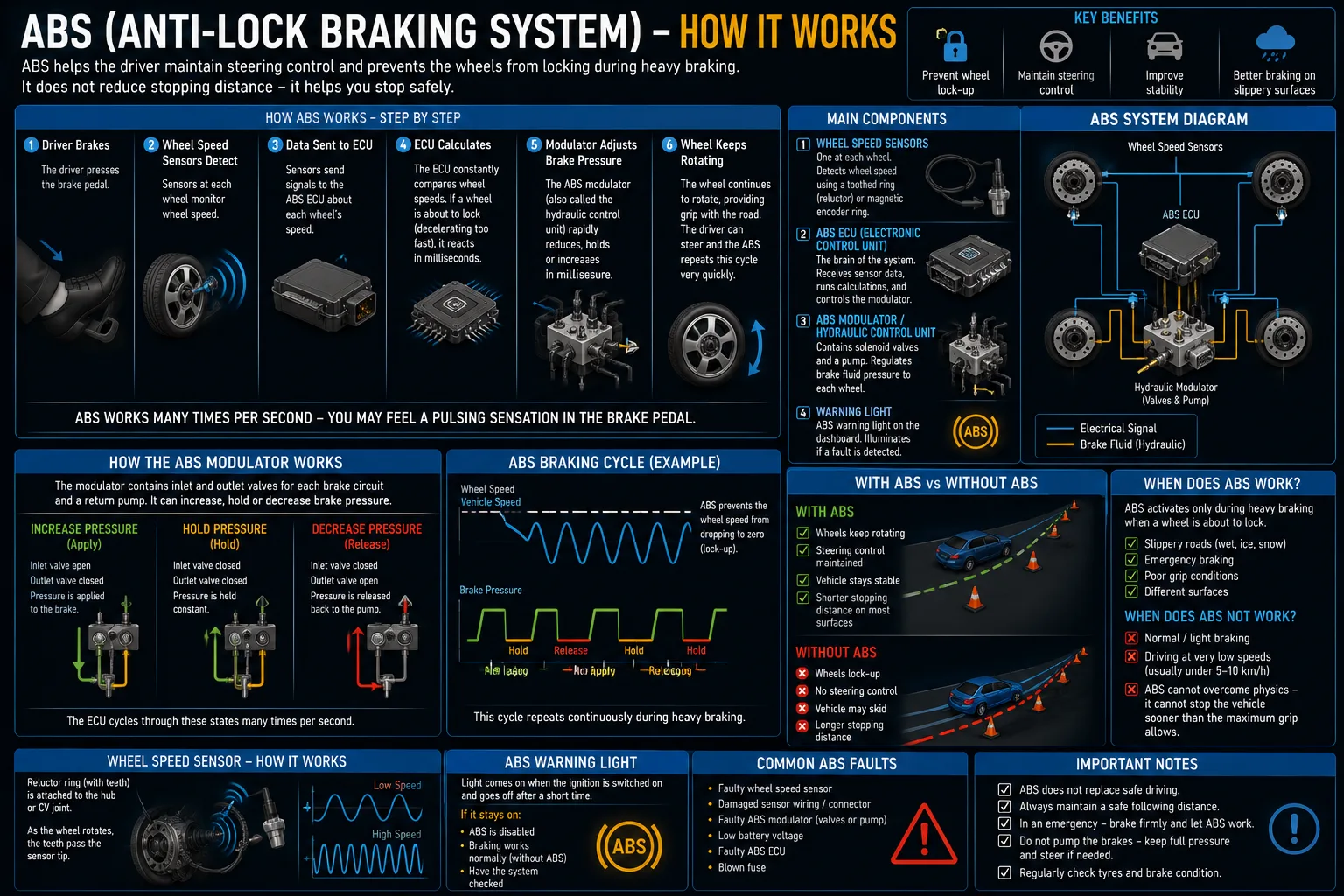
Your ABS system is basically a tiny traffic controller living inside your brakes. Each wheel has a speed sensor clocking how fast it's spinning. The moment you stamp on the brakes in a panic, those sensors report back to the ABS control module — and if any wheel is decelerating suspiciously fast (i.e. locking up), the system pumps the brake pressure on that wheel on and off up to 15 times a second. Faster than you can blink, and vastly faster than any human foot. The result: the tyre stays rolling, keeps its grip on the road surface, and — crucially — you can still steer around whatever disaster is unfolding in front of you. When the light comes on, it means somewhere in that chain — sensor, module, pump, fuse, or fluid level — something has gone AWOL and the system has put itself into safe mode. Safe mode means normal brakes only. The skid-saver has clocked off.
“And on a wet roundabout at 11pm, that is a meaningful distinction.”
Sound familiar?
So what's behind it?
What we do — at your door
We come to wherever your car is sitting — driveway, car park, roadside — with a proper OBD diagnostic scanner that reads ABS-specific fault codes, not just the generic engine stuff. We'll pull the codes, inspect the wheel speed sensors and their wiring, check fluid levels, and give you a straight answer about what's actually failed. No guessing, no "let's start with the expensive bit and work backwards." If it's a sensor or wiring repair we can fix on the spot, we'll do it there and then. If it needs a module or more involved work, we'll tell you exactly what's needed and give you a bespoke quote before anything happens. The ABS light will need to be off before your next MOT — so let's get it sorted while we're already there.
What affects the price
What affects the cost of an ABS repair: which component has failed (a sensor is a very different job to a full ABS module), the make and model of your car (parts prices vary wildly between a Ford Focus and a BMW 5 Series — no surprises there), how accessible the sensor or wiring is on your specific vehicle, and whether the fault is a straight swap or involves corroded connectors and hidden wiring gremlins that only reveal themselves once you're in there. We give bespoke quotes based on what your car actually needs — not a price list built around someone else's vehicle.
Random knowledge you didn't ask for
Questions you're probably asking
Is it safe to drive with the ABS warning light on?
Your normal brakes are still operational, so the car will stop when you press the pedal. What you've lost is the anti-lock function — meaning if you brake hard on a slippery surface, your wheels can lock up and you'll lose steering control. Short, sensible journeys at sane speeds? Generally manageable. Motorway driving in the rain while riding the bumper of the car in front? Much less so. Get it diagnosed promptly and avoid the kind of braking you'd normally rely on ABS to sort out.
Will an ABS warning light fail my MOT?
Yes, unambiguously. An illuminated ABS warning light is classed as a Major defect under current MOT guidelines and is an automatic failure. ABS has been a legal requirement on all new cars registered in the UK since 2004, so on any vehicle where it's fitted as standard, the system must be working. Fix it before you go, not after.
Can a low battery cause the ABS light to come on?
It can, yes. The ABS control module needs stable voltage to operate correctly. A weak or failing battery — or a recent flat that got a jump start — can cause the ABS light to appear temporarily. It's worth getting the battery and charging system checked alongside an ABS diagnostic, particularly if the light appeared out of nowhere with no other obvious symptoms.
Why did my ABS light and traction control light come on at the same time?
Because they're sharing their misery. Traction control and stability control systems use the same wheel speed sensors as ABS. If a sensor or its wiring fails, it knocks out all three systems simultaneously — which is why you often see two or three warning lights appear as a job lot. One diagnostic scan will usually reveal which sensor is the root cause of the whole lot.
ABS Warning Light On — sorted at your door
Stop procrastinating. Get a transparent quote and we'll come to you.