ABS Sensor Replacement: Because Stopping Should Not Be Optional
Your ABS warning light has come on. Maybe it's sitting alongside the traction control light, the ESP light, and possibly half a dozen other amber gremlins that have decided today is the day for a full dashboard rave. Your first instinct might be to slap a bit of black tape over it and carry on. We respect the spirit of denial — truly — but we'd gently point out that ABS isn't there to make your car look clever on a brochure. It's the system that stops your wheels locking up under hard braking so you can actually steer while stopping, rather than just sliding serenely into whatever you were trying to avoid. The component most likely responsible for killing that entire system is a wheel-speed sensor — a small, inexpensive part that lives in the filthiest part of your car and pays for that with a fairly miserable life expectancy. SOSCarFix comes to you, plugs in, diagnoses the exact culprit, and replaces it without you setting foot in a garage.
See our upfront pricingABS light on? Speedo gone funny? Your wheel-speed sensor is having a moment. SOSCarFix diagnoses and replaces it at your door. Get a quote today.
How it actually works
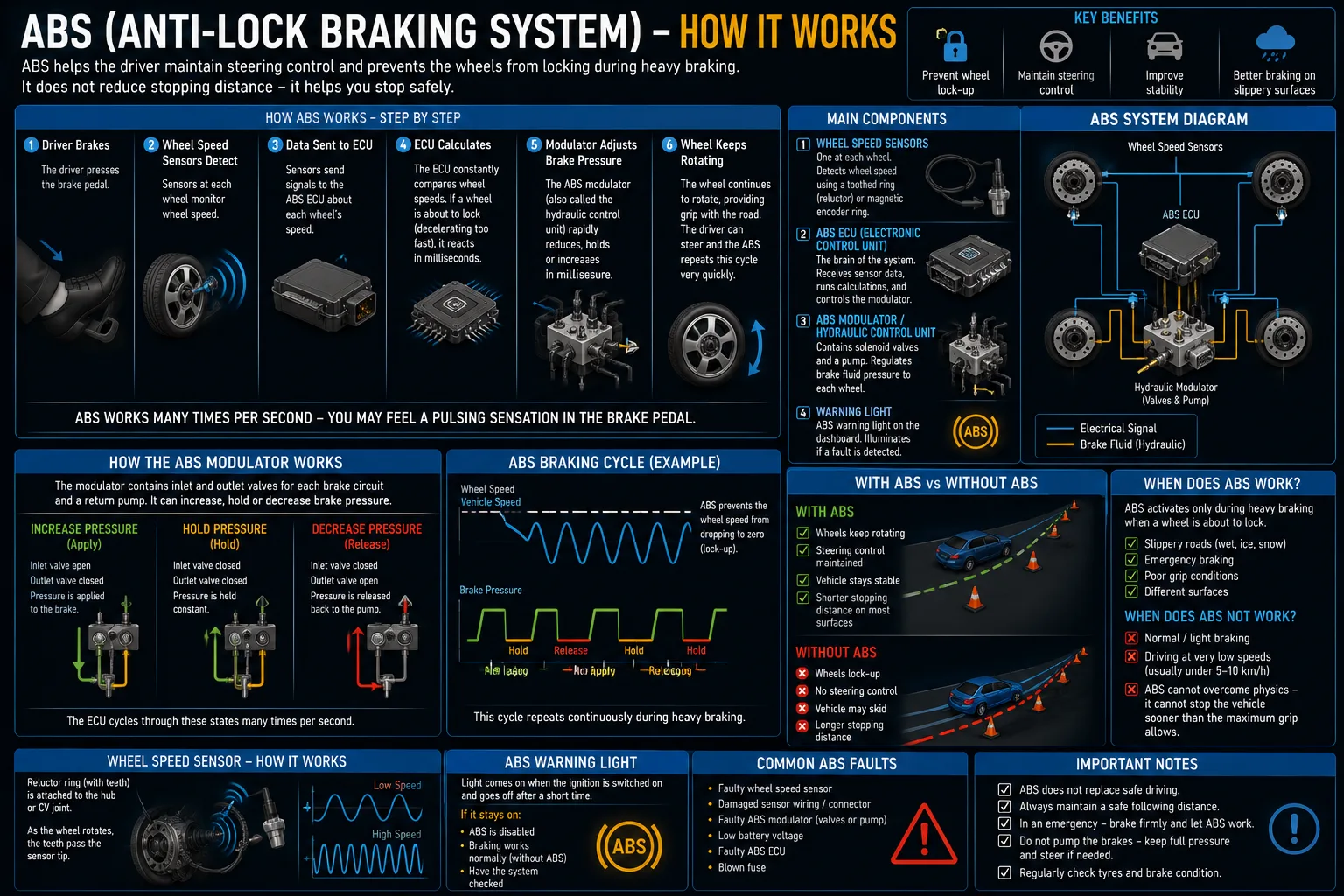
Each wheel on your car has an ABS wheel-speed sensor — a small electromagnetic or Hall-effect sensor mounted millimetres away from a toothed reluctor ring that's pressed onto your hub, axle, or CV joint. As the wheel spins, the reluctor ring's teeth pass the sensor's tip and generate a pulsing signal. The ABS control module reads all four signals simultaneously, and the moment one wheel starts decelerating suspiciously faster than the others — the signature of a lockup — it modulates the brake pressure on that corner up to fifteen or so times per second. That's ABS doing its job, and it requires accurate, continuous data from every sensor to work. When a sensor fails — whether from corrosion eating through the wiring, physical damage from a kerbing, a seized reluctor ring, or just the general misery of living in a British wheel arch through fifteen winters of road salt — the module loses that signal and immediately throws the ABS offline as a safety precaution. It also takes traction control and ESP with it, because those systems draw from the same sensor data. Replacement involves unbolting the old sensor, cleaning or replacing the reluctor ring if it's damaged, routing the new sensor cable correctly, and then — critically — scanning the system to confirm the fault code clears and the module is reading the new sensor properly. Skip that last step and you might just be swapping sensors blindly.
“SOSCarFix comes to you, plugs in, diagnoses the exact culprit, and replaces it without you setting foot in a garage.”
Sound familiar?
So what's behind it?
What we do — at your door
We come to you — your driveway, your office car park, the roadside if it's come to that — with a proper OBD diagnostic tool that reads manufacturer-level ABS fault codes, not the watered-down readout you get from a £25 Bluetooth dongle. That tells us exactly which sensor is playing up, and whether the issue is the sensor itself, the reluctor ring, the wiring, or something further upstream like a wheel bearing. We'll inspect the physical condition of the reluctor ring and the sensor's mounting point before we assume the sensor is the sole villain — because fitting a new sensor onto a corroded mount or a damaged ring is just expensive procrastination. If it is the sensor, we fit a quality replacement, route the cable correctly so it's not going to chafe itself back into failure in six months, and scan the system again to confirm the code has cleared and the module is reading all four wheels properly. No upselling, no phantom ancillary jobs, no leaving you with a light still on because we "couldn't be sure." We leave when it's actually fixed.
What affects the price
The cost of an ABS sensor replacement in the UK varies more than you'd expect from what looks like a simple job, and the main drivers are worth knowing. The sensor itself ranges from relatively modest to moderately eye-watering depending on whether your car is a ten-year-old hatchback with a generic part shared across half of Europe, or a premium German saloon with a proprietary sensor that's apparently been hewn from a meteor. Rear sensors are often dearer than fronts. If the reluctor ring needs replacing alongside the sensor — either because it's corroded, damaged, or it's an integrated bearing-and-ring assembly — that adds parts and labour time. Wiring repair, if the loom has chafed or corroded back from the sensor, is billed by the complexity of the damage. Accessibility matters too: some sensors unbolt in five minutes, others are seized solid with a decade of rust and require heat, persuasion, and a creative relationship with the air compressor. The mobile callout is included in our quote — there's no garage overhead to offset, so what you're quoted is what you pay.
Random knowledge you didn't ask for
Questions you're probably asking
Can I drive with the ABS light on?
Technically yes — your standard brakes still work, you just no longer have anti-lock assistance. On a dry road in normal traffic, you might never notice. On a wet roundabout under emergency braking, you'll notice immediately and unpleasantly. The risk is yours to take, but we'd point out that ABS is there precisely for the moments when it rains, you're going a bit quick, and something unexpected steps out in front of you. Don't wait for that rehearsal.
Why has my traction control and ESP light come on at the same time as the ABS light?
Because traction control and ESP aren't independent systems with their own dedicated sensors — they're software running on the same wheel-speed data your ABS module collects. When a sensor fails and ABS goes offline, the ECU quite reasonably decides it can't trust the data well enough to run traction control or stability control either, so it pulls the plug on all three. Fix the sensor, all three lights go out simultaneously. It looks alarming; it's actually efficient.
How do I know if it's the sensor or the reluctor ring that's the problem?
You probably don't, and that's fine — that's what the diagnostic is for. A live data readout will show the signal from each wheel in real time as the car moves slowly. A faulty sensor typically produces a flatline or erratic signal; a damaged reluctor ring often produces a rhythmic drop-out that correlates with wheel rotation. We check both before ordering anything, because fitting a new sensor onto a knackered reluctor ring produces exactly the same fault codes you started with.
My speedometer is also playing up — is that related to the ABS sensor?
Very likely yes. On many cars, particularly front-wheel-drive and some rear-wheel-drive models, the speedometer signal is derived from the ABS wheel-speed sensors rather than a separate sender unit. A faulty sensor on the relevant wheel can cause the speedo to drop to zero intermittently, read low, or behave erratically. This also affects cruise control on cars that use the same signal. Replace the sensor and the speedo usually sorts itself out — though we'll confirm with a post-repair scan to be sure.
Is an ABS sensor replacement something I could do myself?
On paper, yes — it's a bolt-on component. In practice, sensors that have been sitting in a salty British wheel arch for a decade often need more than a socket set: seized bolts, corroded connectors, and wiring damage are all common complications. The bigger issue is that without a diagnostic tool capable of reading live ABS sensor data, you can't confirm the replacement has actually resolved the fault before driving away. Fitting a new sensor and hoping the light goes out is gambling with a safety system. A proper scan costs less than a repeat visit.
ABS Sensor Replacement — sorted at your door
Stop procrastinating. Get a transparent quote and we'll come to you.