Oil & Filter Change: Because Sludge Is Not a Valid Engine Component
Engine oil is the most important fluid in your car, which is why people treat it with the same benign neglect as the terms and conditions on a software update. It lubricates, cools, cleans, and generally stops several thousand metal components from grinding each other into expensive dust. Over time, though, it degrades. Heat breaks down the additives. Combustion blow-by contaminates it. The filter fills up with the grim particulate evidence of your engine's hard life. What started as clean, amber, carefully-engineered fluid slowly turns into a dark, viscous soup that's doing about 40% of the job at best — and quietly coating your engine internals in a layer of sludge that no amount of future fresh oil will fully undo. The fix is spectacularly simple and spectacularly cheap relative to the alternative: change the oil and filter on schedule, use the correct grade and spec, and move on with your life. SOSCarFix does the whole thing at your door. No waiting room. No upsell. No drama.
See our upfront pricingFresh oil, right grade, at your door. SOSCarFix does your oil and filter change without the garage waiting room or the upsell theatre. Get a quote today.
How it actually works
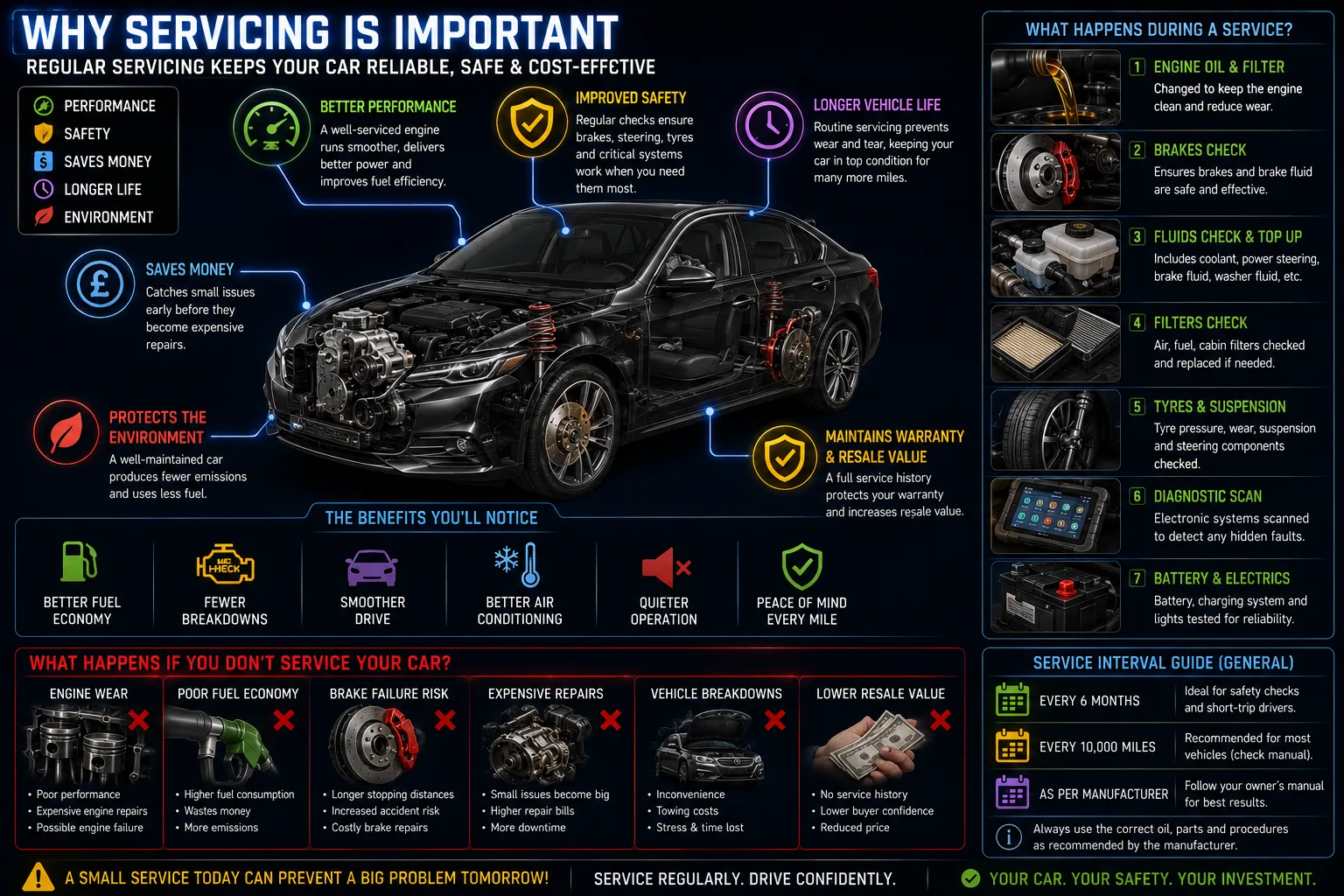
Engine oil has two jobs it does simultaneously and a third it does as a bonus. Job one: lubrication. Oil forms a thin film between moving metal surfaces — crankshaft bearings, camshafts, piston rings — so they slide rather than grind. Job two: cooling. Your oil pump circulates oil around parts that the coolant system doesn't reach directly, pulling heat away and dumping it back into the sump. Bonus job: cleaning. Modern engine oils contain detergent and dispersant additives that grab carbon deposits, combustion residues, and metal particles, holding them in suspension until you drain the oil and take all that filth with it. The filter sits in the middle of this circuit, catching the larger particles before they complete another lap of your engine. It has a bypass valve — if the filter clogs, oil routes around it to prevent oil starvation — which is fine in theory and deeply unpleasant in practice, because now unfiltered oil is doing the rounds. Here's the part most garages don't bother explaining: the spec matters enormously. A 0W-20 engine designed around thin, low-viscosity oil for fuel economy and tight tolerances will not thank you for a rogue litre of 5W-40 that some well-meaning person chucked in. Wrong viscosity, wrong additive package — you're not helping, you're quietly doing harm. We use the correct ACEA, OEM-approved grade for your specific engine, every time.
“It lubricates, cools, cleans, and generally stops several thousand metal components from grinding each other into expensive dust.”
Sound familiar?
So what's behind it?
What we do — at your door
We come to you — your driveway, your workplace car park, your road outside, wherever the car happens to be sitting — with the correct oil and a fresh filter already in the van before we arrive. There is no booking a garage slot, no arranging alternative transport, no sitting in a waiting room watching daytime television while a service adviser works up the courage to mention the cabin filter. We drain the old oil completely, pull the old filter, fit the new filter with a fresh seal, refill with the correct grade and quantity specified for your engine (we look it up by your exact registration, not by guesswork), reset your service indicator, and check the level. We'll also take a look at what comes out — heavily contaminated oil, metallic particles, or a filter that's completely saturated tells a story, and we'll tell you what we found honestly rather than leveraging it into a list of advisory work. Job done, you get on with your day, the engine gets on with its job.
What affects the price
What you'll pay for an oil and filter change in the UK varies more than it probably should, and here's why. The oil itself is the biggest variable: a basic mineral oil for an older engine is cheap; a full synthetic meeting the latest BMW Longlife, VW 504/507, or Mercedes MB 229.51 specification costs considerably more per litre, and some engines need six or seven litres. The filter matters too — a genuine or OEM-equivalent filter isn't the same price as the generic one that technically fits but has a bypass valve set to the wrong pressure. Labour is labour: a straightforward sump drain is quick, but some manufacturers have made access genuinely awkward (skid plates, recessed filter housings, filters buried under intake pipework) which adds time. Coming to you means you're not subsidising a garage's rates and overheads, which generally keeps mobile pricing competitive. What it should never include is a markup on oil that wasn't specified for your car, or extras you didn't ask for.
Random knowledge you didn't ask for
Questions you're probably asking
How often should I actually change my oil — every 6,000 miles, or is that old advice?
It depends entirely on your car and oil spec. Older engines on mineral or semi-synthetic oil: 6,000 miles or 6 months is still sensible. Modern engines specced for full synthetic: 10,000–12,000 miles or 12 months is typical, and some VAG group cars on Longlife service go longer. The manufacturer's handbook is the honest answer — and if you bought the car second-hand without one, we can look it up by reg.
Does it actually matter if I use the wrong grade of oil, as long as it's the right viscosity?
Yes, it genuinely matters, especially in modern engines. A diesel with a DPF needs a low-SAPS oil — low sulphated ash, phosphorus, and sulphur — because high-SAPS oil poisons the DPF catalyst over time. A BMW N47 or similar specced for 0W-30 Longlife will wear faster on a generic 5W-40. The viscosity number is only part of the story. The ACEA classification and OEM approval on the bottle is what actually makes the oil correct for your engine.
My oil light has come on. Is that the same as the service reminder?
No, and this distinction matters enormously. The service reminder (usually a spanner icon or a mileage countdown) means you're due for a change — carry on driving carefully and book it in. The oil pressure warning light (usually a red oil can symbol) means the engine has insufficient oil pressure RIGHT NOW and you need to stop immediately, turn the engine off, and not restart it. Driving on a live oil pressure warning for even a few minutes can destroy an engine. Please don't confuse the two.
Can I just top up rather than doing a full change?
Topping up addresses low level but does nothing for oil quality. If you're a litre low but the oil is clean, fresh, and within service interval, a top-up is fine — but use the correct spec and don't overfill. If the oil is dark, degraded, or overdue, adding fresh oil to contaminated old oil just dilutes the problem slightly. The acids, the combustion by-products, the oxidised compounds — they don't disappear. You need a drain and fill.
What's the risk of going a bit over the service interval — like a thousand miles over?
A thousand miles over on a modern full synthetic is unlikely to cause immediate catastrophe. Five thousand miles over repeatedly, year on year, is how engines develop sludge, accelerated bearing wear, and shortened lives. The additive package depletes on a curve, not a cliff — but once it's depleted, the oil stops cleaning and starts depositing. Occasional mild overruns are forgivable. Making a habit of it is an expensive long game.
Oil & Filter Change — sorted at your door
Stop procrastinating. Get a transparent quote and we'll come to you.