Your Engine Is Suffocating: How Often to Change the Air Filter (And Why It Matters)
Your engine is, at its core, a sophisticated air pump. Petrol or diesel goes in one end, a controlled explosion happens in the middle, and spent gas goes out the other — but the whole process depends on a reliable supply of clean air. The engine air filter is the bouncer at the door, keeping grit, dust, pollen, and assorted British road debris out of your combustion chambers. A new one costs very little. A clogged one quietly robs you of MPG, power, and engine life — while your car dutifully soldiers on, suffering in silence. SOSCarFix changes it at your driveway during a full service so you don't have to schedule a garage visit around your entire life.
See our upfront pricingClogged air filter? Flat power and poor MPG are your engine's polite way of asking for oxygen. SOSCarFix changes it on your driveway — no garage faff.
How it actually works
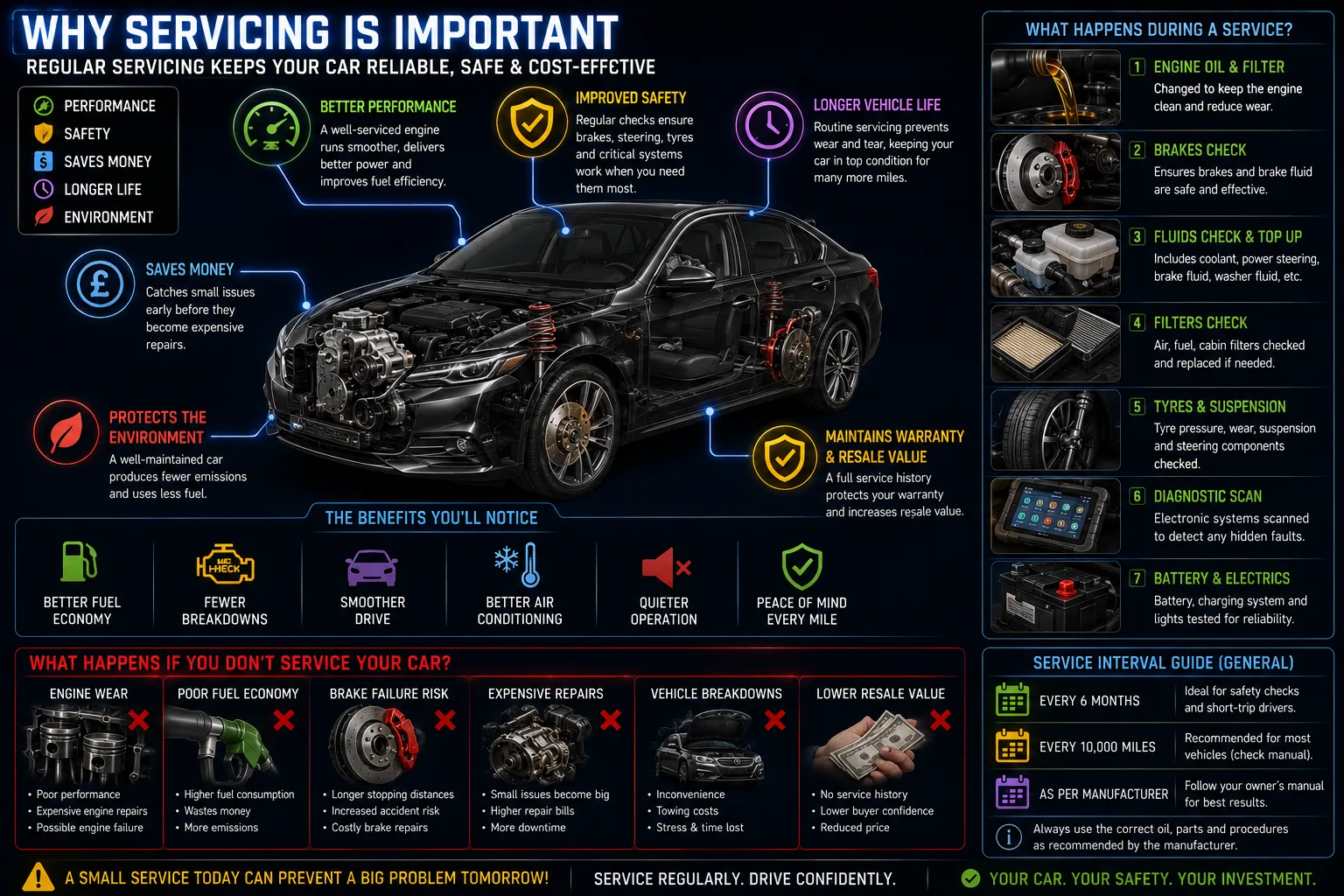
Your engine needs roughly 14 parts of air for every 1 part of fuel to burn properly — that ratio is called the stoichiometric mixture, and your car's ECU works hard to maintain it. Every last wisp of that air passes through the engine air filter before it gets anywhere near the throttle body or intake manifold. The filter is typically a pleated paper or cotton-gauze element housed in a plastic airbox, usually located near the top of the engine bay. As it does its job, it gradually loads up with dust, pollen, road grit, and whatever the British countryside decides to throw at it. Up to a point, a slightly loaded filter actually filters better than a brand-new one — the trapped particles help catch smaller debris. But beyond that point, airflow restriction starts building up. The engine asks for more air; the filter can't deliver; the ECU compensates (badly); fuel economy drops; power goes flat. On modern engines with mass airflow sensors, a dirty filter can confuse the sensor and trigger warning lights too. The fix is embarrassingly simple: swap the element, usually in under ten minutes. It just needs doing regularly.
“SOSCarFix changes it at your driveway during a full service so you don't have to schedule a garage visit around your entire life.”
Sound familiar?
So what's behind it?
What we do — at your door
We come to you — driveway, office car park, or wherever the car lives — and check the engine air filter as part of every full service. We pull it out, hold it up to the light (the oldest test in the book, and still reliable), measure remaining usable life visually, and replace it if it's due or borderline. We fit the correct OEM-specification or quality aftermarket element for your make and model, check the airbox housing and intake trunking for cracks or loose clips while we're in there, and reset the service interval if required. The whole job is ten minutes as part of a wider service — no ramps, no workshop, no half-day sitting in a waiting room. We also keep a note on your service record so you're not guessing the history next time.
What affects the price
The filter element itself is usually inexpensive for mainstream cars — expect a range from a few pounds for a common hatchback to more for premium German brands or performance intakes. Labour as a standalone job is minimal. As part of a full service it's simply included. Factors that shift the cost: performance panel filters or cotton gauze elements (cleanable/reusable, more expensive upfront), vehicles with awkward airbox locations requiring extra time, and whether you're running an aftermarket induction kit that needs a specific replacement element. We quote before we start — no surprises on the invoice.
Random knowledge you didn't ask for
Questions you're probably asking
How often should I change the engine air filter in the UK?
Most manufacturers recommend every 12,000–15,000 miles or once a year as part of a full service — whichever comes first. If you drive regularly on dusty rural roads, farm tracks, or gravel, go sooner: every 8,000–10,000 miles is sensible. Urban stop-start driving is less harsh on the filter than you'd expect because you're not pulling in huge air volumes at motorway speeds. When in doubt, pull it out and look — a heavily grey or brown element is past it.
Will a dirty air filter cause my car to fail its MOT?
Not directly — the MOT doesn't include a filter inspection. However, a heavily clogged filter causing the mixture to run rich can push up exhaust emissions enough to fail the tailpipe test, especially on older petrols. It can also trigger a fault code via the MAF sensor, which will show as a 'check engine' light — and an illuminated MIL is an automatic MOT failure. So indirectly, yes, a neglected filter can cost you an MOT pass.
Is it worth upgrading to a performance or washable air filter?
For the vast majority of everyday road cars, no — a quality OEM-spec paper element is what the engine was calibrated for and does the job perfectly well. Washable cotton-gauze filters (K&N style) are genuinely reusable and fine for the right application, but they require periodic oiling, can over-oil and contaminate MAF sensors if done wrong, and the real-world power gains on a standard road car are negligible. Save the money. Replace on schedule.
Can I check the air filter myself?
Absolutely — on most cars the airbox is a black plastic box near the top of the engine bay, held shut by clips or wing-bolts. Pop it open, lift the element out, and hold it up to daylight. If you can see light through the pleats reasonably clearly, it has life left. If it's uniformly dark grey, brown, or you can't see light through it at all, it's done. When in doubt, replace it — it's one of the cheapest parts on the car.
Does a clogged air filter really affect fuel economy noticeably?
On modern fuel-injected cars with closed-loop fuel management, the effect is more modest than the old carburettor days — the ECU adapts. But a significantly blocked filter still forces the engine to work harder, shifts the fuel trim richer, and the restriction shows up as flat power and marginally higher fuel consumption. On older vehicles (pre-mid-1990s carburettor engines) the effect is far more dramatic. Either way, a fresh filter costs less than an extra tank of fuel, so the maths are straightforward.
Your Engine Is Suffocating — sorted at your door
Stop procrastinating. Get a transparent quote and we'll come to you.