The Filter Everyone Forgets: How Often to Change Your Pollen / Cabin Filter
The cabin filter — also called the pollen filter, or the thing your garage quietly forgot to mention for the third service running — is the one component designed entirely for your comfort and wellbeing, and yet it gets ignored more reliably than a government health advisory. It sits behind your glovebox or under your dashboard, silently hoovering up pollen, dust, diesel particulates, and whatever olfactory horrors the lorry in front of you is producing. When it's fresh, your car's interior smells like a car. When it's clogged — which happens faster than you'd think — it smells like a damp labrador discovered a compost heap. SOSCarFix comes to you, swaps the filter out on your driveway, and your air conditioning stops circulating misery around the cabin. Simple job. Massive difference. Perpetually skipped.
See our upfront pricingMusty smell, weak airflow, or sneezing every commute? Your cabin filter's crying for help. SOSCarFix sorts it on your driveway — no garage faff required.
How it actually works
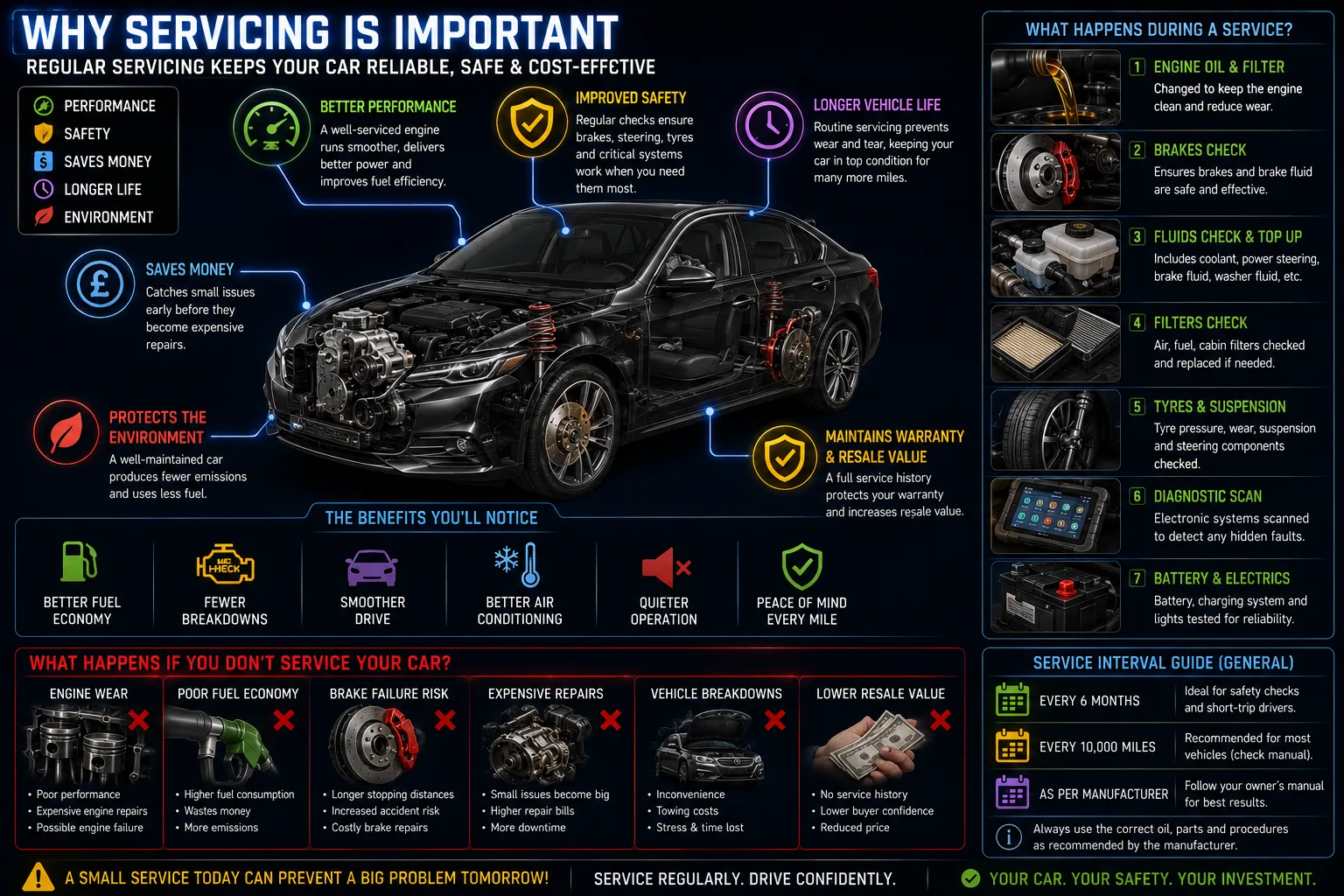
Most manufacturers specify a cabin filter change every 12 months or 12,000 miles, whichever comes first — and that interval exists for a reason. A pollen filter is typically a pleated paper or activated-carbon element, roughly the size of a thick paperback, that intercepts airborne particles before they pass through your blower motor and into the cabin. Premium versions include a carbon layer that also absorbs odours and harmful gases like NOx and ozone. After a year of UK driving — which is to say, a year of stop-start traffic, agricultural lanes, diesel bus fumes, and at least four months of "pollen season" — the filter element is usually visibly gunked. Some are merely grey with road dust; others look like they've been used to mop up after a building site. Either way, the restriction on airflow becomes measurable: your blower has to work harder to move the same volume of air, your air-con efficiency drops, and your windows take longer to demist. Garages sometimes skip it on a service because it takes five to fifteen minutes and the customer doesn't see it happening — but the problem is you then go home and still can't breathe. SOSCarFix does not skip it.
“When it's clogged — which happens faster than you'd think — it smells like a damp labrador discovered a compost heap.”
Sound familiar?
So what's behind it?
What we do — at your door
SOSCarFix is a mobile mechanic service — we come to your driveway, workplace car park, or wherever the car is sitting. There is no garage to book, no waiting room, no courtesy car negotiation, and no mysterious itemised bill that arrives three hours later than promised. For a cabin filter replacement we locate the filter housing (it's usually behind the glovebox, under the dashboard, or occasionally in the engine bay depending on your make and model), remove the old element, check the housing for debris and mould, fit the correct replacement filter — we carry a range for common UK vehicles — and confirm airflow is restored before we leave. If there's mould in the housing or on the evaporator, we'll tell you honestly, because that's a separate job worth knowing about. We don't invent problems, but we do flag real ones. The whole job is typically done in under half an hour. You don't rearrange your day around it; we rearrange ours around yours.
What affects the price
The cost of a cabin filter replacement in the UK varies based on a few genuinely relevant factors — we won't quote you a number that bears no relation to your car. The filter element itself ranges considerably by vehicle: a basic paper filter for a common hatchback is inexpensive; an activated-carbon multi-layer filter for a German executive car is a different price tier entirely. Labour time varies slightly by model, as some housings are straightforwardly accessible and others require removing the glovebox or trim panels. If your car has a particularly awkward fitment location — some VAG group cars and certain Japanese models are culprits — that adds a few minutes. Call or message us with your registration and we'll give you a straight figure up front, not a number that somehow grows by the time the invoice arrives.
Random knowledge you didn't ask for
Questions you're probably asking
How often should I change my pollen / cabin filter in the UK?
The standard recommendation is every 12 months or 12,000 miles, whichever comes first. If you do a lot of urban driving, park under trees during spring, or use your air conditioning heavily, err on the side of annual regardless of mileage. UK roads are not a clean-air environment, and the filter reflects that faithfully.
Can a blocked cabin filter cause MOT failure?
Not directly — the MOT doesn't test cabin air quality. However, a severely blocked filter can impair your ability to demist the windscreen to the required visibility standard, which is an MOT test item. More practically, if the filter is harbouring mould, that mould is circulating through your ventilation system every time you use the blower. Not a failure point; very much a you problem.
My air conditioning smells musty — is that the cabin filter?
Possibly, and it's the first thing to check because it's cheap and quick. However, a persistent musty smell from the air conditioning — especially one that's strongest when you first switch it on — can also indicate mould on the evaporator itself. We'll inspect both when we attend. If it's just the filter, sorted in minutes. If it's the evaporator, we'll tell you that and explain what's involved.
Does my car definitely have a cabin filter?
Most cars built after 2000 do, though there are exceptions — some budget models and certain vans omit them entirely. Some cars have two (one for the main cabin intake and a secondary one for the recirculation circuit). Tell us your registration and we'll confirm before we turn up with the wrong part or, worse, any part at all.
What's the difference between a pollen filter and a cabin air filter?
Nothing — they're the same component, marketed under different names depending on the manufacturer and whoever wrote the service menu. 'Cabin filter', 'cabin air filter', 'pollen filter', 'habitacle filter' on some French cars — all refer to the element that filters the air entering your car's interior via the ventilation system. The activated-carbon versions are sometimes called 'combination filters' or 'combi filters', which sounds fancier and costs proportionally more.
The Filter Everyone Forgets — sorted at your door
Stop procrastinating. Get a transparent quote and we'll come to you.