How Often to Change Engine Oil: The Schedule Your Manufacturer Wrote for Someone Else's Driving
Engine oil is doing a thankless job every second your car runs — lubricating metal surfaces moving at thousands of RPM, suspending combustion soot, holding acids in solution, cooling parts the coolant never reaches, and generally keeping your engine from turning into a very expensive paperweight. It doesn't last forever. It breaks down, gets contaminated, and loses the viscosity your engine was designed around. The interval on the sticker in your door jamb assumes a textbook driver doing textbook miles in textbook conditions. Most UK drivers — short commutes, lots of town traffic, frequent cold starts, a diesel — are nowhere near textbook. Getting the interval right is one of the cheapest forms of engine insurance there is. Getting it wrong is how you quietly spend thousands in future repair bills.
See our upfront pricingLong-life schedule? Short trips? Diesel? Your oil change interval is probably wrong. SOSCarFix comes to you, sorts your oil, and tells you the truth.
How it actually works
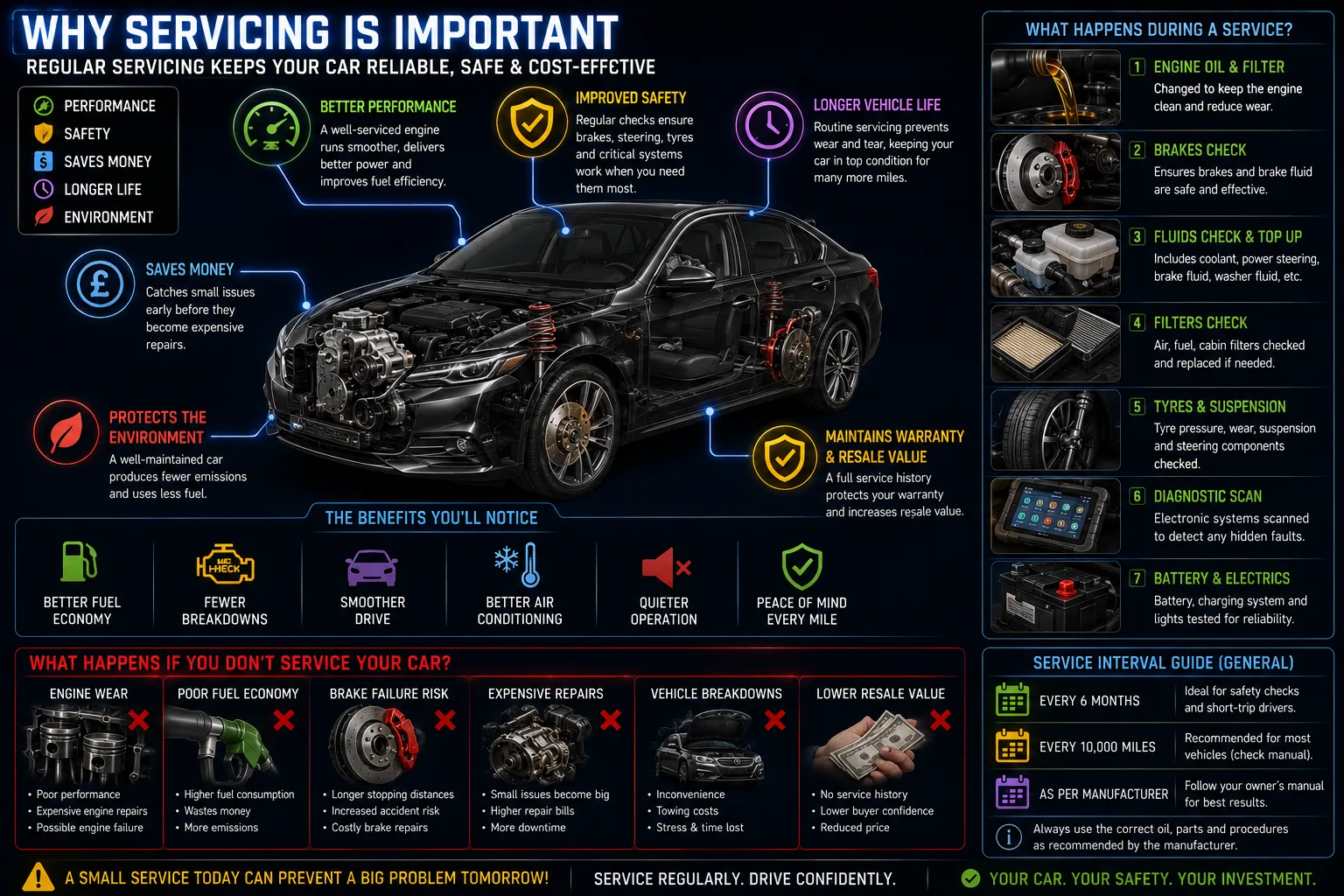
Modern engines use two broad service regimes: fixed-interval and long-life (also called variable or flexible service). Fixed-interval services work on a simple calendar or mileage trigger — typically every 12 months or 10,000 miles, whichever comes first. This is what older cars, most petrols and manufacturers with a sensible opinion of real-world driving use. Long-life (or variable service interval) systems — common on VAG group cars (VW, Audi, Skoda, SEAT), BMWs and Mercedes from the mid-2000s onwards — use an on-board computer to monitor oil condition and calculate when it needs changing. On paper, that sounds clever. In practice, it can stretch intervals to 18,000–20,000 miles or two years, based on algorithms written for a driver doing long motorway miles in a warm climate with fresh oil poured in. Do a lot of short trips, cold starts, town driving or live somewhere damp and grey (so, Britain) — the algorithm flatters the oil condition and the interval runs too long. Diesel engines are particularly unforgiving: fuel dilutes the oil during DPF regeneration cycles, shortening the life of the oil considerably, and yet many diesel long-life intervals push to 18,000 miles. The manufacturer's maximum is a ceiling, not a target. The right interval is the one that matches how you actually drive.
“The interval on the sticker in your door jamb assumes a textbook driver doing textbook miles in textbook conditions.”
Sound familiar?
So what's behind it?
What we do — at your door
We come to your driveway, car park or workplace — wherever the car lives — with the correct oil grade and specification for your make, model and engine. We check the old oil condition, drain the sump, replace the oil filter (always — a new oil through a clogged old filter is a waste of everyone's time and your money), refill to the correct level, reset the service indicator, and note the mileage and date so you have a proper record. We'll also tell you what interval actually makes sense for how you drive, not what the manufacturer's algorithm thinks. No selling you a full major service when you just need an oil and filter; no recommending the most expensive oil when the mid-range fully synthetic the manufacturer specifies is fine. If something else looks wrong during the job — a weeping rocker cover gasket, an oil level that was critically low — we tell you straight, with a quote, not a scare story.
What affects the price
Cost depends on the oil grade and quantity required (a 1.2-litre city car takes around 3.5 litres; a 3.0-litre straight-six diesel can want 7 litres), whether your engine specifies a common fully-synthetic grade or a pricier OEM-approved long-life spec oil (VW 504/507, BMW LL-01/LL-04, Mercedes 229.51 and similar cost more than generic 5W-30), filter type (some engines use cartridge filters, some spin-on, some deeply inconveniently located ones take more labour time), and whether any additional items are due — air filter, cabin pollen filter, and brake fluid are commonly overdue on the same car that's come in for an oil change. We quote the specific oil, filter and any extras upfront before starting. No surprises on the invoice.
Random knowledge you didn't ask for
Questions you're probably asking
My car has a long-life service and the indicator says I've got 4,000 miles left — do I still need to change it?
The indicator is a model, not a lab test. If you do lots of short trips, cold starts or town driving — all extremely common in the UK — the algorithm is almost certainly flattering the oil condition. Many independent mechanics recommend capping long-life diesel intervals at 12 months or 12,000 miles in practice, regardless of what the computer says. The cost of an early oil change is trivial against the cost of worn cam lobes.
What oil grade does my car need and does it really matter?
Yes, it genuinely matters. Grade affects cold-start oil flow (a 0W oil flows faster at -20°C than a 5W), high-temperature protection and fuel economy. Specification (the ACEA/OEM code) affects the additive package — a low-SAPS oil for a diesel with a DPF is formulated to not clog the DPF, a standard oil can. Using the wrong spec repeatedly shortens engine life. We look it up by your plate and use the right stuff.
My diesel does mostly short trips around town. How often should I really change the oil?
Every 6,000–8,000 miles or 12 months, whichever comes first — and honestly lean toward the lower end. Short diesel trips are the worst case: DPF regens that don't complete, constant fuel dilution, and never getting up to temperature to drive off the moisture. Long-life intervals are optimistic on a diesel doing 8-mile commutes. Protect your engine or prepare for injector and engine bills that make oil changes look laughably cheap.
Can I just top up with the same oil rather than a full change?
Topping up between changes is fine and you should do it if the level drops — but it doesn't substitute for a change. Topping up adds fresh oil to old degraded oil; the contaminants, acids and broken-down additives in the sump don't go anywhere. A full drain and refill removes all of that. Think of it like topping up the bath rather than running a new one.
How long does a mobile oil and filter change take?
Usually 30–45 minutes on most cars. Some engines with awkward filter locations or belly pans that need removing take a bit longer. Either way, you don't need to go anywhere — we do it wherever the car is parked.
How Often to Change Engine Oil — sorted at your door
Stop procrastinating. Get a transparent quote and we'll come to you.