Your Car Service Schedule: The Honest Mileage Guide Nobody Else Will Give You
Your car has a stamped service book for a reason. Not because manufacturers enjoy paperwork (they don't) but because ignoring service intervals is roughly equivalent to skipping dental check-ups for seven years and then acting surprised when a molar explodes. Oil degrades, filters clog, fluids absorb moisture and lose effectiveness, and slowly — very slowly, until suddenly all at once — your engine pays the price. SOSCarFix does interim, full, and major services at your home, your workplace, or the car park of that gym membership you keep renewing. No waiting room. No upselling. No being told you also need a "complementary air freshener treatment" for £35. Just a proper service, stamped in the book, done where your car actually lives.
See our upfront pricingInterim, full, or major service — when does your car actually need one? Honest mileage guide, no garage faff. SOSCarFix comes to you. Get a quote.
How it actually works
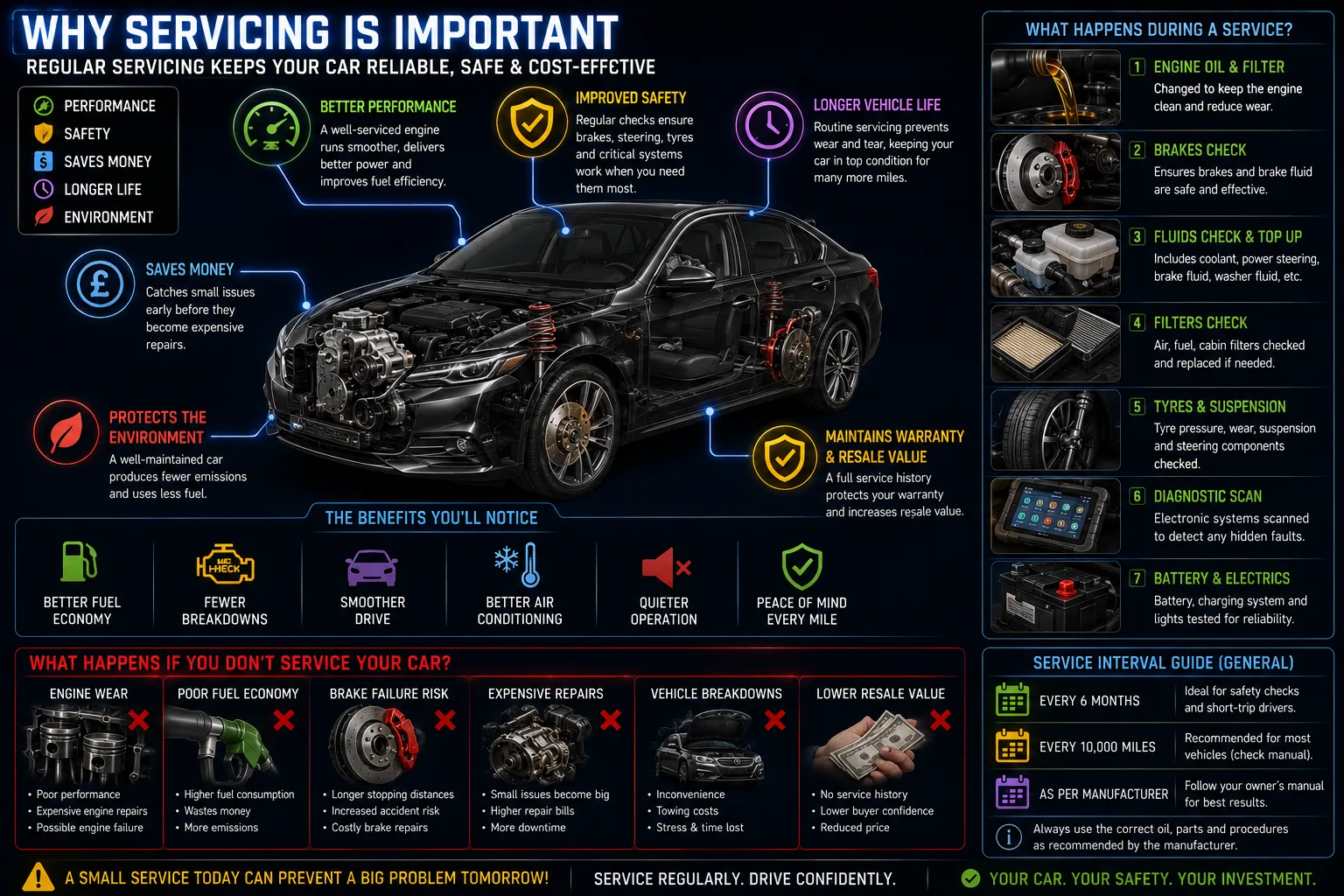
The UK service schedule typically runs on one of two triggers — mileage or time — whichever comes first. Your car doesn't care that you mostly drive to Tesco; oil still oxidises sitting in the sump over winter. **Interim Service** — Every 6,000 miles or 6 months. The essentials: engine oil and filter change, visual inspection of brakes, tyres, lights, and fluid levels. Perfect for higher-mileage drivers or anyone who actually uses their car. It keeps you safe between full services and protects your engine between the big visits. **Full Service** — Every 12,000 miles or 12 months. Everything in the interim plus air filter, cabin (pollen) filter, fuel filter (where applicable), spark plugs if due, coolant check, brake fluid test, full brake inspection, battery check, and a proper look around underneath. This is what keeps your engine breathing, igniting, and generally not disintegrating. **Major Service** — Every 24,000–36,000 miles or 2–3 years, depending on make. The full service plus cambelt/timing chain inspection (and replacement if at manufacturer interval), transmission fluid, coolant flush, brake fluid change, and all wear items that don't get touched in a standard service. This is where you protect against the catastrophic failures that make grown adults cry in car parks. Manufacturer intervals vary — some modern long-life engines specify 18,000-mile oil changes, but we'd raise an eyebrow at anything beyond 12 months without fresh oil. Check your handbook. Then ignore the optimistic mileage if you do lots of short runs, cold starts, or towing.
“Just a proper service, stamped in the book, done where your car actually lives.”
Sound familiar?
So what's behind it?
What we do — at your door
We turn up at your address — driveway, work car park, or the street outside — with everything needed to complete your interim, full, or major service on-site. No ramps required for most service work; we use axle stands or work at ground level where needed. We start with a fresh oil and filter change using oil that meets your manufacturer's specification (not whatever was cheapest that morning), then work through the rest of the service schedule appropriate to your car's mileage and last service date. We check the service book, note what was done and when, and tell you honestly what's coming up — cambelt due in 10,000 miles, tyres approaching legal minimum, that sort of thing. No alarm, no drama, just information. We stamp your service book with the date, mileage, and our details. That stamp is part of your car's financial value, not just a formality. We also reset the service indicator so it counts down correctly, not just sits there annoying you. Parts go straight from our van to your car; used oil and filters get disposed of properly. You don't need to go anywhere. We do.
What affects the price
Service costs vary widely based on your car — a VW Polo full service uses far less oil than a Land Rover Discovery, and parts prices differ enormously by manufacturer. Key factors: engine size (oil quantity), oil specification (standard mineral vs long-life synthetic — the latter costs more but some engines won't tolerate anything else), whether spark plugs, air filter, cabin filter, and fuel filter are included (they should be in a full service), and any advisory work found during inspection. A cambelt replacement at the same visit costs significantly more but saves mobilisation charges if done alongside a major service. We provide a clear quote before we start, itemised so you know exactly what you're paying for. No "it was a bit more complex than expected" at the end.
Random knowledge you didn't ask for
Questions you're probably asking
What's the difference between an interim service and a full service?
An interim service is the halfway check — oil and filter change plus a safety inspection of brakes, tyres, and fluid levels. A full service covers everything in an interim plus air filter, cabin filter, spark plugs (if due), fuel filter, thorough brake inspection, coolant check, battery test, and a proper inspection of the car. If you cover a lot of miles, do both — interim at 6 months or 6,000 miles, full at 12 months or 12,000 miles.
How do I know if my cambelt needs replacing?
Check your manufacturer's service schedule — it'll specify either a mileage figure (commonly 60,000–100,000 miles depending on the engine) or a time interval (often 5–10 years), whichever comes first. If you don't have the handbook, we can look it up from your registration. If you don't know when the belt was last changed and you've owned the car for more than a year, that's the answer: it's probably due.
Does a mobile service stamp my service book the same as a garage?
Yes. A service book stamp is exactly that — a stamp with the date, mileage, and details of who did the work. We stamp your book after every service. Technically any competent mechanic can service your car without voiding manufacturer warranty under UK Block Exemption rules, provided the correct oil specification and genuine-equivalent parts are used. We use both. Your warranty remains intact.
My car has a 'variable service interval' — how does that work?
Variable or 'flexible' service intervals use oil condition sensors and driving pattern analysis to estimate when the oil is actually degraded, rather than using a fixed mileage. Some cars suggest 18,000–20,000 miles between services. We'd recommend capping it at 12 months regardless — the sensor estimates degradation based on mileage and temperature cycles, not actual oil chemistry. Lots of short cold runs fool the system. When in doubt, fresh oil is cheap insurance.
Why does service history matter so much for resale?
Because it's the only evidence a buyer has that the previous owner gave a damn. A full stamped service history tells a buyer the oil was changed regularly, the cambelt was done on time, and the car wasn't just flogged and ignored. Without it, a private buyer will offer less or walk away entirely, and dealers will factor in the unknown risk. Every stamp in that book is money in your pocket when you sell.
Your Car Service Schedule — sorted at your door
Stop procrastinating. Get a transparent quote and we'll come to you.