Pre-MOT Check: Stop Paying for Retests When a £30 Bulb Could Have Fixed It
Every year, around 7.5 million vehicles fail their MOT in the UK — and a depressingly large slice of those fails are for things like a blown number plate bulb, a wiper blade that's separated from its arm, or a tyre sitting 0.1mm below the 1.6mm legal limit. Not catastrophic mechanical failures. Not the consequences of decades of neglect. Just small, absolutely fixable things that nobody checked before driving to the test centre, handing over their keys, and waiting in a plastic chair staring at daytime TV. The MOT is not designed to find problems — it's designed to test whether your car meets a minimum safety standard on the day. It does not care how lovely the rest of your car is. One dipped headlight in a bank of otherwise perfect lights, and you're getting a fail certificate and a retest fee. SOSCarFix comes to your driveway, works through the actual DVSA test checklist before you go anywhere near a test centre, and either confirms you're good to go or fixes what isn't — on the spot.
See our upfront pricingFailing the MOT is expensive, embarrassing and entirely avoidable. SOSCarFix's pre-MOT inspection finds the faults before the tester does. Get a quote today.
How it actually works
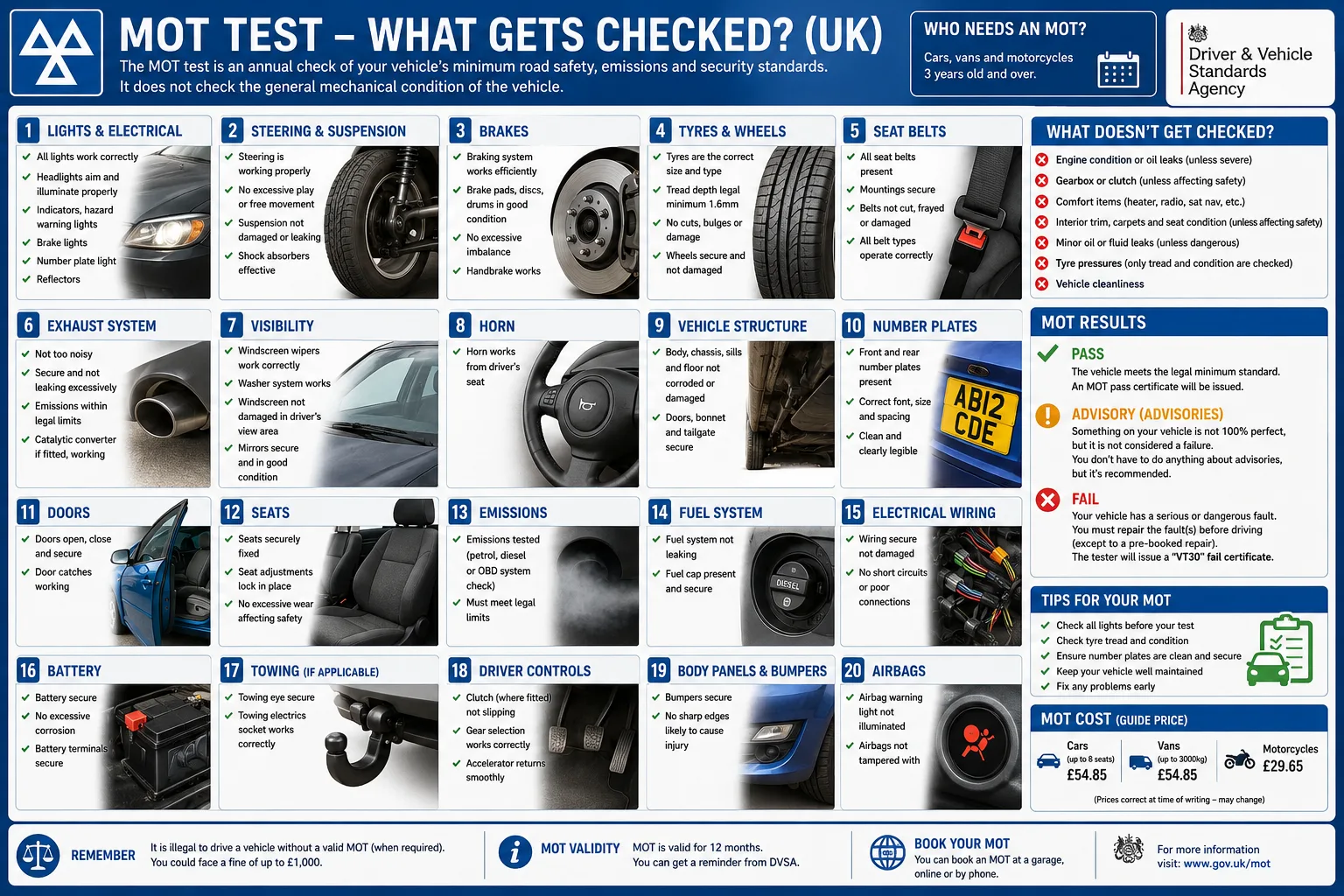
The MOT test has been running since 1960, but the items it checks aren't a mystery — the DVSA publishes the full checklist. The test is divided into categories: lighting and signalling (all exterior lights including number plate illumination), steering and suspension, brakes (all four corners, the handbrake, and a rolling-road brake performance test), tyres and wheels, bodywork and structure (sharp edges, corrosion near load-bearing points), driver's view of the road (wipers, washers, windscreen damage), exhaust emissions, horn, seatbelts, mirrors, fuel system and — since the 2018 revisions — a stricter set of 'Dangerous' and 'Major' defect categories alongside the old Advisory. A Dangerous or Major defect is an automatic fail. Advisories are recorded but don't fail you. The 2018 reform also added checks for diesel particulate filters: if black smoke blows from a DPF-equipped car, that's an automatic fail regardless of what the rest of the car is doing. The tester works through all of this in a set sequence. Our pre-MOT inspection works through the same sequence — we're not doing something clever, we're just doing what the tester would do before the tester gets the chance to charge you for doing it.
“The MOT is not designed to find problems — it's designed to test whether your car meets a minimum safety standard on the day.”
Sound familiar?
So what's behind it?
What we do — at your door
We come to you — your driveway, your work car park, your road — and work through the DVSA's own test criteria on your vehicle before it goes anywhere near a test centre. We check all lighting (every single exterior bulb, including the ones that are technically present but aimed at the sky or the gutter), measure tread depth across each tyre with a proper gauge, assess the sidewalls for cuts and bulges, check brake pad thickness and disc condition, assess the exhaust emissions profile, look at wiper blade condition and washer jet function, physically test suspension and steering components for play and wear, check the seatbelts, mirrors, horn and number plates. Where we find fails or likely fails, we fix them — new bulbs, wiper blades, pads, discs, suspension components — on the spot, at your vehicle, before you drive to the test and discover them the expensive way. You get a clear report of what we found, what we fixed, and anything we flagged as an advisory so you know what's coming at future tests. No garage, no drop-off, no waiting.
What affects the price
What drives the cost of a pre-MOT inspection and any associated repairs is straightforwardly whatever your car actually needs — and that varies enormously. The inspection itself is a flat time charge. Beyond that: bulbs are cheap, wiper blades are cheap, and those two categories account for a meaningful percentage of UK MOT fails. If you need new pads and discs on one axle you're looking at a proper repair job that takes parts and time. Suspension components like ball joints or track rod ends vary significantly by vehicle — they're inexpensive on common hatchbacks and considerably more on German executive saloons, where a drop link can be three times the price for no obvious engineering reason. Emissions-related repairs can range from a sensor swap to a DPF clean. We quote everything itemised before starting any work, so you can decide what to fix now and what to note as an advisory. We don't do the thing where we find seven problems and solve the mystery of how all seven need fixing today.
Random knowledge you didn't ask for
Questions you're probably asking
Can you fix MOT fails on the spot, or do I still have to go to a garage?
Most of the common fail items — bulbs, wiper blades, number plate issues, brake pads, some suspension components — we fix at your vehicle during the pre-MOT inspection. If something needs specialist equipment (a four-wheel alignment rig, a rolling-road brake test, an MOT bay lift) we'll be clear about that. The goal is to sort the fixable things before you go, not send you away with a list.
Is a pre-MOT check worth it, or am I paying twice?
Only if your car is genuinely perfect — in which case the inspection confirms that and costs you a predictable amount. If there's anything wrong, finding it beforehand means you pay once to fix it rather than once to fail, once to fix, and once for a retest. Retest fees vary by centre but finding even a single defect beforehand usually covers the cost of the inspection itself.
What's the minimum tyre tread depth for the UK MOT?
1.6mm across the central three-quarters of the tyre's width, around the full circumference. That's the legal minimum. In practice, handling and wet-weather braking performance degrades noticeably before that — most tyre manufacturers and safety bodies suggest changing at 3mm. The MOT tests the legal limit, not the sensible one. We measure and tell you exactly where you are.
My car has an advisory from last year's MOT — will it fail this time?
Advisories are the tester's way of saying 'not quite a fail today, but watch this.' Whether it fails at the next test depends on how much it's deteriorated in the year since. Some advisories (a slightly scored disc, a tyre at 3mm) will be fine again; others will have crossed the line. Our inspection checks the advisory items specifically so you know what you're dealing with before the test.
Can you do the pre-MOT check on the same day as the MOT?
We can, but it's not ideal — if we find something that needs a part, we need to order it. Booking the pre-MOT inspection a week or two before your test date gives us time to fix anything, let you drive it a bit to confirm everything's bedded in, and send you to the test centre with a reasonable degree of confidence rather than last-minute panic.
Pre-MOT Check — sorted at your door
Stop procrastinating. Get a transparent quote and we'll come to you.