Is It an MOT Failure?: Your Blunt, No-Waffle Guide to Pass or Fix Before Test Day
The MOT is Britain's annual ritual of automotive anxiety — a stranger in a pit deciding whether your car is road-legal while you pretend to be relaxed in the waiting room. The brutal truth is that around 40% of MOT failures are entirely avoidable: blown bulbs, perished wiper blades, bald tyres, things that take twenty minutes to sort if you catch them first. But not everything that looks catastrophic actually fails the test, and not everything that feels minor is fine. This is your quick-reference guide to the most-Googled MOT questions, answered honestly, without the drama. We come to you beforehand, go through the actual DVSA checklist, and fix whatever we find — so you roll into test day knowing exactly what's coming.
See our upfront pricingCoil spring gone? SRS light on? Tyre at 1.5mm? Find out exactly what fails an MOT — and what doesn't — then get it fixed on your driveway. No faff.
How it actually works
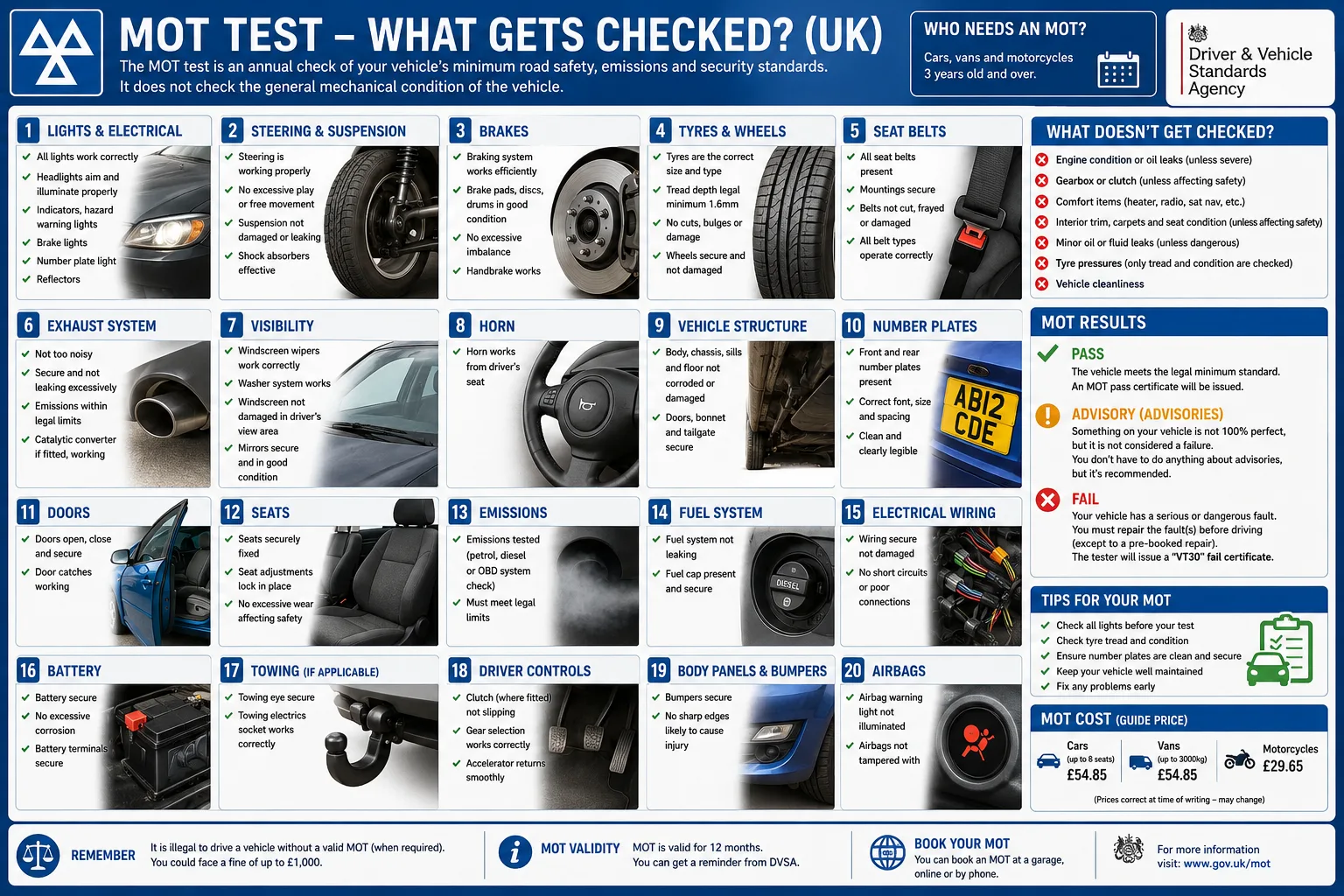
The MOT test has three outcome categories and it's worth knowing them before you panic about anything specific. A **Dangerous** item means the vehicle should not be driven — the tester can refuse to return your keys and the car fails immediately. A **Major** item is a significant defect that causes a fail but doesn't necessarily mean the car is undriveable right that minute (though it is technically illegal on the road). A **Minor** item is noted on the certificate but does not fail the test — it's an advisory that you should sort it reasonably soon. The DVSA updates the test standards periodically, so anything you remember from five years ago may have shifted category. Checking a 2023 memory against a 2025 test is how people get caught out. Where this guide says "Dangerous" or "Major" we're using the DVSA's own language. Where something is a grey area — because condition and severity genuinely matter — we say so honestly rather than pretending it's simple. That's also why a pre-MOT inspection exists: not to predict the future with a crystal ball, but to measure, check and fix things while there's still time to do it without a failed certificate hanging over you.
“But not everything that looks catastrophic actually fails the test, and not everything that feels minor is fine.”
Sound familiar?
So what's behind it?
What we do — at your door
We come to your driveway, workplace or wherever the car is sitting, and go through the actual DVSA inspection checklist — not a vague "visual check" but a methodical walk through every testable item. We measure tyre tread with a calibrated gauge, check brake balance with a portable brake meter, test all lights, check for play in suspension joints and steering components, look for perished or damaged brake hoses, scan for fault codes, check wiper blade condition and washer operation, and check the horn, seatbelts, mirrors and number plate lights. Where we find issues we give you an itemised quote to fix them on the spot or on a follow-up visit, depending on parts availability. After repairs we recheck everything before you book the MOT. Because there's no garage drop-off, no courtesy car waiting list and no sales pressure to replace things you don't need, the whole process is faster and more honest than the alternative.
What affects the price
Cost to fix MOT issues varies hugely by what the item actually is — a blown bulb is a few pounds in parts and fifteen minutes of labour; a broken front coil spring on a modern car with tight packaging is more involved. Brake hose replacement depends on whether it's one hose or all four, and whether the brake line fittings have corroded solid (common on older UK cars). EML faults range from a free fix (loose fuel cap, reset the code) to a lambda sensor or catalytic converter job. We don't publish fixed prices because honest pricing requires knowing the specific car, the specific part and its actual condition — anyone who quotes you a coil spring replacement without knowing whether it's a front or rear, MacPherson strut or multi-link, is guessing. What we will always do is quote you before we touch anything.
Random knowledge you didn't ask for
Questions you're probably asking
Is a broken coil spring an MOT failure?
Yes — and not just a fail, a Dangerous defect. Under the current DVSA standards a broken coil spring is a Dangerous item, which means the tester is entitled to refuse to move the car and you technically shouldn't drive it away. If you suspect a broken spring (corner sits low, clunking over bumps, visible break in the coil), get it inspected before the test, not after.
Does the airbag or SRS warning light fail an MOT?
Yes. An airbag or SRS warning light that is illuminated during the test is a Major failure — it indicates a fault in the supplemental restraint system. The tester cannot verify whether your airbags will actually deploy in a crash, so it automatically fails. Finding and fixing the underlying fault before test day is the only fix; there is no workaround.
Is the engine management light (EML) an MOT failure?
Yes. An EML illuminated during the test is a Major failure. Beyond the light itself, the MOT also tests the OBD (on-board diagnostics) port on cars registered from 2001 onwards — if the system reports a stored fault, that's a separate failure point. Getting the code read and the fault properly diagnosed before the test is the sensible route; clearing the code without fixing the cause just means it'll come back on.
What tyre tread depth fails an MOT?
Below 1.6mm across the central three-quarters of the tread width, around the full circumference. A tyre at exactly 1.6mm passes — just. But 1.59mm fails, and tyres wear unevenly, so if your gauge reads 1.7mm in one spot you may be below 1.6mm elsewhere. Get them measured properly, not eyeballed. The 20p coin trick (if you can see the outer band, they're too low) is a rough indicator, not a substitute for a real measurement.
Can I drive my car if it has a Dangerous defect on the MOT?
Legally, no — a Dangerous item means the vehicle should not be driven. If the tester identifies a Dangerous defect during the test, they can refuse to return the vehicle. If your previous MOT certificate shows a Dangerous advisory that you haven't fixed, you're driving an illegal vehicle. The DVLA can now share MOT data with enforcement agencies, so it's not a theoretical risk.
Is It an MOT Failure? — sorted at your door
Stop procrastinating. Get a transparent quote and we'll come to you.