Failed Your MOT: What Happens Next, What You Can Drive, and How to Get It Sorted Without the Garage Runaround
There are few things quite as deflating as walking back to the waiting room to find a clipboard-wielding tester waiting with a list. Failed your MOT. Two words that feel disproportionately terrible for something that happens to roughly one in three cars every year. The good news: a failed MOT is not the end of the world, it is not necessarily expensive, and it absolutely does not mean you have to roll over and accept whatever the testing station wants to charge you to fix it. You have options — including getting the repairs done by someone who comes to you, then retesting. This guide covers the actual rules (the ones that matter), what you can legally drive, the free retest window, the most common failure items, and how SOSCarFix sorts you out on-site so the retest becomes a formality rather than another lottery.
See our upfront pricingFailed your MOT? Don't panic — and don't drive off illegally. Here's exactly what happens next, the retest rules, and how we fix it at your door. Get a quote.
How it actually works
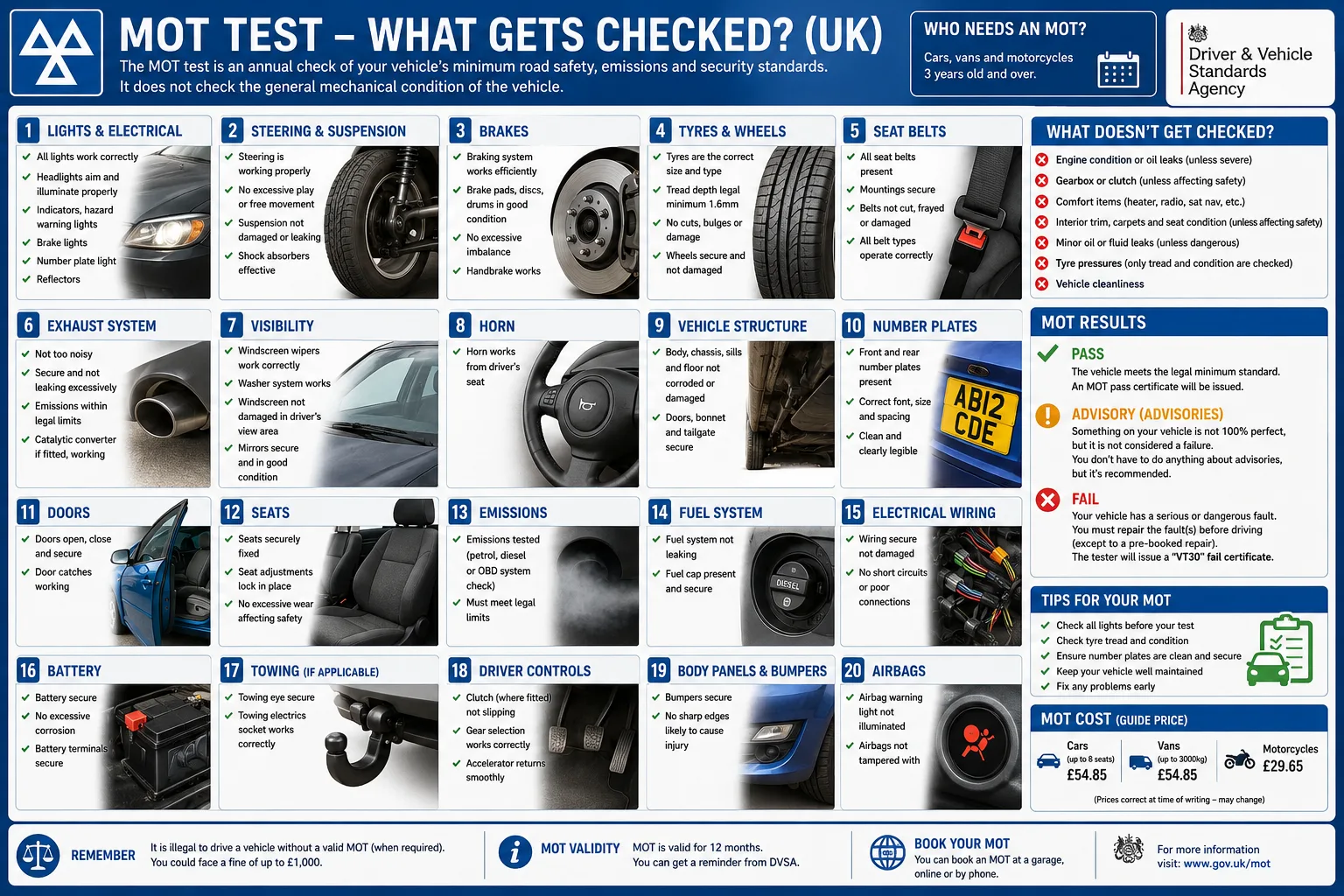
When your car fails its MOT, the testing station must give you a VT30 — the official DVSA refusal of MOT certificate — listing every failure and advisory. Read it. It is more useful than it looks. Each item on it is categorised: Dangerous (stop driving immediately), Major (the car cannot get a new certificate until fixed), or Minor/Advisory (noted but not a failure — yet). The distinction matters enormously. A Minor does not fail the test; it is a heads-up that something will fail in future. A Major or Dangerous item is what actually killed your MOT. Here is the part most people miss: you do not have to have your car fixed by the same garage that tested it. You can take that VT30 to any mechanic — or have a mobile mechanic come to you — get the work done, and return for a retest. The testing station that originally tested your car must offer you a partial retest (usually free, or at a reduced fee) if you return within 10 working days and they carried out the repairs themselves, or a full retest fee if you had repairs done elsewhere. That full retest is still usually cheaper than the original MOT. The key is: get the repairs done properly, return with evidence, and get the pass certificate — called a VT20 — that actually lets you tax and legally drive the car.
“Two words that feel disproportionately terrible for something that happens to roughly one in three cars every year.”
Sound familiar?
So what's behind it?
What we do — at your door
When you call us after a failed MOT, the first thing we do is ask you to photograph or read out the VT30 — the actual failure sheet, not your memory of what the tester said. We come to you (driveway, workplace, wherever the car is sitting), work through the listed failures methodically, and fix what needs fixing: pads and discs if the brake efficiency was the problem, bulbs, tyres sourced and fitted, suspension components if there is play, whatever the sheet says. For any electrical or emissions failure we bring proper diagnostic equipment rather than guessing. We will tell you honestly if something on the list is genuinely complex and would be better handled in a specialist facility — but the vast majority of MOT failure items are bread-and-butter repairs we handle on-site, often the same day. You then take the car back for a retest — straightforward, documented, done.
What affects the price
MOT failure repair costs vary enormously depending on what failed — a couple of blown bulbs is a handful of pounds in parts plus the call-out; a pair of front tyres, new brake pads and a ball joint on the same car is a different conversation entirely. The honest variables: how many Major items are on the VT30 (one common item is very different to five), the age and make of the car (parts for a ten-year-old Korean hatchback cost less than equivalent components for a German premium brand), whether the failure items are straightforward consumables (tyres, bulbs, pads) or labour-heavy components (wheel bearings, suspension arms, sills). We quote itemised, per-failure, before starting — so you know exactly what the retest is going to cost you before you commit. We do not bundle failures together into an opaque service charge and hope you do not ask questions.
Random knowledge you didn't ask for
Questions you're probably asking
Can I drive my car after it has failed its MOT?
It depends on whether your existing MOT certificate is still valid. If your car failed its MOT on the day it expired, you cannot legally drive it on a public road (except back home or to a pre-booked retest). If it failed before expiry — i.e. you tested early — you can continue driving on the old certificate until it runs out, unless the tester marked an item as Dangerous. A Dangerous item means do not drive it regardless of certificate status.
What is the free retest rule, and does it actually apply?
If your car failed and you leave it at the testing station for them to repair, they must offer a free partial retest within 10 working days. If you take it away and have repairs done elsewhere (like by us), you will pay the full retest fee when you return — but that full retest is usually around £30–£55, which is considerably less than the original test fee. Getting the repairs done by a mobile mechanic and paying the retest fee is often still cheaper than having the testing station do the work.
Do I have to fix everything on the VT30 to get a pass?
Only the Major and Dangerous items are failures — those must be fixed before the car can receive a new MOT certificate. Advisory and Minor items do not prevent a pass, but ignoring advisories is unwise: they have a habit of turning into next year's Majors. Fix the failures first; address the advisories at your next service before they escalate.
How long does a retest take and do I need to rebook?
Most testing stations require a retest booking rather than just turning up. A partial retest (same station, same items) is usually quicker than a full test — often 20–30 minutes — because the tester only needs to check the items that previously failed. A full retest covers the whole car again. Ring ahead, confirm what they need, and book a slot rather than assuming you can walk in.
What are the most common things SOSCarFix fixes after a failed MOT?
In rough order of frequency: brake pads and discs (brake efficiency failures), blown bulbs (lighting failures), tyres below 1.6mm tread depth, track rod ends or ball joints with excessive play, and wiper blades or washer jets (visibility failures). Emissions failures on older diesels come up regularly too — sometimes a DPF clean sorts it, sometimes it needs more investigation. We work from the actual VT30 rather than assumptions.
Failed Your MOT — sorted at your door
Stop procrastinating. Get a transparent quote and we'll come to you.