MOT Emissions Failure: Your Car Just Got Caught Lying to the Air
The emissions test is the bit of the MOT where your car has to stop pretending it's fine and actually prove it. And an alarming number of vehicles fail — because the combustion system that used to look after itself now relies on a small army of sensors, valves, filters and injectors all cooperating, and any one of them going rogue sends your car over the legal limits. A failed emissions test doesn't mean your car is ruined; it means something specific is going wrong with how fuel is being burned, processed or cleaned up before it exits the exhaust. That something has a real cause — a gunked-up EGR valve, a DPF that's quietly given up, injectors spraying more like a garden hose than a mist, or a lambda sensor that's been feeding the ECU bad data for months. SOSCarFix comes to your driveway, diagnoses the real culprit with proper equipment rather than hopeful guesswork, and fixes it so you actually pass — not just this time, but reliably.
See our upfront pricingFailed your MOT on emissions? Black smoke, CO limits, DPF or EGR faults — SOSCarFix diagnoses and fixes the real cause at your door. Get a quote today.
How it actually works
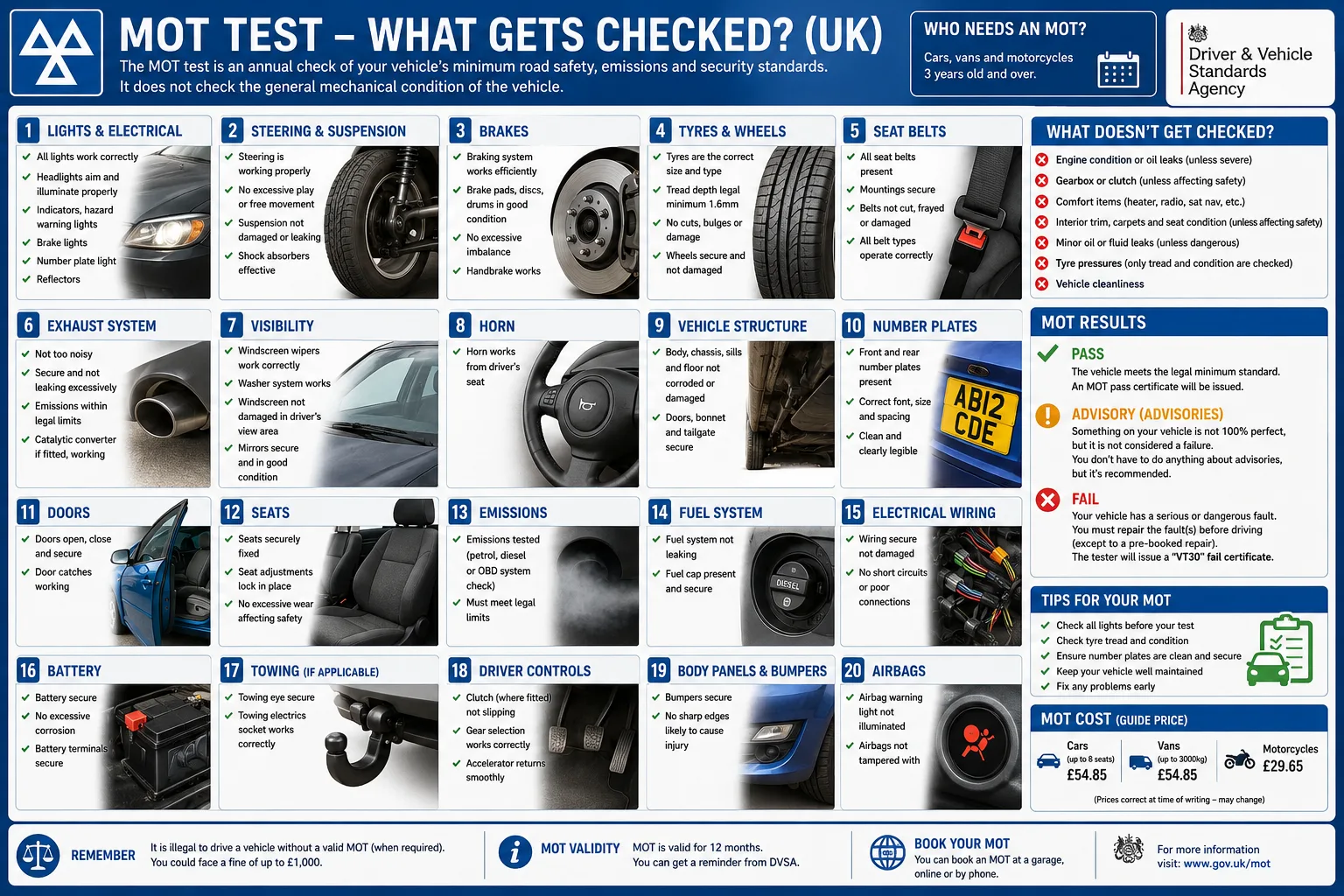
The MOT emissions test for petrol cars measures carbon monoxide (CO) and unburnt hydrocarbons (HC) at the exhaust pipe, plus checks the lambda (air/fuel ratio) reading sits within a tight band around 1.0 — meaning the engine is burning fuel efficiently with neither too much nor too little oxygen. Diesel tests are different: they measure opacity — how much light the exhaust smoke blocks — using a smoke meter. An opacity reading above roughly 1.5 m⁻¹ (the exact limit varies by registration year) means visible smoke that's dense enough to fail. Both tests are testing the combustion process and the emissions clean-up equipment downstream of it. On a petrol, the three-way catalytic converter scrubs CO, HC and NOx — but it needs a properly cycling lambda sensor to work efficiently. A lazy lambda means the catalyst runs in open-loop guesswork and its conversion efficiency collapses. On a diesel, the DPF (diesel particulate filter) traps soot; if it's blocked, cracked, or has been illegally removed, the test is over before it starts. The EGR (exhaust gas recirculation) valve recirculates a controlled amount of exhaust gas back into the intake to reduce combustion temperatures and NOx — when it sticks open or closed, or when it's caked in carbon, the knock-on effects cascade through both fuel economy and emissions readings. Injector wear, oil burning, coolant contamination and incorrect ignition timing can all push the readings over the line too.
“The emissions test is the bit of the MOT where your car has to stop pretending it's fine and actually prove it.”
Sound familiar?
So what's behind it?
What we do — at your door
We don't rock up and spray aerosol emissions cleaner down the throttle body and hope for the best — that particular garage trick is the automotive equivalent of putting a plaster over a broken arm. Instead we connect our diagnostic equipment, read the live lambda data and fuel-trim figures, check freeze-frame data from any stored fault codes, and use a gas analyser to see exactly what the exhaust is producing before we touch anything. On a diesel we'll check DPF pressure differential and soot load data from the ECU, inspect EGR operation and assess injector balance. Once we know the actual cause — not the most likely guess — we carry out the repair or service required: DPF cleaning or replacement, EGR clean or replacement, lambda sensor replacement, injector cleaning or testing, catalyst replacement, or addressing the underlying oil-burning issue that's killing everything downstream. All of it mobile, at your home, office or workplace — because hauling a smoking diesel across town to a garage and back is nobody's idea of a good time, and it doesn't exactly help the filter either.
What affects the price
What you'll pay depends entirely on what's actually wrong — and the range is wide. A lambda sensor is a relatively straightforward repair; a DPF replacement on a large diesel can run to several hundred pounds in parts alone because the filter itself is expensive, and on some vehicles access is genuinely unpleasant. EGR valve work sits somewhere in between: sometimes a clean is sufficient, sometimes it's past saving and needs replacing. The honest answer is that a full diagnosis is the first step, because throwing a new catalyst at a car that's actually burning oil through worn rings is just expensive theatre — it'll fail again in six months. UK parts prices vary significantly by make: German and French premium diesels are consistently more expensive to rectify than Japanese or Korean equivalents. We'll itemise the actual costs clearly before any work starts, so there are no surprises — unlike the MOT retest fee you're about to pay regardless.
Random knowledge you didn't ask for
Questions you're probably asking
My car just failed the MOT on emissions — can I drive it home?
Yes. An MOT failure isn't an automatic prohibition; you can drive the car home or to a repairer on the existing (failed) MOT as long as it was previously valid. You cannot use the car for general driving once the old MOT has also expired. Get it diagnosed and fixed before the retest — don't just book straight back in hoping it was a one-off reading, because it won't be.
Can emissions additives or a 'DPF cleaner' fix a diesel emissions failure?
They might help marginally if the DPF is only mildly blocked and the underlying cause is just urban driving starving it of regeneration cycles. But if the filter is heavily loaded, cracked, or if the root cause is a faulty EGR or worn injectors, an additive will do nothing. We see cars come in that have had three bottles poured into them — still failing, owners still baffled. Proper diagnosis first.
My petrol car failed on high CO — what does that usually mean?
High CO (carbon monoxide) on a petrol car almost always means the engine is running rich — too much fuel relative to air. The most common culprits are a failing lambda sensor (so the ECU is flying blind), a faulty fuel pressure regulator, leaking fuel injectors, or a catalyst that's past its useful life. High HC alongside it usually points to incomplete combustion — a misfire or very rich running. Both are diagnosable with live data.
My diesel produces black smoke under hard acceleration but passes easily at idle — will it fail the MOT?
Possibly, yes. The MOT smoke test on a diesel includes a series of free-acceleration snap-throttle tests specifically designed to reveal smoke under load. If your car smokes heavily under acceleration, there's a reasonable chance the opacity reading will exceed the limit on at least one of those acceleration snaps. Black smoke under load typically points to injector wear, a restricted air intake, or a DPF that's coping at rest but not under demand.
How long does it take to fix an emissions failure — can I get the car retested the same day?
It depends what's wrong. A lambda sensor swap can be done in an hour or two; a DPF clean takes longer and may need a forced regeneration cycle afterwards; a full DPF replacement is a bigger job. We'll give you a realistic timescale when we've diagnosed the cause. Some fixes allow a same-day retest, others don't — we won't rush a repair just to hit an optimistic deadline if it means the fix won't hold.
MOT Emissions Failure — sorted at your door
Stop procrastinating. Get a transparent quote and we'll come to you.