Interim, Full or Major Service: The No-Faff Guide to Which One Your Car Actually Needs
Car servicing has a PR problem. Most people know they're supposed to do it. Most people also have no earthly idea what the difference is between an interim service, a full service, and a major service — and garages have historically been very comfortable with that confusion, because vague customers are easier to upsell. So here is the honest guide nobody bothered to write. Three service types, different intervals, different price brackets, and each one justified by actual engineering reality rather than somebody's quarterly sales target. SOSCarFix does all three — engine oil, filters, fluids, plugs, the lot — and we do it on your driveway or at work, so you don't have to book a day off to sit in a waiting room watching Jeremy Kyle reruns on a TV bolted too high on the wall.
See our upfront pricingConfused by interim, full and major services? We break down what's included, when to book each, and why skipping them costs you more. Mobile, at your door.
How it actually works
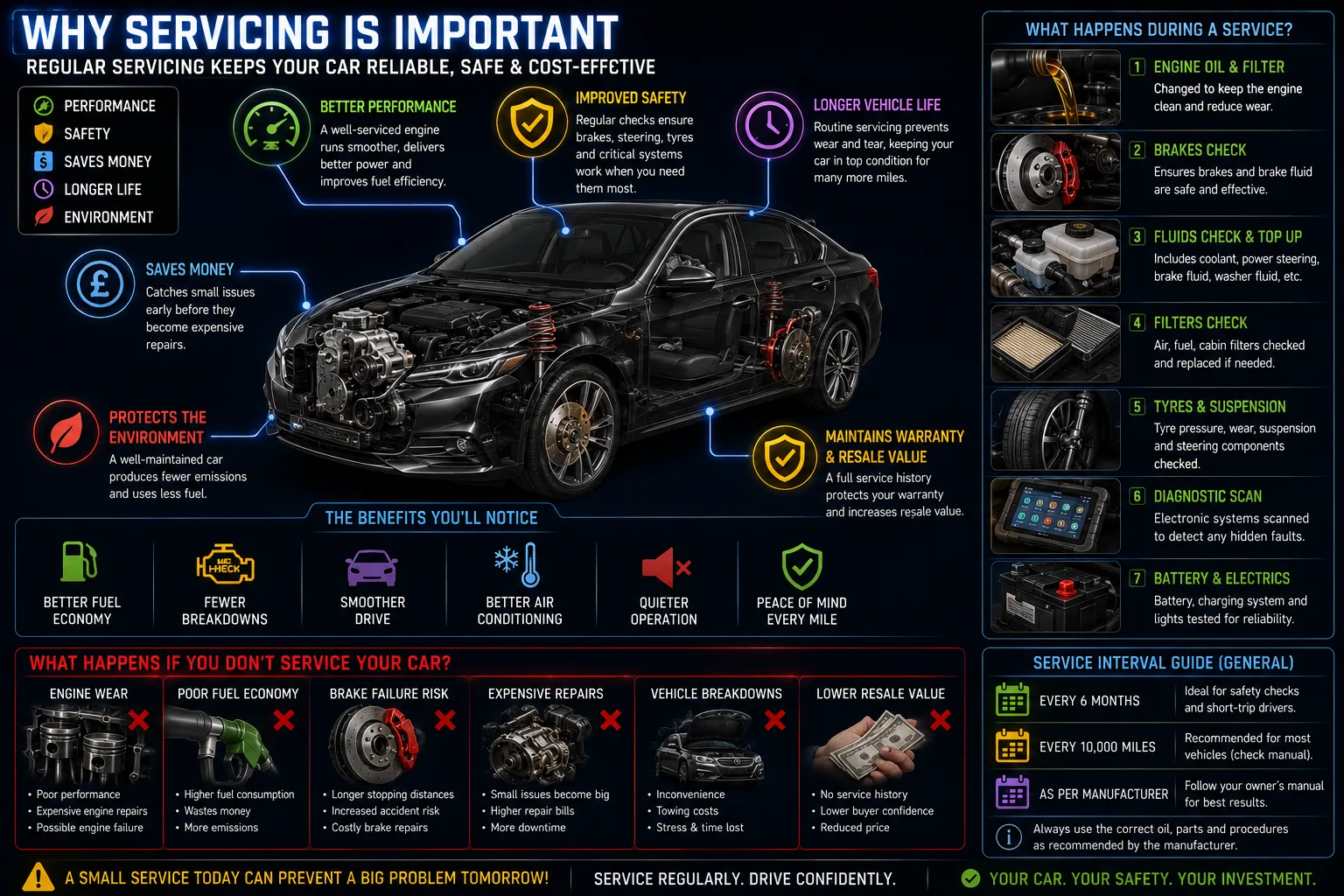
Think of your car's service schedule like dental hygiene. You brush every day (interim), you go for a check-up every six months (full), and occasionally you get the full deep clean and X-rays (major). Skip the brushing and the six-month clean gets much worse. Skip everything and eventually the dentist finds something that costs considerably more than all the missed appointments combined. An **interim service** is the light-touch top-up: engine oil and filter change, visual safety checks, fluid top-ups, tyre pressures and condition. Recommended roughly every 6,000 miles or 6 months — whichever comes first — and aimed squarely at higher-mileage drivers who'd otherwise be running 12,000 miles on the same oil. A **full service** does everything in the interim, plus a deeper sweep: air filter, cabin filter, brake fluid condition, spark plugs (on some cars), detailed brake and suspension inspection, lights, battery health, and more. Recommended at around 12,000 miles or 12 months. A **major service** (sometimes called a manufacturer service or 2-year service) adds the heavy-hitters on top of all that: fresh coolant/antifreeze, timing belt check, fuel filter, gearbox oil on some vehicles, transmission fluid, and a comprehensive inspection against the manufacturer's schedule for that specific mileage. Typically every 24,000 miles or 2 years. Every job ends with a stamp in your service book or a digital service record entry — because service history is a real, tangible thing that protects your resale value and keeps any remaining manufacturer warranty intact.
“So here is the honest guide nobody bothered to write.”
Sound familiar?
So what's behind it?
What we do — at your door
We come to you — driveway, car park, workplace, wherever the car is sitting — with all the parts pre-ordered for your specific make, model and engine. We check the manufacturer's service schedule for your car before we arrive, so we're not improvising on your driveway. On the job: we drain and replace the engine oil with the correct grade and specification (not whatever's on the shelf), fit a new oil filter, replace whichever additional filters are due for this service level, check and top up all fluids, inspect brakes, tyres (minimum 1.6mm legal tread limit — we measure), lights, battery condition and the suspension and steering components for any obvious wear. We use a proper diagnostic tool to clear any service reminder messages and check for any hidden fault codes that the car has stored. Everything gets logged and your service book gets stamped. We tell you if we find anything else that needs attention — and we quote you before we touch it.
What affects the price
Service cost in the UK varies a fair amount based on your car rather than garage theatre. The main variables are: engine oil specification and volume (a large diesel that takes 8 litres of long-life synthetic costs more to fill than a small petrol taking 4 litres of standard grade), the specific parts required (air filters and spark plugs vary wildly between a Ford Fiesta and a BMW 3 Series), and the service level itself — major services include more parts and more labour time than an interim. Labour rates at franchised main dealers are typically the most expensive; independent mobile mechanics can offer comparable or better work at a lower rate because the overheads of a physical premises aren't baked into your bill. What you should expect to pay in the UK ranges from modest for a basic interim on a smaller car to notably more for a full or major service on a larger or premium vehicle — we'll give you a fixed quote upfront for your exact car before booking, so there are no surprises when the invoice arrives.
Random knowledge you didn't ask for
Questions you're probably asking
What is actually included in a full service in the UK?
A full service typically covers: engine oil and filter change, air filter, cabin/pollen filter, brake fluid condition check, fuel filter (on many cars), inspection of brakes, tyres, lights, battery, steering, suspension and exhaust. It should also include a diagnostic scan for fault codes. Exactly what's included varies slightly by garage and car manufacturer — always ask for an itemised list before booking.
How often should I get an interim service vs a full service?
The standard rule of thumb: interim service every 6,000 miles or 6 months (whichever comes first) — mostly to get the oil changed more frequently on higher-mileage cars. Full service every 12,000 miles or 12 months. Major service every 24,000 miles or 2 years. Your car's handbook will have manufacturer-specific intervals, and some modern cars have variable intervals — check both.
Do I have to use a main dealer for servicing to keep my warranty valid?
No — and this is a common misconception that main dealers don't rush to correct. Under UK consumer law (and EU Block Exemption rules that the UK retained post-Brexit), you can have your car serviced by any competent independent mechanic during the warranty period, provided they use the correct specification parts and oil and keep a proper service record. The dealer cannot void your warranty purely because you didn't go to them. Get it stamped and keep the receipts.
What happens if I go over my service interval — is the car immediately damaged?
Not immediately, no. Going a few hundred miles or a couple of weeks over isn't a disaster. Going thousands of miles or a year over is a different story — degraded oil gets viscous and acidic, stops protecting the engine properly, and the damage is cumulative and invisible until it isn't. Think of it less like a cliff edge and more like a slope: every extra mile past overdue is slightly more wear that compounds.
Will servicing my car help it pass its MOT?
Directly, not always — MOT and service are different things. But they overlap a lot in practice. A well-serviced car is much less likely to have tyres below the 1.6mm legal limit, brake fluid that's moisture-contaminated and softening the pedal, advisory-level wear on brakes or suspension, or bulbs out. A car that's been serviced regularly tends to sail through MOTs more reliably than one that hasn't. It also means the MOT tester isn't the first person to spot a problem in two years.
Interim, Full or Major Service — sorted at your door
Stop procrastinating. Get a transparent quote and we'll come to you.