Full Car Service: The Big Annual Reset Your Car's Actually Been Waiting For
A full service is the closest thing a car has to an annual health check — the works: fresh oil, all the filters, every fluid inspected or topped up, brakes measured, tyres checked, lights tested, and a multi-point inspection that looks at everything from the steering rack to the exhaust mounts. Unlike a dealer service, where your car disappears into the mysterious back of a glass-fronted building for four hours only to return with a list of "advisory" items and a bill that suggests they've rebuilt it from scratch, a full service with SOSCarFix happens on your driveway, in front of you, explained in plain English. We stamp your service history while we're there — because a full stamp means a full resale price, and we're not going to let your car lose hundreds of pounds in value for want of a bit of ink.
See our upfront pricingA proper full car service — oil, filters, fluids, brakes, the lot — done on your driveway. No waiting rooms, no upsells. Get a quote from SOSCarFix today.
How it actually works
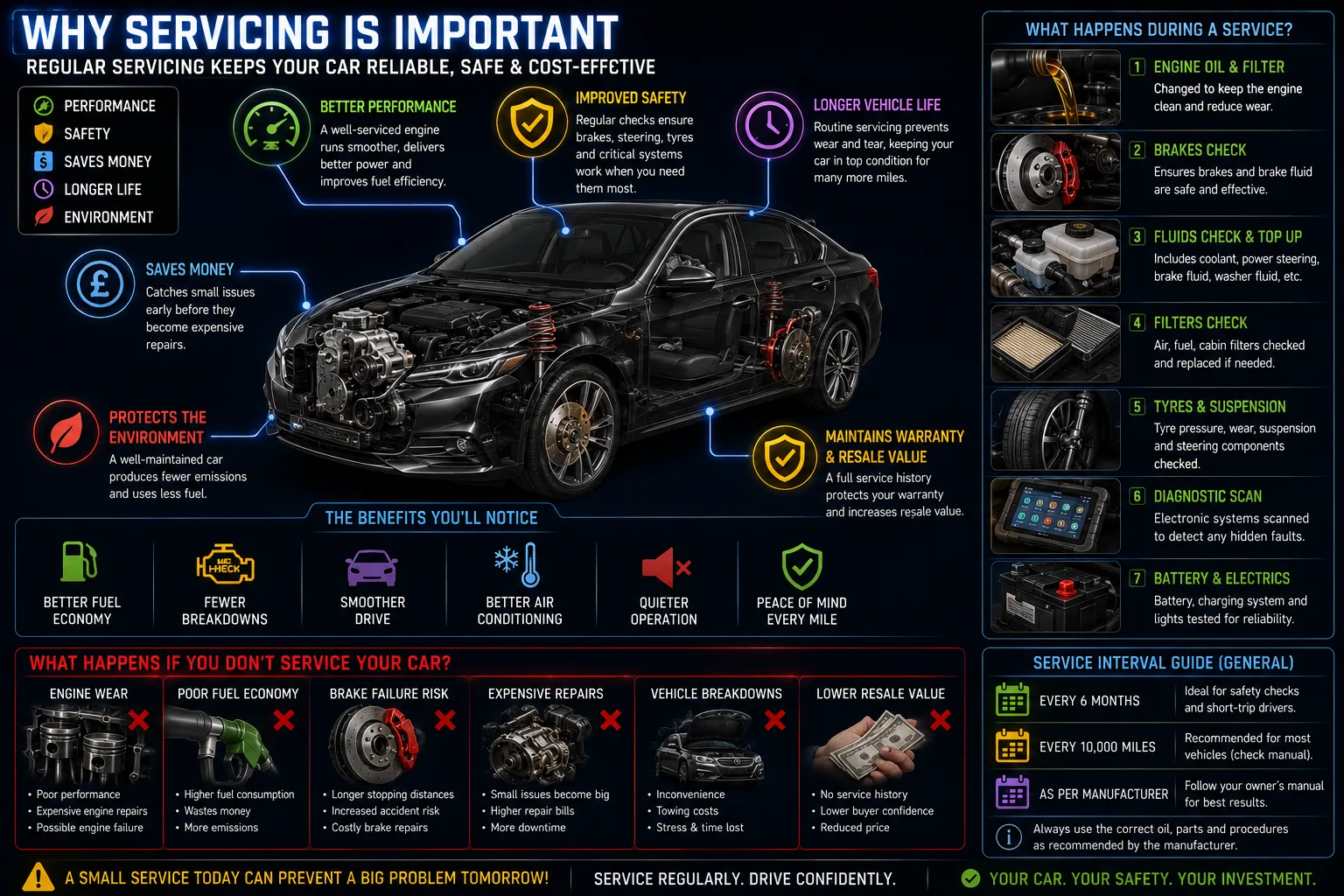
A full service is structured around two things the manufacturer defined when they built your car: a service interval (usually every 12 months or 12,000 miles, whichever comes first — though some modern long-life oil systems stretch to 18,000 miles or 2 years) and a service schedule (a checklist of exactly what gets changed, inspected or measured at each visit). A full service is the more comprehensive tier above an interim service, below a major service. The interim is a halfway-top-up (oil change, safety essentials) done at roughly 6 months or 6,000 miles. The full adds a proper brake inspection with measurements, air and cabin pollen filters, full fluid checks and corrections, and a thorough multi-point inspection of suspension, steering, belts, hoses, exhaust and anything else that needs an annual once-over. A major service — usually every 2 or 3 full service cycles — adds the big-ticket consumables: spark plugs, coolant flush, gearbox fluid, possibly a cambelt check or replacement. Think of interim as topping up a glass, full service as properly washing it, and major as replacing the glass entirely.
Sound familiar?
So what's behind it?
What we do — at your door
We come to you — home, office, car park, wherever the car lives — and carry out the full service schedule for your make, model and engine using the oil specification the manufacturer actually requires (not whatever's cheapest on the shelf). That means draining and replacing the engine oil and filter, replacing the air filter and cabin/pollen filter, checking and correcting all fluids (brake fluid, coolant, power steering, screenwash, gearbox if accessible), inspecting brake pads with a measurement against the wear limit (1.5mm is the legal minimum but we'll flag anything under 3mm), checking disc thickness and condition, examining tyre tread depth and pressures, testing lights, checking for any warning lights or stored fault codes with a diagnostic scan, and working through the full multi-point inspection — steering, suspension, wheel bearings, CV joints, exhaust, engine mounts and belts. We document everything, give you a copy, and stamp your service history book or update your digital service record. If anything needs attention, you get an honest, itemised quote — and we'll tell you what's urgent and what can wait, because not everything advisory is actually urgent.
What affects the price
What drives the cost of a full car service in the UK is mostly the oil — engine oil is not all the same, and the difference between a budget generic oil and the correct OEM-specified long-life oil for a modern turbocharged diesel or petrol engine is significant. An A3/B4-spec VW Group oil costs considerably more per litre than a basic 10W-40, and the right spec matters for engine protection and warranty validity. Beyond oil, your car's size and engine type affects cost (a 4-litre V8 needs more oil than a 1.0-litre three-cylinder), the filter count varies by model, and whether the car's brake fluid needs replacement (typically every 2–3 years or when moisture contamination reaches a threshold above 3.5%) is a variable. Where a service sits in the service schedule — and what additional items are flagged during the multi-point inspection — will also affect the final number. A mobile service doesn't add a forecourt surcharge or a complimentary coffee that cost £8, so you're paying for the actual work.
Random knowledge you didn't ask for
Questions you're probably asking
What's the difference between a full service and an interim service?
An interim service is a halfway check — fresh oil, oil filter, and a safety look-over at key items — done every 6 months or 6,000 miles. A full service goes considerably further: air filter, cabin filter, all fluids inspected and corrected, a full brake inspection with measurements, and a comprehensive multi-point check of the whole car. Think of the interim as maintenance between full services, not a replacement for one.
What's the difference between a full service and a major service?
A full service handles the annual consumables and inspection. A major service — usually due every second or third full service — adds the longer-interval items: spark plugs, coolant system flush, gearbox fluid, possibly a cambelt inspection or replacement. Your car's service schedule (in the handbook) tells you when each applies. We'll also let you know when we're there.
Will you stamp my service history book?
Yes. We stamp your physical service book and complete the relevant section, or update a digital service record if your car uses one. This matters: a complete, stamped service history is a genuine financial asset at resale time. Buyers pay a premium for it, and dealers will hammer the price down without it — sometimes by more than the cost of several services.
Does a mobile service count as a 'proper' service for warranty purposes?
Yes, for the vast majority of cars. A new-car manufacturer warranty requires the car to be serviced at the correct intervals using the correct oil specification — it does not legally require a franchised dealer. We use the right oil grade and spec for your car and provide a full service record. If you're inside a dealer's 'free servicing' package that's part of a finance deal, check those terms separately, as those often are dealer-tied.
How long does a full car service take?
Typically 2 to 3 hours on a standard family car, done at your location. Some cars take longer depending on access to filters (certain engines hide them with impressive creativity), the number of fluid points, or if we find and discuss something unexpected during the inspection. We'll give you a realistic estimate when you book.
Spanner warning light on my dash — is it a fault or just a service reminder?
Almost certainly a service reminder, not a fault. The spanner icon (or a wrench, or a message reading "Service Due" / "Service Required") is your car's built-in nag: it's calculated — based on mileage, time, or oil quality data — that you're due a service. It is not an emergency. You can keep driving carefully and book it in. What you should not do is confuse it with the oil pressure warning light (usually a red oil-can symbol with a drip) — that one means stop immediately and turn the engine off. The spanner means book a service soon. The red oil can means right now.
Full Car Service — sorted at your door
Stop procrastinating. Get a transparent quote and we'll come to you.