Engine Mount Replacement: When Your Engine Decides It Wants to Be Somewhere Else
Your engine is essentially a large, violently vibrating lump of metal that your car's designers would quite like to keep in one place. Engine mounts (and their close cousin, the gearbox mount) are the components that make this happen — thick rubber-and-metal sandwiches, sometimes filled with hydraulic fluid, that bolt the drivetrain to the car's subframe and absorb the constant shake before it reaches you. When they wear out, fail or collapse, you start to feel things you absolutely shouldn't: a clunk every time you select gear, the whole cabin buzzing at idle like you're sat on a washing machine, or a lurch as the engine physically rocks on pull-away. SOSCarFix comes to your driveway, diagnoses which mount is the culprit with a proper on-site inspection, and replaces it there and then — no garage, no tow truck, no drama.
See our upfront pricingClunks, cabin vibration and an engine that moves like it's trying to escape? We diagnose and replace engine & gearbox mounts at your door. Get a quote.
How it actually works
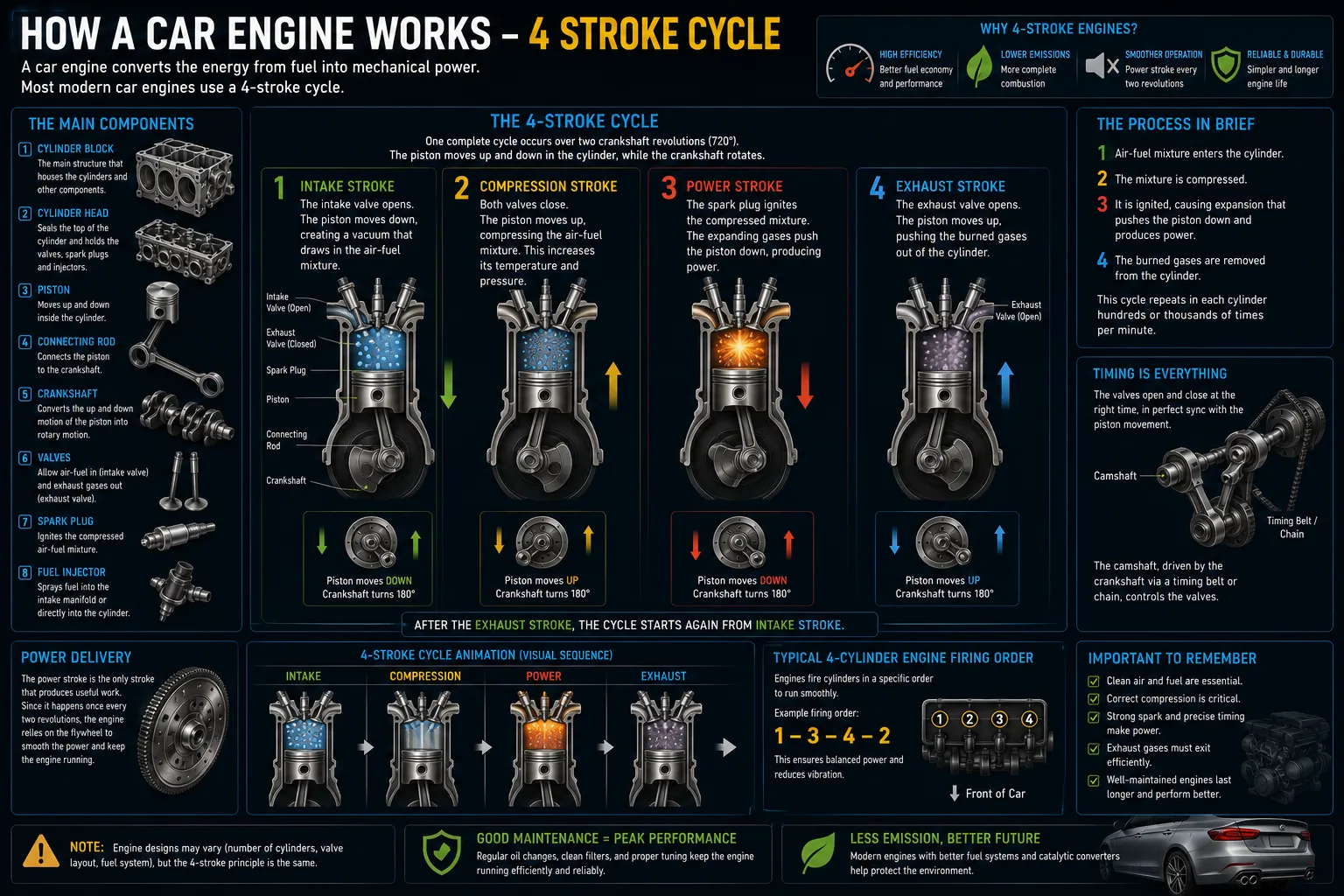
A petrol or diesel engine produces torque — a rotational twisting force — every time it fires. Without something to control it, the entire engine and gearbox assembly would spin, shift and shake its way through the engine bay in short order. Engine mounts (also called motor mounts) do two jobs simultaneously: they locate the drivetrain — keeping it physically bolted in the right place relative to the gearbox, driveshafts and subframe — and they isolate vibration, so that the constant buzz of combustion doesn't transmit straight into the cabin and your fillings. Most cars have two to four engine mounts plus one or two gearbox mounts. The classic design is a bonded rubber bush: a metal inner sleeve bonded to a metal outer bracket with a thick layer of rubber in between. Higher-spec variants are hydraulically damped — filled with fluid that gives a softer, more variable response across different frequencies. Both designs share the same failure mode: the rubber degrades with age and heat, cracks, hardens or simply collapses, losing its ability to control movement or dampen vibration. The metal brackets can also crack on higher-mileage vehicles, or if the car has taken a serious knock. Once a mount is gone, the engine is free to move excessively in any direction — and every gear change, every hard acceleration, every cold start that causes the engine to rock will tell you about it loudly and without apology.
Sound familiar?
So what's behind it?
What we do — at your door
We come to you — driveway, work car park or wherever the car lives — and start with a proper visual inspection under the bonnet: we check each mount for obvious rubber collapse, cracking, oil contamination, and bracket damage. Then we use an assistant or a prop to load the engine while we observe movement directly; on front-wheel-drive cars we also use the steering to rock the drivetrain under load. If the visual isn't conclusive, we get underneath for the gearbox mount — often the most neglected one. Where needed we can use live data via our scan tools to rule out misfire or other engine faults that might be masking or contributing to the vibration. Once we've confirmed which mount (or mounts — sometimes it's more than one) is the culprit, we give you a clear quote before touching anything. Replacement is carried out on-site using quality OEM-spec or genuine parts, engine repositioned correctly and all fixings torqued to spec.
What affects the price
Cost varies considerably depending on make, model and which mount needs replacing — a straightforward top or rear engine mount on a common hatchback is a much simpler job than a torque mount buried under the battery tray on a transversely-mounted engine, or a gearbox mount that requires dropping a subframe. The mount itself ranges from inexpensive rubber items through to pricier hydraulic OEM parts. Labour time typically runs from around an hour for an accessible mount to considerably more for awkward locations. We'll always confirm the exact position before quoting. As a general principle: catching a failed mount early is far cheaper than the collateral damage — a severely collapsed mount can allow the driveshaft to pull, wiring and hoses to chafe, and on a few unlucky cars the power steering rack or exhaust to make contact with moving engine components.
Random knowledge you didn't ask for
Questions you're probably asking
Is it safe to drive on a failed engine mount?
Depends how bad. An early-stage worn mount — you hear the clunk, feel some vibration — you can drive carefully for a short while to get it sorted. A severely collapsed mount is a different matter: the engine can move far enough to pull on wiring, damage hoses, or stress driveshafts. If you can see the engine lurching visibly under load, or you're getting new noises on full steering lock, stop driving and get it looked at promptly.
Can a bad engine mount cause other problems?
Yes, and this is the bit people miss. A failed mount allows the whole engine and gearbox assembly to move more than it should. That extra movement strains driveshaft CV joints, can chafe wiring looms and coolant hoses against brackets, pulls on the exhaust at its manifold, and — on some transverse-engine cars — can allow contact between the engine and the inner wing or subframe. What starts as a clunk and some vibration can quietly be doing collateral damage every time you drive.
How do I tell if it's the engine mount or the gearbox mount?
Location of the clunk and the load that provokes it gives strong clues: clunks on gear selection often point to the gearbox or rear torque mount; clunks on hard acceleration and lift-off typically implicate the main engine mounts. Vibration at idle through the floor tends to be a failed hydraulic mount. That said, these overlap, and the only definitive answer is a physical inspection with the engine loaded — exactly what we do on-site before quoting.
Do all mounts need replacing at once?
Not necessarily — a mount is either failed or it isn't, and we'll only recommend replacing the ones that have actually failed. That said, if one mount has collapsed through age on a high-mileage car, the others are likely not far behind. We'll check them all and give you an honest picture: what needs doing now and what to keep an eye on, so you can make a sensible decision rather than one based on what a garage thinks is a good upsell.
How long does engine mount replacement take?
An accessible engine or gearbox mount on a common car is typically one to two hours on-site. Awkward mounts — particularly on some modern compact cars where the battery tray, air filter housing and half the engine bay has to come off first — can run to three hours or more. We'll confirm timing when we quote, based on your specific make and model, so there are no surprises.
Why does my car clunk when I accelerate or pull away?
That clunk on pull-away is a classic failed engine or gearbox mount. When you accelerate, the engine twists against its mounts — if the rubber has collapsed or cracked, it hits its travel limit and you hear (and feel) the thud. It can also clunk when you lift off, as the engine rocks back. Left alone, a dead mount lets the drivetrain move far enough to stress driveshafts and wiring. Worth getting it checked properly — we can diagnose and replace the offending mount at your door.
Engine Mount Replacement — sorted at your door
Stop procrastinating. Get a transparent quote and we'll come to you.