Yes, Your Low-Mileage Car Still Needs a Service: Time Doesn't Care About Your Odometer
Barely put a dent in the odometer this year? Retirement, working from home, the general reluctance to go anywhere — whatever the reason, clocking up 3,000 miles in twelve months does not make your car a spring chicken. Oil doesn't just wear out from friction; it ages, oxidises and picks up moisture whether the engine turns or not. Brakes corrode. Fluids absorb water. Rubber perishes. Short trips are classified as "severe use" by manufacturers — brutal cold starts, condensation in the engine, never reaching full operating temperature. The 12-month service interval exists for a reason, and that reason is time, not miles. SOSCarFix comes to you — driveway, car park, or wherever the car is sitting collecting cobwebs — and gets it sorted properly.
See our upfront pricingYour car does 4,000 miles a year. Still needs a service. Oil ages, brakes seize, rubber perishes. SOSCarFix comes to you — no garage drama.
How it actually works
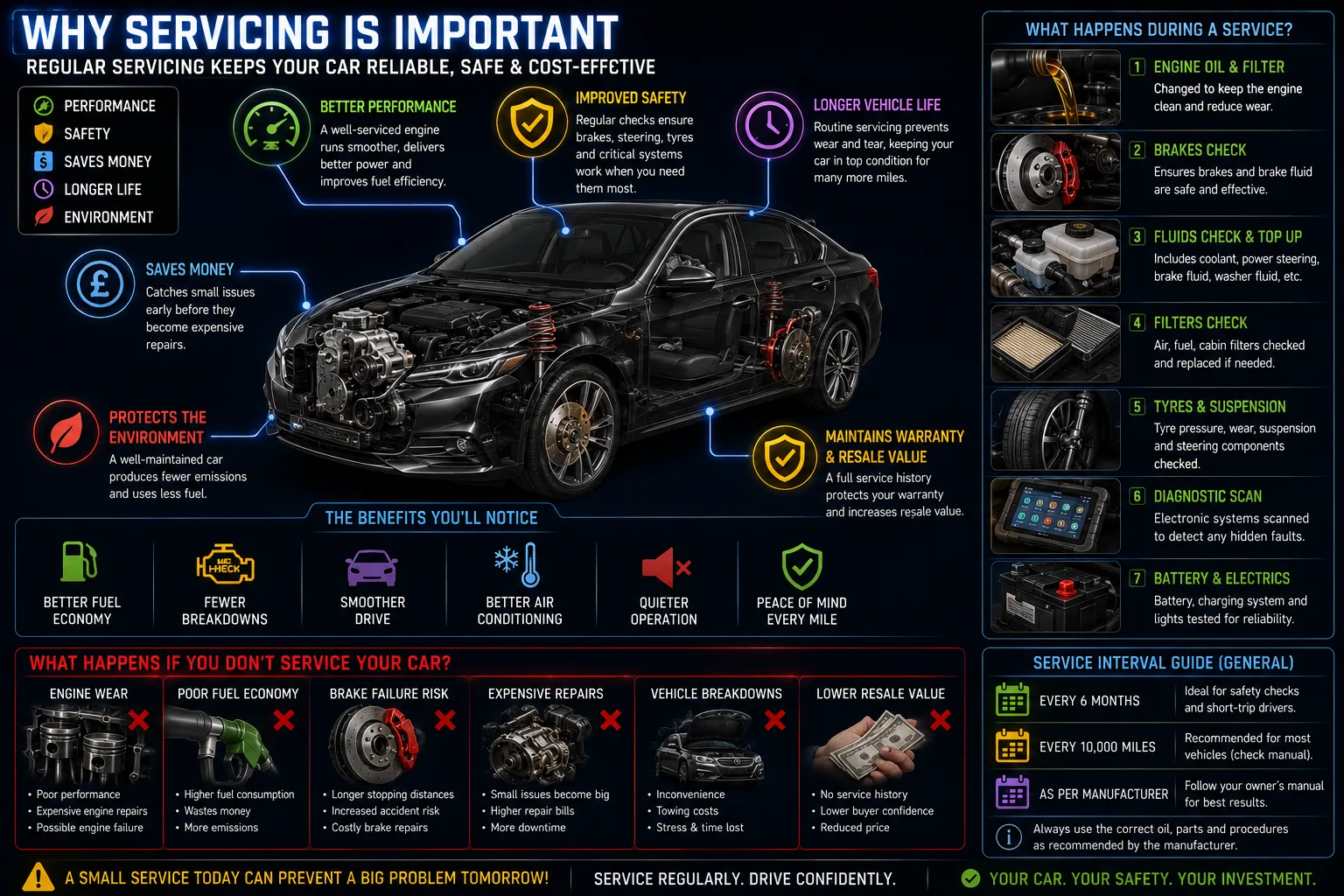
Every car has two service intervals: one based on mileage and one based on time — usually 12 months, whichever comes first. That "whichever comes first" clause is not small print to be ignored. It's there because chemistry doesn't care about the trip counter. Engine oil is the clearest example. Modern fully-synthetic oils are remarkable, but they degrade over time regardless of use. Combustion blow-by gases (yes, even on a car that only pops to the shops) introduce acids and soot into the sump. Moisture accumulates. The oil's additive package — the stuff that fights corrosion and maintains viscosity — depletes on a calendar, not a mileage schedule. Leaving 18-month-old oil in an engine on the basis it's "barely been used" is a false economy that quietly accelerates wear. Short-trip driving is specifically classified as "severe use" by most manufacturers because the engine never fully warms up. Water and acids that would burn off on a longer run sit in the oil and exhaust system. Diesel particulate filters can clog because a regeneration cycle (which needs a sustained motorway run) never happens. Meanwhile, hydraulic brake fluid absorbs moisture from the air through the system over time, lowering its boiling point and softening the pedal. Rubber seals and hoses perish. Caliper pistons corrode if rear handbrake-side calipers are never worked hard enough to keep them moving. A once-a-year check isn't paranoia — it's basic mechanical due diligence.
“SOSCarFix comes to you — driveway, car park, or wherever the car is sitting collecting cobwebs — and gets it sorted properly.”
Sound familiar?
So what's behind it?
What we do — at your door
We come to wherever the car lives — your driveway, your works car park, the village street it hasn't moved from in three months — and carry out a full service on-site. That means draining and replacing the engine oil with the correct grade and specification for your car (not whatever was on offer at a factor), fitting a new oil filter, and working through the full inspection: air filter, cabin filter, brake fluid condition and moisture content, coolant concentration, all brake components including caliper movement on rear calipers, tyre pressures and tread depth, condition of rubber hoses and belts, battery voltage and charging behaviour, and lights. We check the DPF status on diesels and advise if a regeneration run is overdue. We don't invent advisories to make the bill longer — we tell you what's actually due, what can wait, and what's advisory. Because we're at your car rather than you being at our mercy in a waiting room, the whole thing is straightforward, and you're not paying for a building.
What affects the price
Cost varies with the car — not surprising when a basic hatchback takes 4 litres of oil and a prestige German saloon takes 8 litres of something expensive and specific. Factors that affect the price honestly: engine size and oil capacity; the exact oil specification required (a Volkswagen group car needing 504/507 long-life spec or BMW LL-04 costs more in oil than a car on a generic 5W-30); the number and type of filters (some cars have both an oil filter and a separate cartridge housing with a seal); whether brake fluid is due a change (typically every 2 years regardless of mileage — a separate line item); and whether any additional items surface during inspection (most do not on a genuinely low-mileage car). We quote before we start — no surprises on the invoice.
Random knowledge you didn't ask for
Questions you're probably asking
My car has only done 4,000 miles this year. Do I really need to spend money on a service?
Yes — because the 12-month interval exists for time-dependent reasons, not just mileage-dependent ones. Oil degrades, brake fluid absorbs moisture, rubber perishes, and brakes corrode whether you drive them or not. A skipped annual service doesn't save money; it quietly moves the costs forward and usually makes them larger. The manufacturers aren't padding their schedules to keep dealers busy.
What is 'severe use' and why does short-trip driving count as it?
Most manufacturers define severe use as conditions that put extra strain on the car's systems — towing, extreme temperatures, lots of dust, and short trips. Short journeys qualify because the engine never reaches full operating temperature. That means fuel dilutes the oil, moisture stays in the sump, and the catalytic converter and DPF (on diesels) never properly clean themselves. Counterintuitively, 4,000 miles of short trips is often harder on an engine than 10,000 motorway miles.
Does low mileage make any difference to what a service costs?
Not much, honestly. The oil drain-and-fill, filters and inspection take the same time regardless of what the odometer says. Where low mileage might help you is in the advisory items — a low-mileage car used gently is less likely to have worn brake pads or a marginal tyre. But the core service items are time-based, so the cost is largely the same.
How often should brake fluid be changed on a low-mileage car?
Every two years is the standard recommendation for most cars, regardless of mileage — because brake fluid absorbs moisture from the air over time, not just from use. Moisture in brake fluid lowers its boiling point, which can cause fade under hard braking and accelerate corrosion inside calipers and the master cylinder. We test moisture content as part of a full service and advise if it's due.
Can you service a car that hasn't moved in several months?
Yes — and it probably needs it more than a regularly-used one. Sitting still is surprisingly hard on a car: tyres develop flat spots, brakes corrode, battery state-of-charge drops, and diesel fuel can degrade. We'll flag anything that's cropped up from extended standstill alongside the standard service items, all without the car needing to go anywhere.
Yes, Your Low-Mileage Car Still Needs a Service — sorted at your door
Stop procrastinating. Get a transparent quote and we'll come to you.