Blue Smoke from Your Exhaust: Your Engine Is Burning Oil (And It's Not Shy About It)
Blue smoke from your exhaust is your engine doing something it really shouldn't: burning engine oil along with the fuel. It's not subtle — it smells acrid, hangs in the air like a fog machine at a budget wedding, and if it's bad enough it'll leave the driver behind you mouthing words you can lip-read from space. The good news is that blue smoke is a symptom, not a death sentence — at least, not necessarily. Some causes are cheap and easy to sort; others are the kind of conversation you have whilst making a cup of tea to steady the nerves. The important thing is finding out which you're dealing with before guessing your way through expensive parts. SOSCarFix comes to you — driveway, workplace, wherever the smoke plume led us — with the tools to diagnose it properly on the spot rather than booking you in for a week hence.
See our upfront pricingBlue exhaust smoke means your engine's burning oil. Could be valve seals, piston rings or a dicky turbo. We diagnose it on your driveway — get a quote.
How it actually works
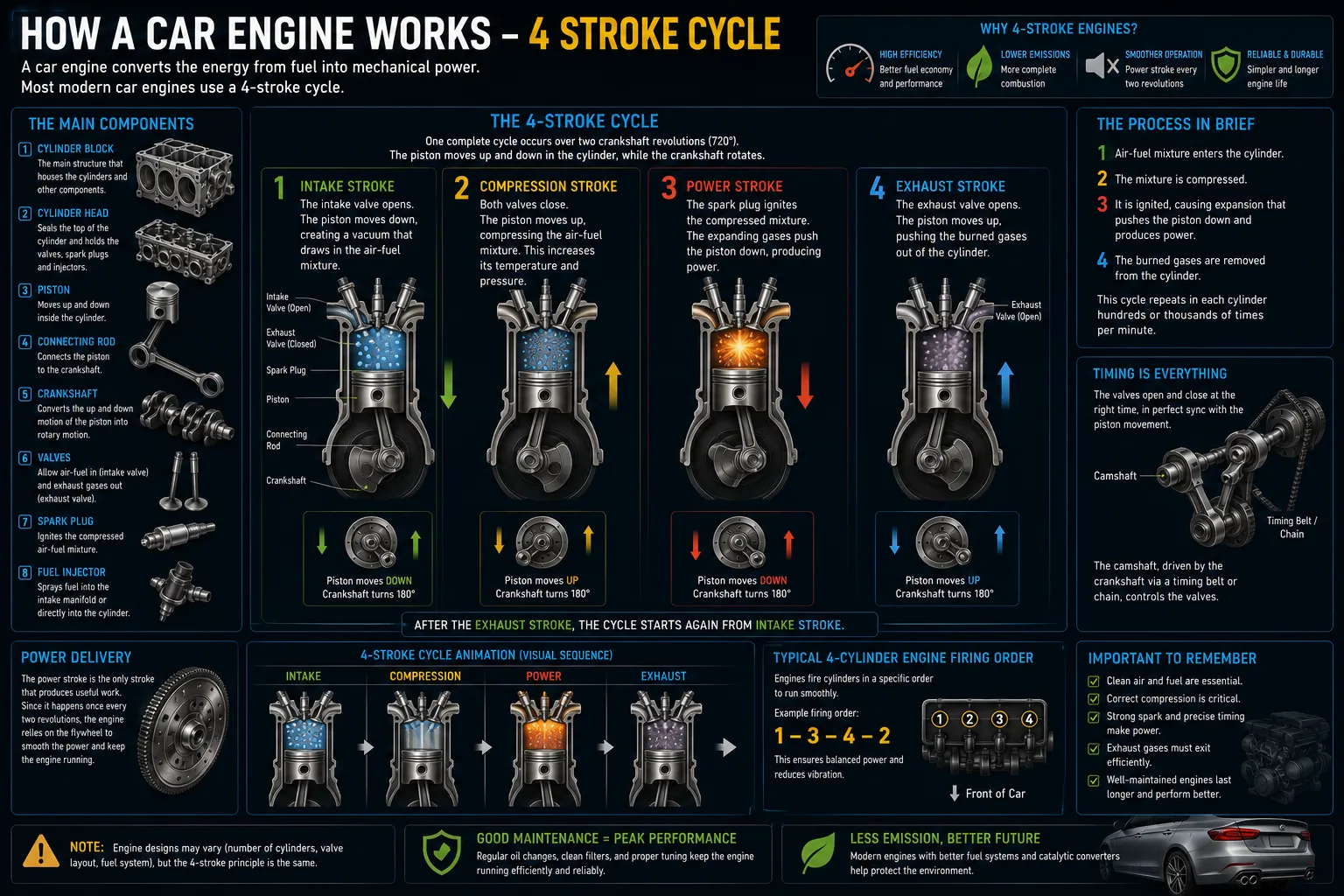
Your engine has two sets of things it very much wants to keep separate: combustion gases on the inside of the cylinders, and oil on the outside lubricating the moving parts. The boundary between the two is held by a series of seals and rings — most critically the piston rings, which sit in grooves around each piston and scrape excess oil off the cylinder walls, and the valve stem seals, which stop oil being sucked in past the valve guides into the combustion chamber. When those seals and rings are in good shape, only a tiny, invisible wisp of oil ever makes it into combustion. When they start to fail, oil sneaks in, gets burnt along with the fuel, and exits via the exhaust as that telltale blue-grey smoke. The colour is the giveaway: blue or blue-grey means oil; white means coolant or condensation; black means over-fuelling. Turbocharged engines add another route — a failing turbo shaft seal can push oil directly into the intake or exhaust side. The PCV (Positive Crankcase Ventilation) system is another culprit: it recirculates blow-by gases from the crankcase back into the intake, and if it gets blocked or the breather fails, it can carry oil mist with it into the engine.
“Blue smoke from your exhaust is your engine doing something it really shouldn't: burning engine oil along with the fuel.”
Sound familiar?
So what's behind it?
What we do — at your door
We arrive at your location with a proper diagnostic kit — not a £20 Bluetooth dongle — and start by reading live data and any stored fault codes, then carry out a compression test and a leak-down test to immediately tell us whether the cylinders are holding pressure as they should. A failed compression test across one or more cylinders points toward piston rings or bore wear; good compression with blue smoke on startup points toward valve stem seals; smoke only under boost with a healthy engine suggests the turbo seal. We'll also inspect the PCV system, check for oil in the intake, check the spark plugs for contamination and pull the oil filler cap to look for excessive crankcase pressure. The point of all this before quoting is that blue smoke can mean a £60 PCV valve or a very different conversation, and we'd rather not guess at your expense. You get a clear, itemised diagnosis and quote before any work starts — and if it's the kind of job best done in a workshop, we'll tell you that honestly too.
What affects the price
Cost varies enormously depending on root cause — and that's not us being evasive, it's the nature of the fault. A blocked PCV breather is a fraction of what valve stem seals cost, which is itself a fraction of a piston ring or bore job (which edges into engine-rebuild or replacement territory). Valve stem seals are labour-intensive because the cylinder head has to come off, so the part cost is modest but the hours mount up. Turbo seal replacement means removing the turbo — cost depends heavily on whether you're also replacing the whole unit or just the CHRA (centre cartridge). Labour rates for mobile mechanics are typically lower than franchised garages without a workshop's overheads. The make and model matters a lot: accessing valve seals on a big V6 is a different proposition to a small four-cylinder. We give you the full breakdown before we start, so there are no end-of-job surprises.
Random knowledge you didn't ask for
Questions you're probably asking
Is it safe to keep driving with blue smoke from the exhaust?
Depends on how much there is and how fast the oil is dropping. A light puff on cold startup that clears within a minute is common on older engines with worn valve seals — you can usually drive it, but keep a close eye on the oil level and don't let it run low. Continuous heavy blue smoke under acceleration is a different matter: you can be burning oil fast enough to run the engine low without noticing, and that route ends in catastrophic damage. Check the dipstick first. If it's dropping fast, stop driving and get it diagnosed.
Can it just be that I've overfilled the engine oil?
Yes — and it's worth checking before you panic. Pull the dipstick: if the oil is above the MAX mark, you've overfilled it. Excess oil can be pressurised into the intake and burnt off. The fix is to drain it to the correct level (between MIN and MAX) and see if the smoke stops. If it does, problem solved for virtually nothing. If the level is fine, you've still ruled out the easiest cause and the diagnosis can move on.
What's the difference between blue smoke at startup versus blue smoke under acceleration?
It's a useful clue. Blue smoke only at cold startup — especially on a higher-mileage car — that clears after a minute or two strongly suggests worn valve stem seals. Oil pools on the valve heads overnight and gets sucked in on the first few seconds of running. Smoke that appears specifically under hard acceleration or load, but not at idle, points more toward piston rings or turbo seals, because those faults show up when cylinder pressures or boost levels are high.
My car has been using oil but there's no visible smoke — is that still oil burning?
Possibly. Light oil burning doesn't always produce visible smoke — the catalytic converter can deal with small amounts before anything becomes visible at the tailpipe. If your oil level is dropping noticeably between services and there are no obvious external leaks (check under the car and around the rocker cover), internal burning is the most likely culprit even without a smoke show. A compression test and a check of the spark plugs will tell us a lot.
Does blue exhaust smoke mean I need a new engine?
Not automatically. The diagnosis matters enormously. Valve stem seals and turbo seals can be replaced without touching the bottom of the engine. A blocked PCV is usually a cheap fix. It's only when compression tests reveal severely worn bores or rings — typically at very high mileage or after prolonged oil starvation — that a full rebuild or engine swap enters the conversation. That's why we diagnose before quoting, rather than the other way round.
Blue Smoke from Your Exhaust — sorted at your door
Stop procrastinating. Get a transparent quote and we'll come to you.