Turbocharger Replacement: When Your Forced Induction Stops Cooperating
The turbocharger is a remarkable piece of kit — a miniature turbine spinning at up to 200,000 rpm, driven entirely by exhaust gases that would otherwise just vanish out of the back of your car, using that energy to force more air into the engine so it can burn more fuel and produce significantly more power. It's ingenious, and for most of its life it works silently and invisibly, doing its job without so much as a thank-you. Then one day it starts whistling like a broken kettle, produces a cloud of blue or black smoke, and your car's power output drops from "adequate" to "vigorously apologetic." That's a turbo failing, and ignoring it doesn't make it better — it makes it worse, more expensive, and increasingly likely to introduce metal fragments to your engine oil, which is the kind of relationship your engine absolutely did not sign up for. SOSCarFix comes to you, diagnoses the actual problem (because not every boost issue is the turbo itself), and replaces it if needed — on your driveway, not in some garage where your car will sit for a fortnight.
See our upfront pricingWhistling, smoking, limp mode, zero boost — your turbo is having a breakdown. SOSCarFix diagnoses and replaces turbos at your door. Get a quote today.
How it actually works
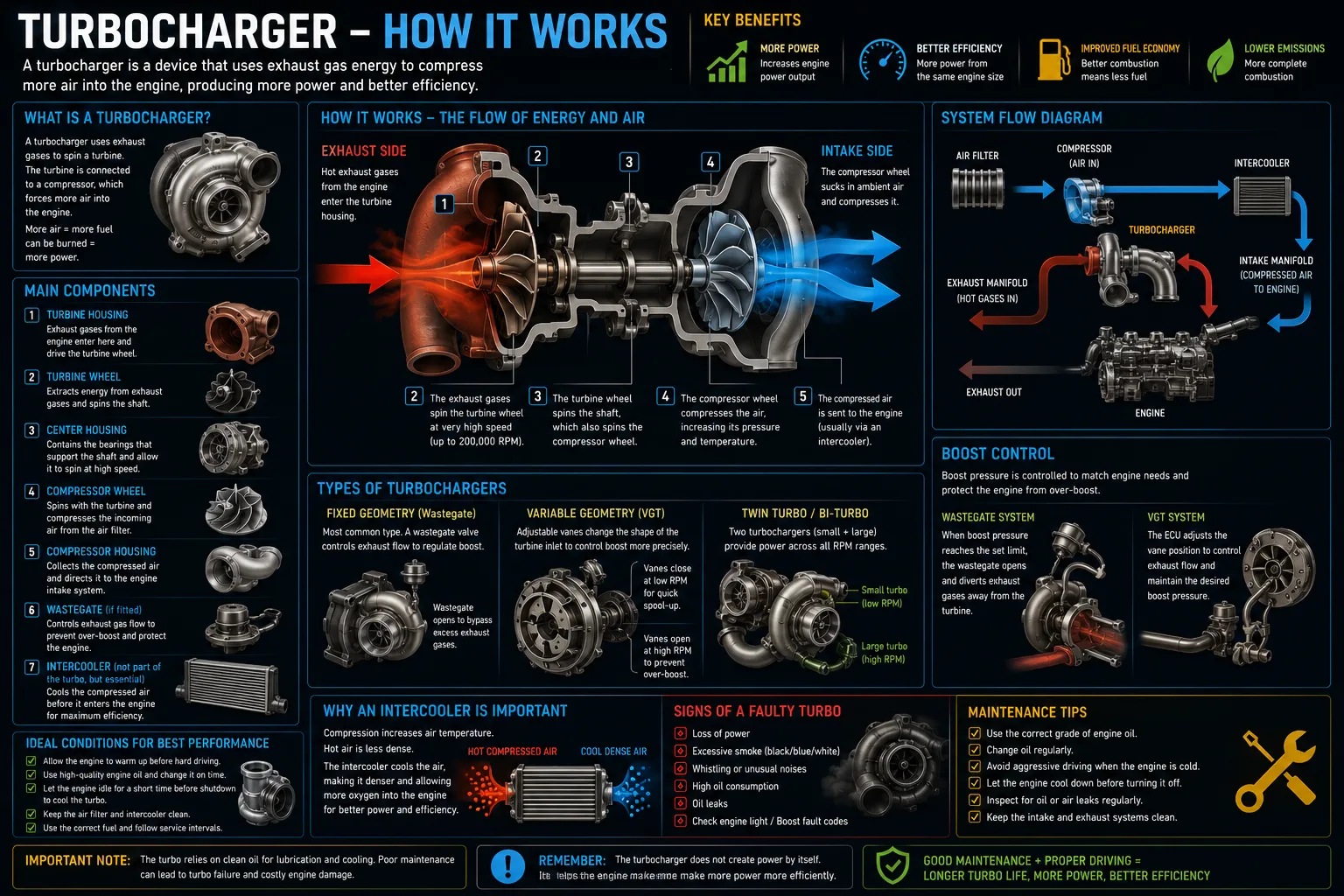
The turbocharger works by using the energy of your exhaust flow — gas that's leaving the engine anyway — to spin a turbine wheel. That turbine is connected by a shaft to a compressor wheel on the other side of the housing, which draws in fresh air and compresses it before it enters the engine. More air in means more fuel can be burned, which means more power from the same engine displacement. It's why a 1.5-litre turbocharged engine can outperform a naturally-aspirated 2.0-litre. The whole thing spins on a shaft supported by bearings, which are lubricated and cooled by your engine oil — and occasionally by a separate coolant circuit on more modern units. Variable-geometry turbos (common on diesels) add another layer: a ring of adjustable vanes that change the angle of exhaust flow hitting the turbine, giving better efficiency across a wider rev range. An actuator moves those vanes, and it's often the actuator or the vanes seizing up — rather than the core turbo itself — that causes problems. When we replace a turbocharger, we're also fixing the root cause of why it failed: usually oil starvation, oil contamination, or a blocked return pipe. Fit a new turbo without addressing that and you're just buying yourself a second failure, which is an expensive lesson in not skipping steps.
“It's ingenious, and for most of its life it works silently and invisibly, doing its job without so much as a thank-you.”
Sound familiar?
So what's behind it?
What we do — at your door
We come to you — driveway, car park, wherever the car has decided to become a problem — with a proper diagnostic setup, not a vague hunch and a quote for the most expensive thing in the engine bay. First we scan the ECU for boost pressure codes and read the live data to see what the turbo was actually delivering versus what it was supposed to. We physically inspect the turbo: check for shaft play, look for oil in the intake or exhaust, check the actuator movement on variable-geometry units, and inspect the oil feed and return pipes for blockages or damage. If the turbo genuinely needs replacing, we'll tell you clearly and quote you for the job — which includes sourcing the correct unit (OEM or quality aftermarket), cleaning out the oil feed line, fitting a new oil feed pipe and filter where recommended, and ensuring the engine oil is fresh before the new unit goes in. We do not fit a new turbo and reconnect a blocked return pipe; that is not a repair, that is a countdown timer. Once everything is back together, we run the turbo through its paces to confirm boost pressure is back where it should be and the smoke has packed its bags.
What affects the price
Turbocharger replacement varies considerably in cost depending on a handful of factors that genuinely matter. The turbo unit itself is the biggest variable: a replacement for a common 1.5-litre diesel hatchback sits in very different territory to a twin-scroll unit for a performance saloon or a compound turbo setup on a heavy diesel. OEM parts cost more than quality pattern parts; for most everyday cars a reputable aftermarket turbo is perfectly sound, but for higher-output or unusual applications we'll discuss options honestly. Labour time depends on accessibility — some turbos are almost courteous about being removed, others require dismantling half the intake system and the exhaust manifold to get at. Associated work matters too: the oil feed and return pipes should often be replaced at the same time, and an oil flush or oil change is not optional if the old turbo failed from contamination. Making the car right — rather than just fitting the part and hoping — takes more time and costs a little more. It is, however, considerably cheaper than doing it again in six months because the root cause was ignored. We quote transparently, by job, before we start anything.
Random knowledge you didn't ask for
Questions you're probably asking
Is it always the turbo itself, or could it be something else causing the lost boost?
Very often something else — a split intercooler hose, a failed boost pressure solenoid, a cracked intake pipe, or a sticking variable-vane actuator can all cause the same symptoms as a failed turbo core. We diagnose before we quote for anything; the last thing we want is to sell you a turbocharger when a thirty-quid boost hose would have sorted it. Diagnosis is the non-negotiable first step.
Can I drive with a failing turbo?
Briefly and gently, possibly — but the risk calculus is bad. A turbo that's leaking oil is pushing that oil into places it shouldn't be. A turbo producing metal fragments is circulating those fragments through your engine oil. The longer a failing turbo runs, the more likely it is to damage the engine itself, turning a turbo job into an engine rebuild conversation. If it's smoking or you've lost significant power, don't push it.
Should I get a new turbo or a reconditioned one?
For most everyday vehicles, a quality reconditioned turbo from a reputable rebuilder is a perfectly sound choice — they're built to original spec, balanced, and usually carry a warranty. For performance applications or where the unit is unusual, we'll discuss the options honestly. The quality of the supplier matters more than new-versus-recon; cheap no-name turbos from marketplace listings are a different proposition entirely.
Why do I need an oil change when fitting a new turbo?
Because if the old turbo failed from oil contamination or starvation, putting that same oil through a brand-new unit is a reliable way to kill the replacement. Fresh oil, a cleaned or replaced oil feed pipe, and — where the feed line may be partially blocked — an engine flush are standard practice. Skipping it is false economy; it's also what some garages do to keep the initial quote down, and it's not something we do.
How long does a turbocharger replacement take?
On a typical car, a straightforward turbo swap takes three to five hours on the vehicle. If the exhaust manifold needs to come off with it, or the car is particularly cramped around the turbo mounting, it can take longer. Some installations are genuinely unpleasant to work on — turbos buried deep in engine bays with heat shields, awkward manifolds, and connectors that do not want to cooperate. We'll give you a realistic time estimate when we quote.
Turbocharger Replacement — sorted at your door
Stop procrastinating. Get a transparent quote and we'll come to you.