The Boost Has Gone: split intercooler and boost pipe repair, sorted at your door
Your turbo spent years carefully compressing air and passing it neatly through the intercooler and down into the engine. Then a cheap rubber hose decided it had had enough, split along its seam, and everything that hard-working turbine built up is now venting quietly into your engine bay rather than making power. The result: a car that drives like a damp cloth, a dashboard warning light, and possibly the world's least exciting whistle every time you ask it to actually move. SOSCarFix comes to you — driveway, layby, or supermarket car park — finds the leak with a proper pressure test, and replaces the offending pipe or hose on the spot. No tow truck, no waiting room, no dealer telling you it's definitely something more expensive.
See our upfront pricingLosing power or stuck in limp mode? Split boost pipe or intercooler hose — we come to you, diagnose it and fix it. Get a fast quote from SOSCarFix.
How it actually works
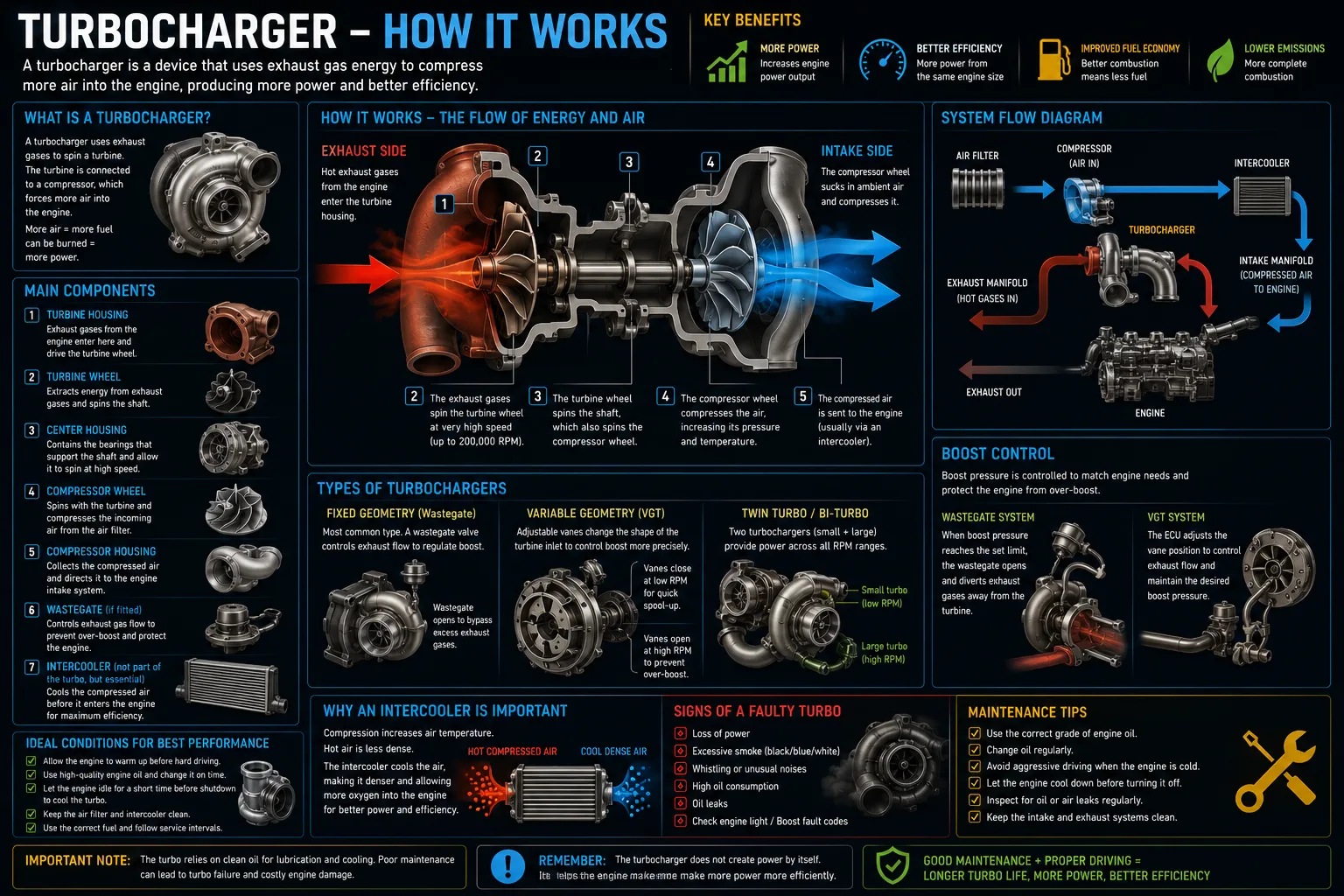
Your turbo compresses intake air — which gets hot under pressure — and sends it to the intercooler to cool back down before it enters the engine. Cooler, denser air means more oxygen, more fuel, more power. Clever. The intercooler sits at the front of the car (usually) and is connected to the turbo inlet and engine intake manifold by a series of rubber hoses, silicone pipes, or rigid metal pipes with rubber couplers — the collective term is the boost pipe circuit or charge pipe system. Under boost, this circuit is pressurised — typically between 0.8 and 2.0 bar depending on the engine and any tuning. The weak links are the rubber hoses and the clamped silicone couplers at each end of the hard pipes. Heat cycles, old age, and poorly tightened clips (thanks, previous owner) all cause the rubber to harden, crack, or simply pop off a spigot entirely. When a hose splits or pops, pressurised air escapes before reaching the engine. The turbo is working, but the engine sees less boost than the ECU expects. It either drops power noticeably, or the ECU compares requested boost against actual boost, decides something is wrong, and puts the car in limp mode as a precaution — limiting power to prevent damage. Boost-deviation fault codes (P0299 underboost being the classic) get logged at the same time. The fix is almost always straightforward: find the leak, replace the hose or pipe, and pressure-test to confirm the circuit holds.
“Your turbo spent years carefully compressing air and passing it neatly through the intercooler and down into the engine.”
Sound familiar?
So what's behind it?
What we do — at your door
We come to wherever the car is sitting. First step is a visual inspection of the entire boost pipe circuit — intercooler inlet hose, outlet hose, all couplers and clamps, and the intercooler itself if accessible. Oily residue is a tell. Then we do a proper pressure test: we block the circuit, pressurise it to the manufacturer's specified boost pressure using a dedicated smoke machine or pressure tester, and listen or look for the leak. This takes the guesswork out of it — you can waste half a morning replacing hoses on feel and miss the one crack that was actually causing the problem. Once the leak is found, we replace the faulty component on-site. Most boost hoses and couplers are standard stock items we carry or can source to your location within the hour for common platforms. If it's a cracked intercooler end-tank, we'll let you know — that's a bigger job but still doable mobile on most cars. After fitting, we pressure-test the circuit again, clear any stored fault codes, and do a road test (or instruct you to do one) to confirm boost is back where it belongs and limp mode doesn't return. No garage drop-off, no courtesy car faff, no waiting.
What affects the price
Cost depends on what's actually leaking and what the replacement part costs for your specific car. A standard rubber or silicone boost hose on a common diesel is inexpensive; a cracked intercooler on a hot hatch with a charge-cooled setup is a different conversation entirely. Labour for a single pipe replacement is straightforward and quick on most cars — some takes under thirty minutes once the leak is confirmed. Cars where the intercooler is buried behind the front bumper or requires significant strip-down take longer. Aftermarket silicone hose kits (where available for your car) often cost more than OEM rubber but last significantly longer and are worth considering. We'll quote on the diagnosed fault, not a speculative list of everything it might possibly be.
Random knowledge you didn't ask for
Questions you're probably asking
Will my car be safe to drive with a boost pipe leak?
Short distances at gentle throttle are unlikely to cause immediate damage — the engine won't be making full power but it won't self-destruct. What you want to avoid is extended high-load driving, because the ECU may compensate in ways that aren't great long-term, and if the car is in limp mode repeatedly it's telling you something. Get it diagnosed sooner rather than later; a boost hose is cheap, a damaged turbo from a fault left to fester is not.
Can I just tape or cable-tie a split boost pipe as a temporary fix?
You can, and people do. Self-amalgamating tape around a small split will sometimes hold long enough to get somewhere sensible. It won't hold under sustained boost pressure indefinitely, it won't pass any kind of inspection, and it will eventually let go — usually at the least convenient moment. Treat it as 'get me home tonight' not 'sorted'. The actual repair is straightforward enough that there's no good reason to drive on a bodge for weeks.
How do I know if it's a boost pipe leak or the turbo itself that's failing?
A failing turbo typically comes with its own calling cards: excessive blue or grey smoke under acceleration or on the overrun, oil consumption with no obvious external leak, a grinding or rattling noise from the turbo itself, and often shaft play you can feel if you remove the intake hose and waggle the impeller. A boost pipe leak is almost always just low boost and a limp mode, with no smoke and no unusual mechanical noise from the turbo housing. A proper pressure test and live boost data reading separates the two clearly — no guessing required.
Is it worth upgrading to silicone boost hoses while you're at it?
Often yes, especially on cars where the OEM rubber hoses are a known weak point (the VW 2.0 TDI's various inlet hoses being the textbook example). Silicone doesn't perish the same way rubber does, handles heat cycling better, and for many common platforms the aftermarket kit costs a reasonable premium over OEM rubber. It's not an enthusiast-only upgrade; it's just a longer-lasting material. We'll tell you if it's available and worth doing for your specific car.
What fault codes will a boost pipe leak cause?
P0299 (Turbocharger/Supercharger Underboost Condition) is the headline act — it means the ECU is seeing less boost than it expects. You may also see manufacturer-specific variants of this code depending on the car. On some platforms you'll see boost pressure sensor correlation codes too, because the sensor is reporting pressure that doesn't match the demand map. Clearing codes without fixing the underlying leak will just bring them back the moment you put the car under load.
The Boost Has Gone — sorted at your door
Stop procrastinating. Get a transparent quote and we'll come to you.