Turbo Actuator Repair: Because Limp Mode Isn't a Lifestyle Choice
Your turbocharger is the reason your 1.6-litre diesel hauls itself down the motorway with something approaching enthusiasm. It works by shoving compressed air into the engine — more air, more fuel burned, more power from a smaller package. The turbo actuator is the mechanism that controls exactly how much boost you get and when. When it goes wrong, the car does one of two things: it sulks into limp mode and delivers all the performance of a damp flannel, or it over-boosts and starts generating fault codes like a printer running low on ink. Either way, you're suddenly very aware of a component you'd never heard of last Tuesday. The good news is that turbo actuator faults — whether it's a sticking VNT mechanism, a gummed-up variable-geometry vane system, or a failing electronic actuator — are something we diagnose and fix at your door. No drag to a garage, no guessing, no unnecessary turbo replacement.
See our upfront pricingLimp mode, lost boost or over-boost? Your turbo actuator's having a moment. SOSCarFix diagnoses and fixes VNT & electronic actuator faults at your door. Get a quote.
How it actually works
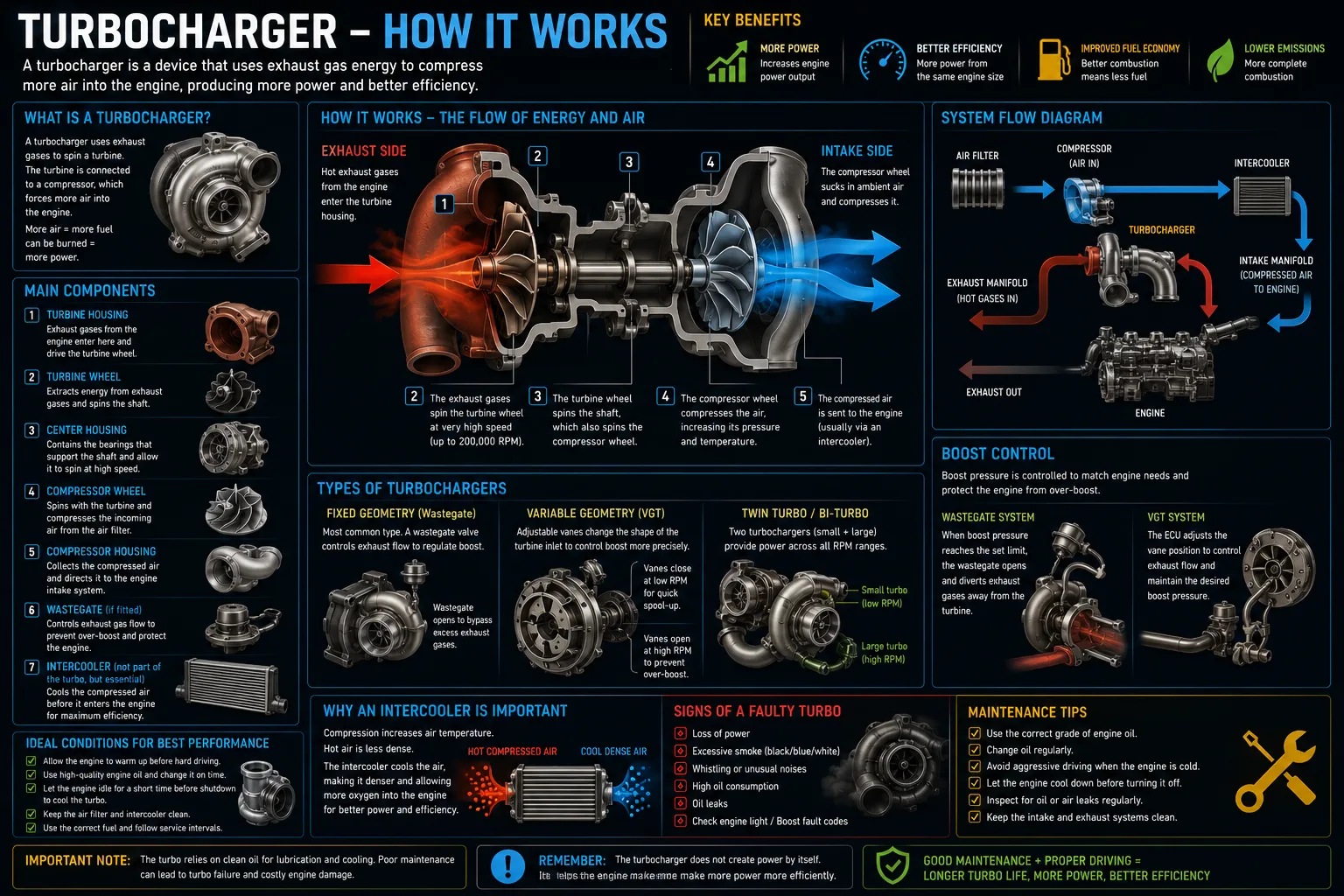
Most modern turbocharged diesels (and an increasing number of petrols) use a Variable Nozzle Turbine — VNT, also called variable-geometry turbo or VGT. Instead of a fixed turbine housing, a ring of adjustable vanes surrounds the turbine wheel. At low revs the vanes close, channelling exhaust gas through a narrow passage to spin the turbine quickly and deliver boost early — killing the lag that used to make small turbodiesels feel asthmatic off the line. At higher revs the vanes open wider to control boost pressure and prevent over-boost. The actuator is the mechanism that moves those vanes. On older turbos it was a simple pneumatic unit — a vacuum-operated canister. On newer cars it's an electronic stepper-motor actuator (often called an electronic or e-actuator), controlled directly by the ECU and able to position the vanes with millimetre precision. The ECU monitors boost pressure via a MAP sensor and continuously adjusts the actuator to hit the target boost curve. When the actuator can't reach the commanded position — because it's seized, worn, carbon-fouled or its motor has failed — the ECU sees the discrepancy and throws a boost-pressure fault code, usually shoving the car into reduced-power mode to protect the engine. Diagnosing the fault properly means reading live data: target boost vs actual boost, and ideally looking at actuator position feedback, not just reading a code number and ordering parts.
“It works by shoving compressed air into the engine — more air, more fuel burned, more power from a smaller package.”
Sound familiar?
So what's behind it?
What we do — at your door
We start with live data, not assumptions. Using proper diagnostic equipment we pull the fault codes across all modules, then watch actual vs target boost pressure and — where the car supports it — actuator position feedback in real time. That tells us immediately whether we're dealing with a boost leak, a carbon-fouled vane mechanism or a genuinely dead actuator, rather than swapping parts and hoping. If the vanes are sticking from carbon, we can often clean and free the mechanism without pulling the turbo — applying specialist VNT cleaner through the intake or working the vane ring manually while the engine is cold, then confirming the actuator can hit its range of motion and recalibrating it to the ECU's expected position range. If the electronic actuator has failed — motor or sensor — we replace it, then carry out the mandatory calibration procedure so the ECU knows where 'fully open' and 'fully closed' actually sit with the new unit. We also check for the underlying causes: are the oil change intervals contributing to that carbon build-up, and is there an oil leak at the turbo seals that'll kill the new actuator the same way? All of this happens in your driveway, car park or wherever you've managed to limp it to — no recovery truck needed.
What affects the price
Turbo actuator work varies enormously in cost depending on what's actually wrong, which is exactly why diagnosis before quoting matters. On one end of the scale, a pneumatic actuator vacuum pipe on an older diesel is cheap and quick. VNT vane cleaning — where the mechanism is carbon-fouled but the actuator itself is fine — sits in the middle: labour-intensive but avoids the cost of a new actuator. Electronic actuator replacement is the bigger job: the part itself ranges from modest to eye-watering depending on the turbo manufacturer (Garrett, BorgWarner, Mitsubishi and IHI all command different prices), and some vehicles require the new actuator to be configured via a live server connection, adding time. For a complete turbo replacement — which is rarely necessary if the actuator and vanes are the only problem — costs jump significantly. We'll always tell you what we found, what it actually needs, and what the alternative options are before any work starts.
Random knowledge you didn't ask for
Questions you're probably asking
Can I just clean the VNT vanes instead of replacing the actuator?
Sometimes, yes — and it's always the first thing we check. If the actuator motor and position sensor are healthy and the vanes are just carbon-fouled and sticking, a proper clean and free-up of the vane mechanism can restore full function at a fraction of the cost of a new actuator. It depends on live data: if the actuator is commanding the right position but the vanes aren't reaching it, cleaning is the logical first step. If the actuator itself is faulty, cleaning won't help.
My car goes into limp mode but only when warm or under hard acceleration — is that a turbo actuator fault?
Quite possibly. Carbon-fouled vanes often stick more as heat soaks into the turbo, and the fault becomes apparent under the kind of load that demands maximum vane movement. Intermittent boost faults that follow a warm-up pattern or appear under hard throttle rather than light cruise are a classic VNT symptom. That said, boost leaks behave similarly — a split intercooler hose opens up under full boost pressure — so live data under load is the only way to tell them apart properly.
My fault code says P0299 under-boost — does that mean the turbo needs replacing?
Rarely. P0299 means the ECU can't hit its target boost pressure — but the turbo itself is usually fine. The most common culprits are a sticking actuator or vane mechanism, a boost leak (split pipe, failed clip), or a faulty MAP sensor giving the ECU false readings. Replacing the turbo on a P0299 code without proper diagnosis is how workshops charge four-figure bills for problems that needed a £30 hose clip and a clean.
Do I need a calibration after fitting a new electronic turbo actuator?
Yes, and this is non-negotiable. The new actuator doesn't know where 'fully open' or 'fully closed' sits relative to your specific turbo's vane travel. The calibration procedure — done via the diagnostic port using software that communicates with the ECU — sets those limits. Skip it and the ECU will either throw a fault immediately or run the vanes against their mechanical stops, which damages the new actuator fairly quickly.
How long does a turbo actuator job take if you come to me?
Diagnosis and a VNT clean is typically a couple of hours. Electronic actuator replacement, including the calibration procedure, is in the same ballpark, depending on access on your specific car — some are awkwardly placed. We'll give you a realistic time estimate when we quote, so you're not watching us crouch over your engine bay wondering when you'll get your driveway back.
P0234 turbo overboost code — what causes it?
P0234 means the ECU has seen boost pressure exceed its upper limit — your turbo is delivering more than it's supposed to. The most common real-world culprits are a VNT actuator that's stuck in a closed or partially closed vane position (often from carbon fouling), an actuator that's lost its calibration so the vanes never open fully under load, or a boost-pressure sensor giving false readings. It's not usually the turbo itself failing — it's the control side. Worth getting the live boost data read properly before anything gets replaced.
Turbo Actuator Repair — sorted at your door
Stop procrastinating. Get a transparent quote and we'll come to you.