Your Infotainment Screen Has Given Up: Blank, Frozen, or Rebooting Itself Into Oblivion
Your infotainment screen — the big glossy slab that controls the stereo, sat-nav, reversing camera, climate, and approximately forty-seven other things you now can't do without — has decided to stop participating. Maybe it's gone completely black. Maybe it's stuck on a loading screen like a Windows Vista laptop in 2009. Maybe it reboots itself every time you go over a speed bump, which in this country means every thirty seconds. Whatever it's doing, it's annoying, and if the reversing camera has gone with it, it's also a genuine hazard. SOSCarFix comes to you — car on your drive, at work, or wherever the thing packed in — diagnoses whether it's a software fault, a power issue or a wiring problem, and tells you what it'll actually take to fix it. No dealer waiting lists. No being told to "try turning it off and on again" by someone who'll charge you £120 to do exactly that.
See our upfront pricingBlank screen, frozen menus, no reversing camera? We diagnose infotainment faults at your door — software glitch to wiring fault. Get a quote.
How it actually works
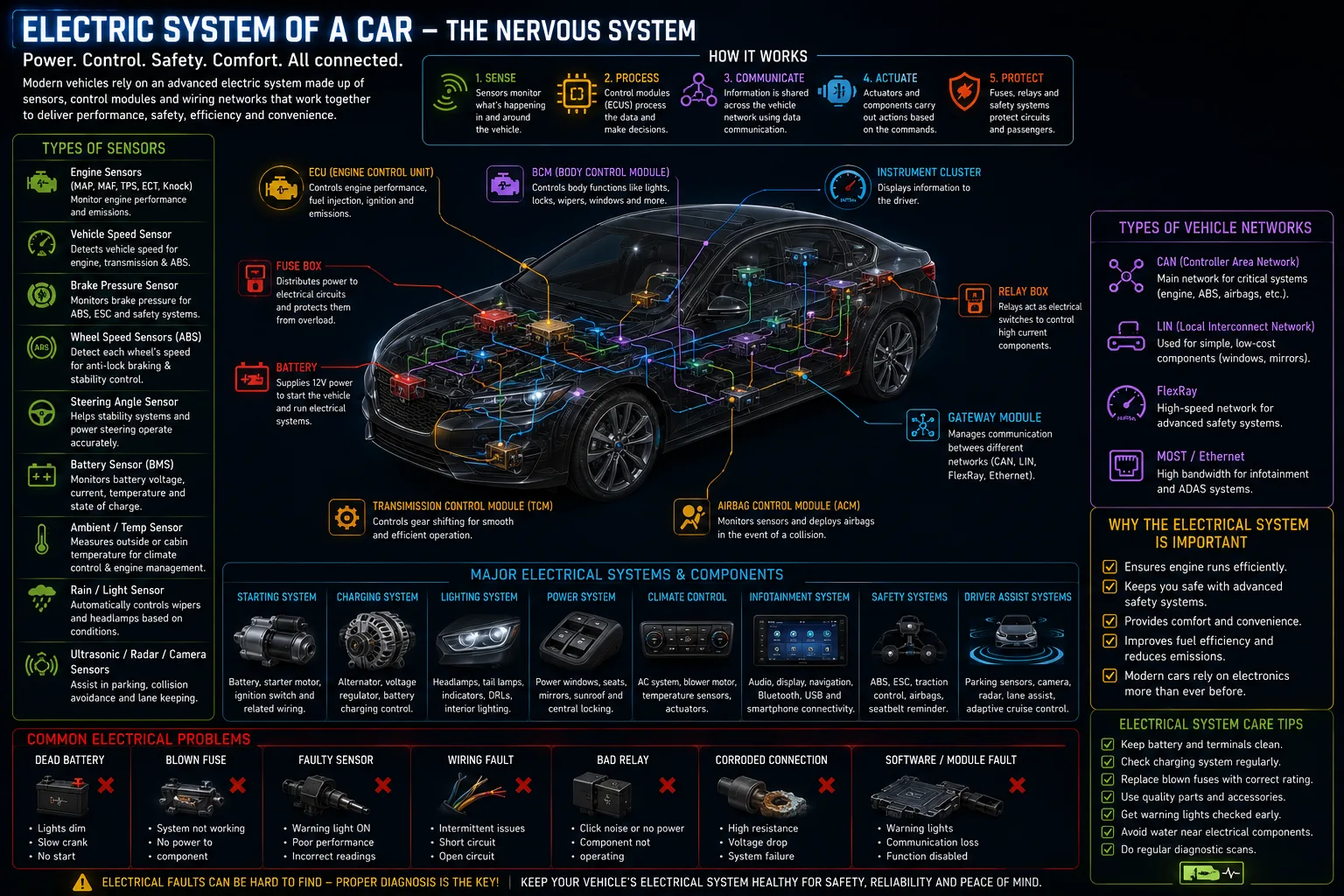
Modern infotainment head units are essentially Android or Linux tablets bolted into your dashboard — they run a full operating system, pull power from the car's 12V supply via dedicated fuses and relays, communicate with the rest of the car over the CAN bus, and receive input from cameras, microphones, USB ports and aerial connections. The screen itself is typically an LCD with a capacitive touch layer on top; the processing happens in a separate unit behind the dash. When they go wrong, the fault usually falls into one of two camps. First, software: the firmware crashes, hangs or corrupts — common after a failed over-the-air update, a flat battery mid-boot, or just accumulated bugs across thousands of drive cycles. Second, hardware or power: a blown fuse, a failing voltage regulator on the unit's internal board, a corroded CAN bus connection, or a damaged wiring harness (particularly on older cars where the dash wiring has flexed for years). The reversing camera is usually a separate module feeding a video signal to the head unit — when the screen dies, the camera feed goes with it, but it doesn't always mean the camera itself is broken. Diagnosis tells you which side of that equation the fault actually lives on, so you're not replacing a head unit when all you needed was a fuse.
“Maybe it reboots itself every time you go over a speed bump, which in this country means every thirty seconds.”
Sound familiar?
So what's behind it?
What we do — at your door
We come to you — driveway, office car park, or wherever it died — and approach it the way any sensible electrical diagnosis should go: methodically, starting with the boring but important stuff before assuming anything expensive is broken. First we check the basics that are easy to miss: infotainment-specific fuses (most cars have several, sometimes hidden in secondary fuse boxes), voltage supply at the unit, and whether a software reset (a hard power cycle with the correct procedure for that make) brings it back. A surprising number of frozen or blank screens recover from a proper reset that the owner didn't know how to do. If it's not that simple, we connect a scan tool to check for CAN bus fault codes related to the infotainment module, and use a multimeter to verify the power and earth supply at the head unit connector. For camera faults specifically, we test the video signal independently to isolate whether the issue is the camera, the cable or the head unit itself. We give you a clear explanation of what we found and a quote for the repair — whether that's a software reflash, a wiring repair, a fuse fix or, if the unit itself has genuinely failed, an honest assessment of whether repair or replacement (OEM or quality aftermarket) makes more financial sense. No guesswork, no parts-swapping on your bill.
What affects the price
Cost depends entirely on what the diagnosis finds — which is why we diagnose before quoting rather than throwing a head unit price at you. A blown fuse costs almost nothing. A wiring repair or connector clean is modest. A software reflash using manufacturer tools is a fixed-fee job. A failed head unit is where the numbers vary most: dealer OEM replacements can run to several hundred pounds or more on premium cars, but quality remanufactured units or compatible aftermarket options often solve the problem for considerably less. Reversing camera cable or module replacement is generally a mid-range repair. We tell you the options and let you decide — no pressure, no unnecessary work.
Random knowledge you didn't ask for
Questions you're probably asking
Can a software reset fix a blank or frozen infotainment screen without replacing anything?
Yes — and it's the first thing we check. Most head units have a hard reset procedure (often holding specific buttons for 10–15 seconds, or a pinhole reset behind the screen) that forces a clean reboot of the operating system. On frozen or crash-looping units this fixes the problem without touching any hardware. The procedure varies by make and model, which is why randomly button-mashing rarely works.
My reversing camera has stopped working — does that mean the head unit is broken?
Not necessarily. The reversing camera is usually a separate module connected via a dedicated video cable, with its own power supply triggered by reverse gear. If the head unit otherwise works, the fault is almost certainly in the camera, cable or its connector rather than the screen itself. We test the camera signal independently so you're not paying to replace the head unit when a £30 cable repair would do it.
The screen works but there's no sound — is that the head unit or something else?
Audio and display are handled differently inside the unit, so one failing while the other works is a genuine fault pattern. The amplifier stage on the head unit's board can fail independently of the display, or the fault might be a blown audio fuse, a disconnected speaker wire, or a muted or misconfigured system setting after a software reset. We work through the chain to find where it's actually broken.
My car is out of warranty — is it worth repairing the infotainment or just replacing it?
Depends on the fault and the car. A software fix or wiring repair is almost always worth doing. If the head unit itself has failed on an older or mid-range car, a quality remanufactured OEM unit or a compatible aftermarket replacement can be far cheaper than a main dealer price and still keeps everything working as it should. We give you the options honestly — we're not here to sell you the most expensive route.
Will you need to take my dashboard apart?
To physically access the head unit, yes — but on most cars the fascia and head unit can be removed and refitted without damage using the correct trim tools. It's a routine part of the job. We carry the appropriate tools for the make, and we're not the type to use a flat-head screwdriver and optimism on your dashboard trim.
Your Infotainment Screen Has Given Up — sorted at your door
Stop procrastinating. Get a transparent quote and we'll come to you.