12V Socket & USB Ports Not Working: The Dignified Death of Your Car's Power Outlet
The 12V cigarette lighter socket is one of the longest-surviving relics in automotive history. It was literally designed so people could light cigarettes in moving vehicles — a habit we've mostly abandoned — and yet here it is in 2026, still faithfully powering your phone charger, your dashcam, your tyre inflator, and approximately seventeen other things you have permanently plugged in. When it stops working, it takes all of those with it simultaneously, which is how you discover your car's USB ports weren't actually charging anything either — they were just providing the comforting illusion of power. SOSCarFix comes to you — driveway, office car park, or the layby where your dashcam conspicuously stopped recording — diagnoses which part of this elegantly simple circuit has given up, and fixes it before you resort to plugging your phone into your laptop, which is plugged into nothing, which is the problem.
See our upfront pricing12V cigarette lighter or USB ports dead? Blown fuse, corroded socket, or a rogue coin doing nothing useful. We come to you and sort it. Get a quote.
How it actually works
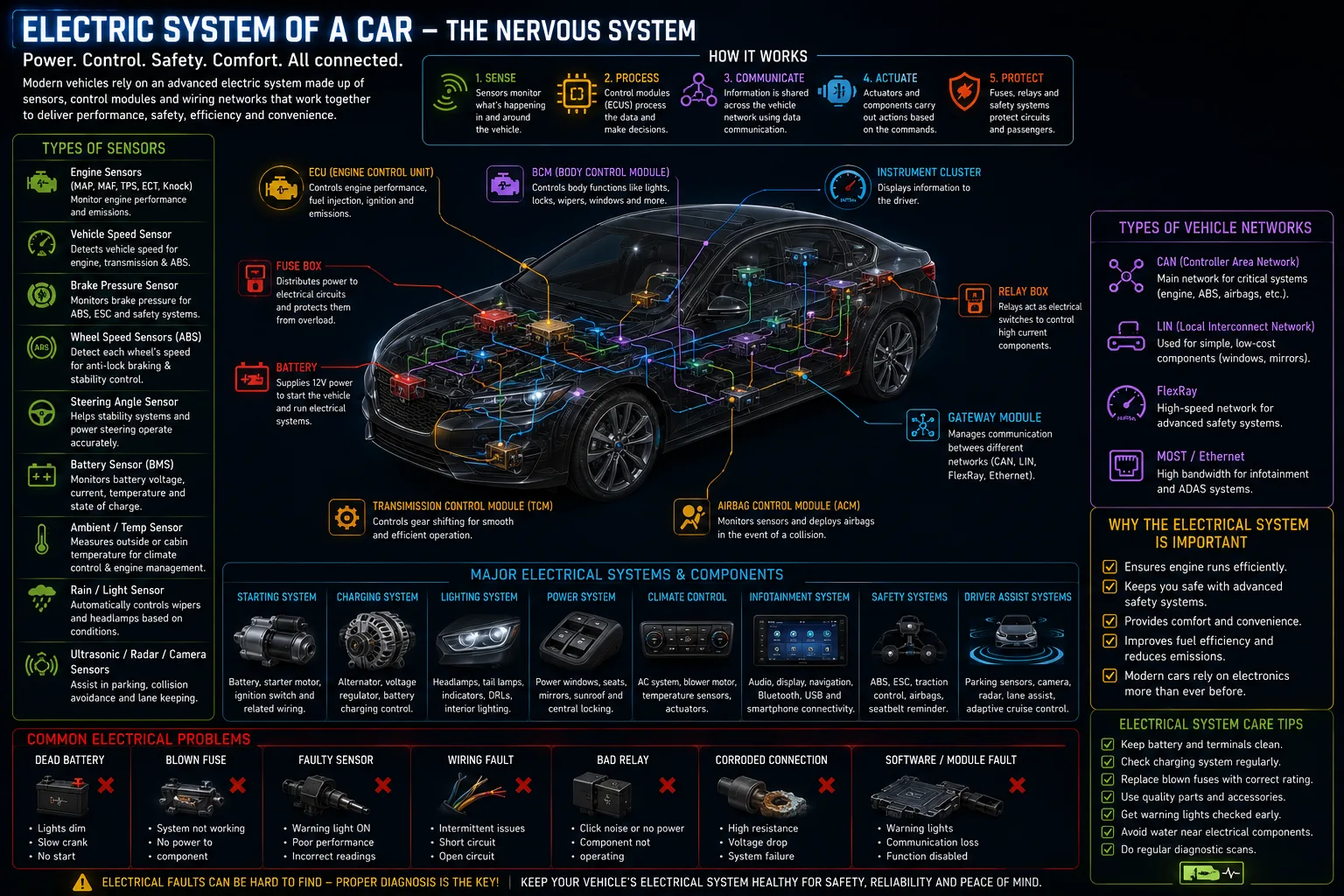
The 12V socket circuit is one of the simpler electrical systems on your car, which makes it all the more embarrassing when nobody can work out why it's dead. Here's how it actually functions: a constant or ignition-switched live feed (depending on make and model) runs from the fuse box, through a dedicated fuse — typically 15A or 20A — to the socket itself. The socket has a centre positive terminal at the back and an earth return via its outer casing, which connects to the car's body earth. That's it. One live, one earth, one fuse. USB ports fitted by the manufacturer work on the same principle but sit behind their own voltage regulator to step the 12V down to the 5V (or 9V/12V for fast-charge protocols) your device expects. Some vehicles have USB ports on the same fused circuit as the 12V socket; others have their own separate fuse; on newer cars, USB hubs are controlled by the infotainment or body control module. When the circuit fails, it's usually one of three things: the fuse has blown (the socket is protected specifically because people routinely plug in undersized tyre inflators that draw too much current), the socket itself has corroded contacts or accumulated debris — particularly at the centre pin, which is spring-loaded and prone to losing contact — or there's a wiring fault further upstream, which is rarer but does happen on older vehicles where the loom has chafed against metalwork. A fourth, deeply undignified cause is that something has been jammed into the socket that shouldn't be there: a coin, a pen lid, a child's creative experiment with a 2p piece. We see this more than we'd like to admit.
“The 12V cigarette lighter socket is one of the longest-surviving relics in automotive history.”
Sound familiar?
So what's behind it?
What we do — at your door
We come to you — wherever the car is parked — with a multimeter, a circuit tester, and a working knowledge of fuse box layouts across most common UK makes and models. We start by locating the correct fuse for your 12V socket circuit, which sounds simple until you realise some manufacturers split the cigarette lighter and USB ports across two different fuses in two different fuse boxes, neither of which is labelled particularly clearly. We test for power at the fuse, at the socket feed wire, and at the socket terminal itself, which tells us immediately whether this is a fuse issue, a wiring issue, or a socket fault. If there's debris jammed in the socket, we extract it without damaging the terminal. If the fuse keeps blowing, we check the socket and wiring for a short before simply fitting a replacement — because a fuse that keeps blowing is telling you something, and that something isn't "use a bigger fuse." For vehicles where the USB ports are module-controlled, we run a diagnostic scan to check whether the issue is electrical or a software/module fault. We carry replacement sockets, fuses, and connectors, so the majority of these jobs are sorted on the same visit. No garage drop-off required — this is, after all, not a complicated job when you know what you're looking at.
What affects the price
The cost of this repair varies considerably depending on the root cause, which is exactly why we diagnose before quoting. Replacing a blown fuse — if that's genuinely all it is — is a minimal job; the fuse itself costs pence, and labour is a short call-out. Replacing the socket unit sits at the lower end of auto electrical work: it's a simple component, not an expensive one, and access is usually straightforward unless the trim around it is particularly determined. Where costs increase is when the fault involves wiring damage — tracing a chafed cable or failed connector block takes time even when the symptom is simple. Vehicles where USB ports are controlled by an infotainment or body control module can be more involved if a module itself is at fault rather than just a fuse or wiring issue. There are no invented price promises here: what we can tell you is that "12V socket not working" is firmly in the category of sensible, proportionate repairs — not the kind of job that should lead to a long and philosophical conversation about whether to fix it or part-exchange the car.
Random knowledge you didn't ask for
Questions you're probably asking
Why did my 12V socket just stop working with no warning?
Almost always a blown fuse. The socket circuit is fused specifically because plugging in high-draw devices — tyre inflators, portable vacuums, certain fast-charge adaptors — can briefly exceed the circuit's rated current. The fuse does its job and sacrifices itself quietly. The fix is straightforward, but it's worth checking why it blew rather than simply swapping the fuse and hoping for the best, particularly if it happens repeatedly.
I replaced the fuse and it blew again immediately — what's going on?
Something is causing a short circuit or overload on that circuit. Common culprits include a damaged socket with a shorted contact, debris inside the socket causing an intermittent short, or a device that's drawing more current than the fuse rating allows. Don't keep replacing fuses with the same or higher-rated ones — that's the electrical equivalent of ignoring a fire alarm by removing the battery. Get it properly diagnosed.
My USB ports are dead but the 12V socket works fine — or vice versa. Why?
Because they're often on separate circuits with separate fuses. On many modern vehicles the USB ports are also on a separate sub-circuit that may run through the infotainment system or a dedicated USB hub module, completely independent of the legacy 12V socket. A dead 12V socket with working USB ports (or the reverse) is quite common and simply means the fault is in one specific circuit, not a general power failure.
There's something stuck in my 12V socket — can I get it out myself?
Possibly, but proceed carefully. The socket has a live centre terminal, so anything metallic that contacts both the centre pin and the outer casing simultaneously will short the circuit and blow your fuse — or worse. Turn the ignition off first. Use a wooden or plastic implement rather than metal. If it's a coin or metal object that's wedged firmly, stop and let someone with proper tools remove it safely rather than turning a simple extraction into a wiring fault.
My car is new-ish and has no cigarette lighter socket at all — just USB-C ports that have stopped working. Is that the same kind of fault?
Broadly yes in terms of diagnosis approach, but the hardware is different. Modern USB-C vehicle ports often sit behind a dedicated control module and may need a software reset or a scan tool to check for logged faults before concluding there's a hardware failure. A simple fuse may still be involved, but on newer vehicles it's worth running a diagnostic check before assuming it's purely electrical — some ports go to sleep in a fault state and need a module reset rather than a new socket.
12V Socket & USB Ports Not Working — sorted at your door
Stop procrastinating. Get a transparent quote and we'll come to you.