Starter Motor Replacement — Because "Click Click Nothing" Is Not a Valid Engine Note
Picture the scene. You're already running late. You get in, turn the key, and... click. Maybe two clicks. Maybe a sad little whirring noise that sounds like a hamster giving up. Then silence. Absolute, mocking silence. That, my friend, is the sound of your starter motor — the big bruiser whose entire job is to physically heave your engine into life — either throwing in the towel or quietly decomposing. It doesn't start gradually. It doesn't negotiate. One day it bounces the engine onto the dance floor, the next day it's lying face-down in the car park. SOSCarFix will come to wherever that car park happens to be and sort it out.
See our upfront pricingClick. Click. Nothing. The starter motor bouncer has gone on strike. SOSCarFix replaces starter motors at your door across the UK — no garage, no faff, no tow truck.
How it actually works
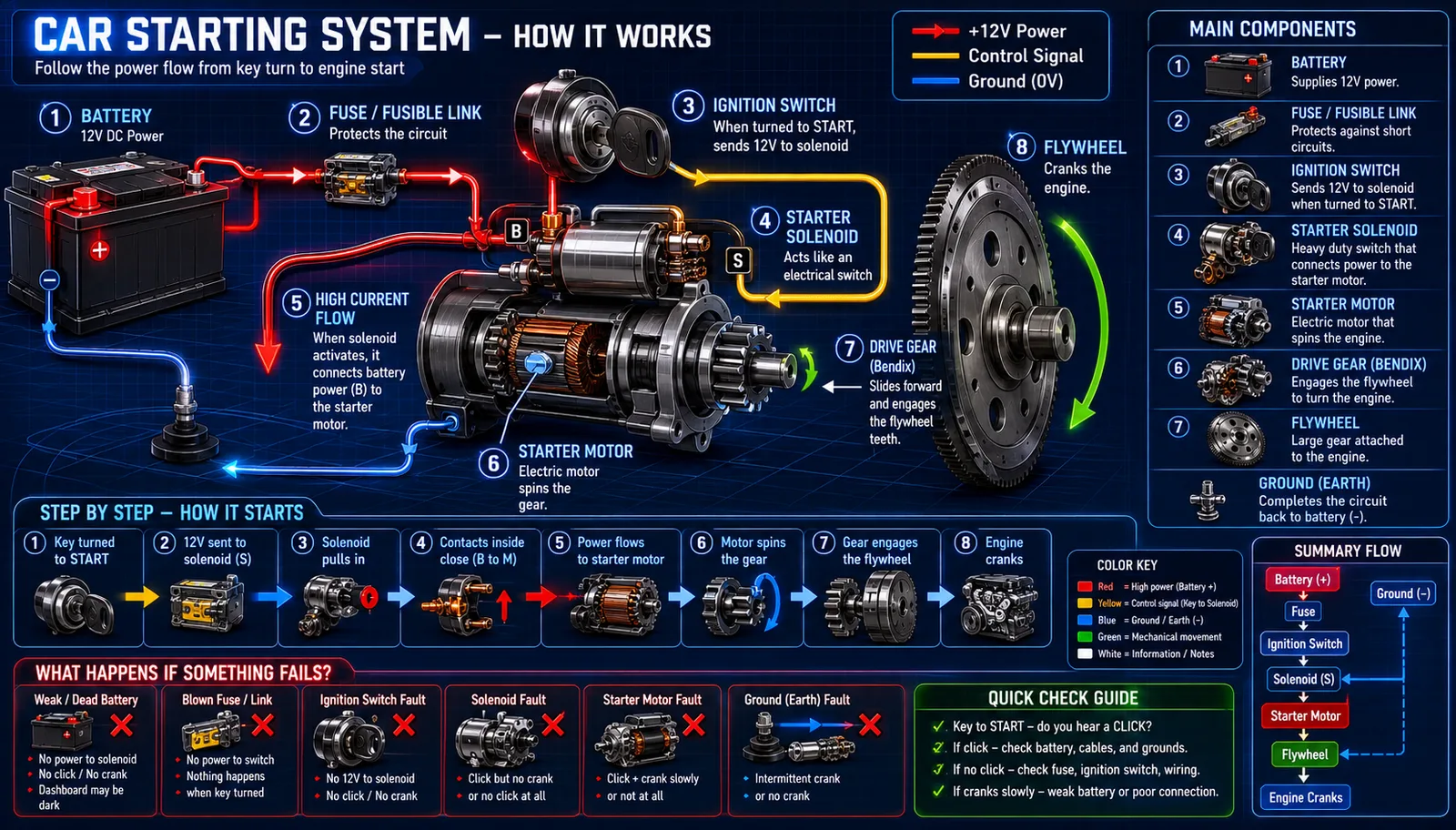
The starter motor is essentially the world's most overqualified doorman. Every single time you turn that key or jab the start button, it has a fraction of a second to do a very violent and precise job. Here's the full routine: the ignition signal fires the solenoid — a magnetic switch — which shoves a small gear called the pinion forward so it meshes with the teeth on your flywheel, the big spinning disc bolted to the back of the engine. The electric motor inside the starter then spins that pinion at speed. Because the starter pinion is tiny (around 9–10 teeth) and the flywheel is enormous (typically 120+ teeth), you get a gear ratio of roughly 12:1 — meaning the starter has to spin twelve times to turn the engine once. All that torque, all that grunt, delivered in the time it takes you to think "right, let's go." The moment the engine fires and catches, the pinion retracts automatically — because if it stayed in contact with a running engine, it'd be destroyed in milliseconds. When the starter motor wears out, the whole chain breaks down: weak motor, sticky solenoid, worn pinion, or a combination of all three. End result: click, whirr, or magnificent nothing.
“One day it bounces the engine onto the dance floor, the next day it's lying face-down in the car park.”
Sound familiar?
So what's behind it?
What we do — at your door
A mobile starter motor replacement with SOSCarFix means we come to you — driveway, car park, office, the layby where you've been sitting for an hour wondering what that click was — armed with the right part and the tools to fit it. We'll diagnose first: not every click-and-nothing is a dead starter. We'll check the battery, the connections, and the solenoid before condemning the motor, because there's no dignity in replacing a perfectly good starter motor only to find a corroded earth strap was the villain all along. Once we've confirmed the starter is the culprit, we'll fit a quality replacement unit, reconnect everything properly, and make sure the car fires up cleanly before we pack up and leave. On most vehicles this is a one-to-two hour job at the roadside. On some models where the starter is buried deep in the engine bay — tucked behind the manifold or accessible only from below — it takes longer, and we'll tell you that upfront. No drama, no garage, no waiting around. Just a working car where there wasn't one before.
What affects the price
Several things affect what your starter motor replacement will cost, and we'll always give you a proper quote before touching anything. The big one is location — not yours, the starter's. Some starters sit right on top of the engine, cheerfully accessible in under an hour. Others are buried under the intake manifold, sandwiched between other components, or only reachable from below with half the engine bay stripped. More access time means more labour. Then there's the part itself: the cost of a starter motor varies significantly by make, model, and whether you're driving a sensible hatchback or something Germanic and complicated. OEM parts cost more than quality aftermarket alternatives — we'll advise on the best option for your car. And if the flywheel ring gear has taken a battering from a grinding starter that was ignored too long, that's additional work. Sort it when the symptoms first appear and you'll almost certainly spend less than if you leave it until the pinion has chewed its way through the flywheel teeth.
Random knowledge you didn't ask for
Questions you're probably asking
Can I drive with a failing starter motor?
Technically, once the engine is running, the starter motor isn't involved — so if you can get it started, you can drive it. The real problem is that a failing starter will eventually strand you somewhere inconvenient. Intermittent faults have a habit of becoming permanent faults at the worst possible moment. Get it looked at while you still have the luxury of choosing when.
Could it be the battery and not the starter?
Absolutely yes — and we'll check both before jumping to conclusions. A flat or failing battery produces almost identical symptoms: clicking, slow cranking, or complete silence. The key difference is that a battery issue usually comes with warning (dimming lights, sluggish starts over several days), whereas a starter motor tends to fail more abruptly. Either way, we'll test rather than guess.
How long does a starter motor replacement take at the roadside?
On most common UK cars — your Fords, Vauxhalls, Volkswagens, typical family motors — it's a one-to-two hour job. Some vehicles are straightforward; others require dropping the car onto axle stands and working from below, or removing surrounding components to access the starter. We'll tell you what's involved for your specific vehicle when you book.
My car has stop-start technology. Does that affect the starter?
Yes — cars with stop-start systems use a reinforced, higher-cycle starter motor (or sometimes a combined starter-generator) because the standard unit simply wouldn't survive being operated dozens of times per journey. If your stop-start vehicle needs a starter replacement, it's important to fit the correct specification part rather than a standard motor. We know the difference and we'll fit the right one.
Starter Motor Replacement — sorted at your door
Stop procrastinating. Get a transparent quote and we'll come to you.