Alternator Replacement: Stop Blaming the Battery, It's Innocent
Somewhere in the UK right now, someone is standing in a Halfords car park fitting their third battery in two years, absolutely baffled as to why the car keeps dying. Here's the thing — it was never the battery. The battery is a storage device. It holds charge. It does not create charge. That is the alternator's job, and when the alternator quietly clocks off, the battery runs down like a phone with someone streaming Netflix on it. The battery gets blamed. The battery gets replaced. The alternator carries on failing, completely undetected, living its best life at your expense. We've seen this film many times. SOSCarFix are mobile mechanics — we come to you, wherever you are — and we are fluent in the dark art of telling these two apart.
See our upfront pricingYour battery keeps dying and you keep blaming it — but the alternator is the real villain. SOSCarFix replaces alternators at your home or work across the UK. No garage, no nonsense.
How it actually works
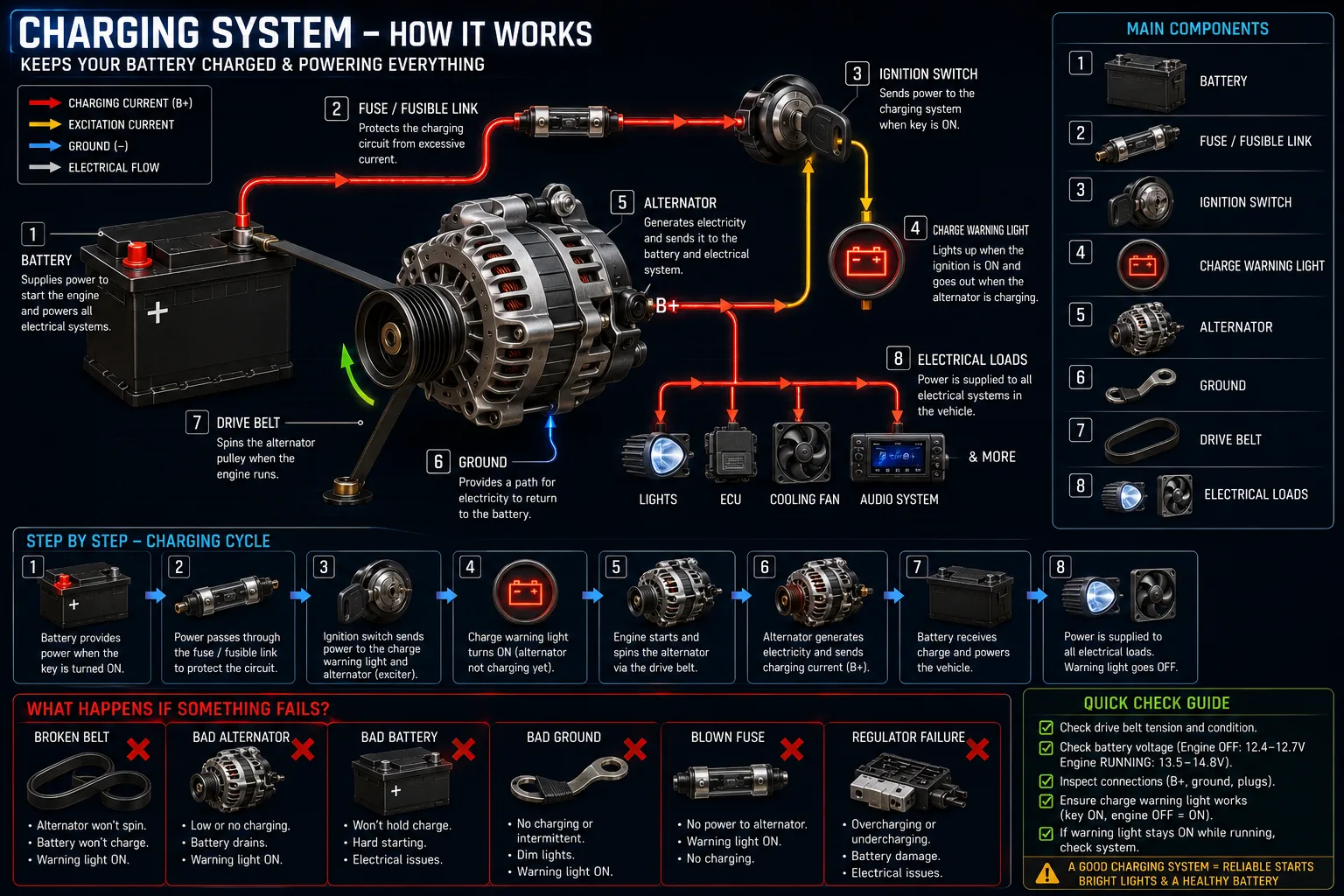
The alternator is belt-driven off the engine — while your engine runs, it spins a rotor inside a set of copper windings, generating AC electricity that a built-in rectifier converts to DC. That DC current does two things simultaneously: it powers everything electrical in your car right now (lights, climate control, infotainment, the lot), AND it tops up the battery for next time you want to start it. Think of the battery as your car's savings account and the alternator as its income. No income, and no matter how healthy the savings account was when you started, it'll be empty soon enough. A healthy alternator holds the system at roughly 13.8 to 14.4 volts with the engine running — the sweet spot where everything is fed and the battery stays happy. Drop below that and you are quietly draining the battery every mile you drive. Our mobile mechanics carry proper diagnostic equipment to test charging voltage on your driveway, right there, no guesswork, no "let's just try a new battery and see".
“SOSCarFix are mobile mechanics — we come to you, wherever you are — and we are fluent in the dark art of telling these two apart.”
Sound familiar?
So what's behind it?
What we do — at your door
We come to you — driveway, car park, roadside, workplace — with the diagnostic equipment needed to actually tell the alternator and battery apart before anyone buys anything. We test charging voltage with the engine running, check output under load, inspect the belt and belt tensioner, and look for any contamination or physical damage that would kill the new unit prematurely. If the alternator is the problem, we replace it with a quality unit and road-test the charging system before we leave. We do not throw parts at problems. We do not replace batteries that do not need replacing. We are a mobile mechanic service, which means no garage overheads and no upselling service you did not ask for — just a qualified mechanic, your car, and the correct diagnosis.
What affects the price
Alternator replacement cost varies quite a bit depending on a handful of honest factors: the make and model of your vehicle (a small hatchback and a prestige German saloon live in different pricing universes), whether a remanufactured or brand-new unit is the right call for the car's age and mileage, the accessibility of the alternator itself (some are a thirty-minute job; on others an entire front end needs removing — the engineers responsible for the latter know who they are), and whether there are any associated repairs needed such as the drive belt, belt tensioner, or fixing whatever contamination caused the failure in the first place. We give bespoke quotes because a blanket price for alternator replacement would be meaningless — and honestly, anyone quoting you a firm figure without knowing your vehicle probably deserves a raised eyebrow.
Random knowledge you didn't ask for
Questions you're probably asking
How do I know if it's the alternator or the battery that's actually failed?
This is the question that saves people from buying a second unnecessary battery. With the engine running, a healthy alternator keeps system voltage between roughly 13.8 and 14.4 volts. Below that, it is not charging properly. A battery test alone — even a passed one — cannot tell you the alternator is fine. Our mobile mechanics test both, correctly, before recommending anything.
Can I drive with a failing alternator?
Briefly, and we would not recommend it as a lifestyle choice. A car with a failing alternator is running entirely on whatever is left in the battery. That gives you somewhere between a few minutes and an hour depending on what is switched on and how depleted the battery already is. Turn off everything non-essential, do not stop the engine if you can avoid it, and get it looked at immediately. Stranding yourself somewhere is the polite version of what can happen.
My car jump-started fine — doesn't that mean the battery is the problem?
No, and this is the single most common misdiagnosis in the book. Jump-starting puts enough charge in the battery to start the engine. If the alternator is then failing to recharge it, the car will run for a while and die again. A successful jump start tells you precisely nothing about whether the alternator is doing its job. It just means the battery accepted a charge, which most batteries will do right up until they are completely dead.
Do you carry alternators with you, or do I need to wait for parts?
For common vehicles we carry stock or can source same-day. For less common makes and models we will confirm parts availability when you book — we tell you upfront rather than turning up empty-handed. Either way, we will not leave you in the dark about timing.
Red battery / charging warning light came on while driving — what does it mean?
Despite looking like a battery, that light is actually warning you about the entire charging system — which means the alternator is very much in the frame. It illuminates when the system voltage drops below the threshold the car expects, and a failing alternator that's stopped charging properly will do exactly that. It can also be a snapped or slipping drive belt, a dead voltage regulator, or a wiring fault. What it almost certainly is not: a simple battery problem. Get it looked at promptly — driving on a flat battery is a race you will lose.
Alternator Replacement — sorted at your door
Stop procrastinating. Get a transparent quote and we'll come to you.