Spare Key Programming: Because Your Single Key Is One Bad Day Away From Catastrophe
Here's a scenario that plays out across the UK roughly several hundred times a day: someone has exactly one car key, it goes in the washing machine / down a drain / into the hands of a seagull, and they discover that having a replacement programmed via a main dealer costs somewhere between painful and genuinely criminal — because modern car keys aren't keys, they're miniature computers. Inside that battered plastic fob is a transponder chip that talks to your car's immobiliser on a rolling encrypted code. Without the right chip, programmed to your exact vehicle, the engine simply will not start. No bypass, no workaround, no YouTube trick. SOSCarFix comes to your driveway, your office car park, or wherever your car happens to be sitting looking smug, and programs a working spare key — cloned from your existing one where the system allows, or added fresh to your immobiliser ring where it doesn't. No garage. No three-week wait. No dealer markup.
See our upfront pricingLost your only car key or need a spare before disaster strikes? SOSCarFix programs transponders, fobs and smart keys at your door. Get a quote today.
How it actually works
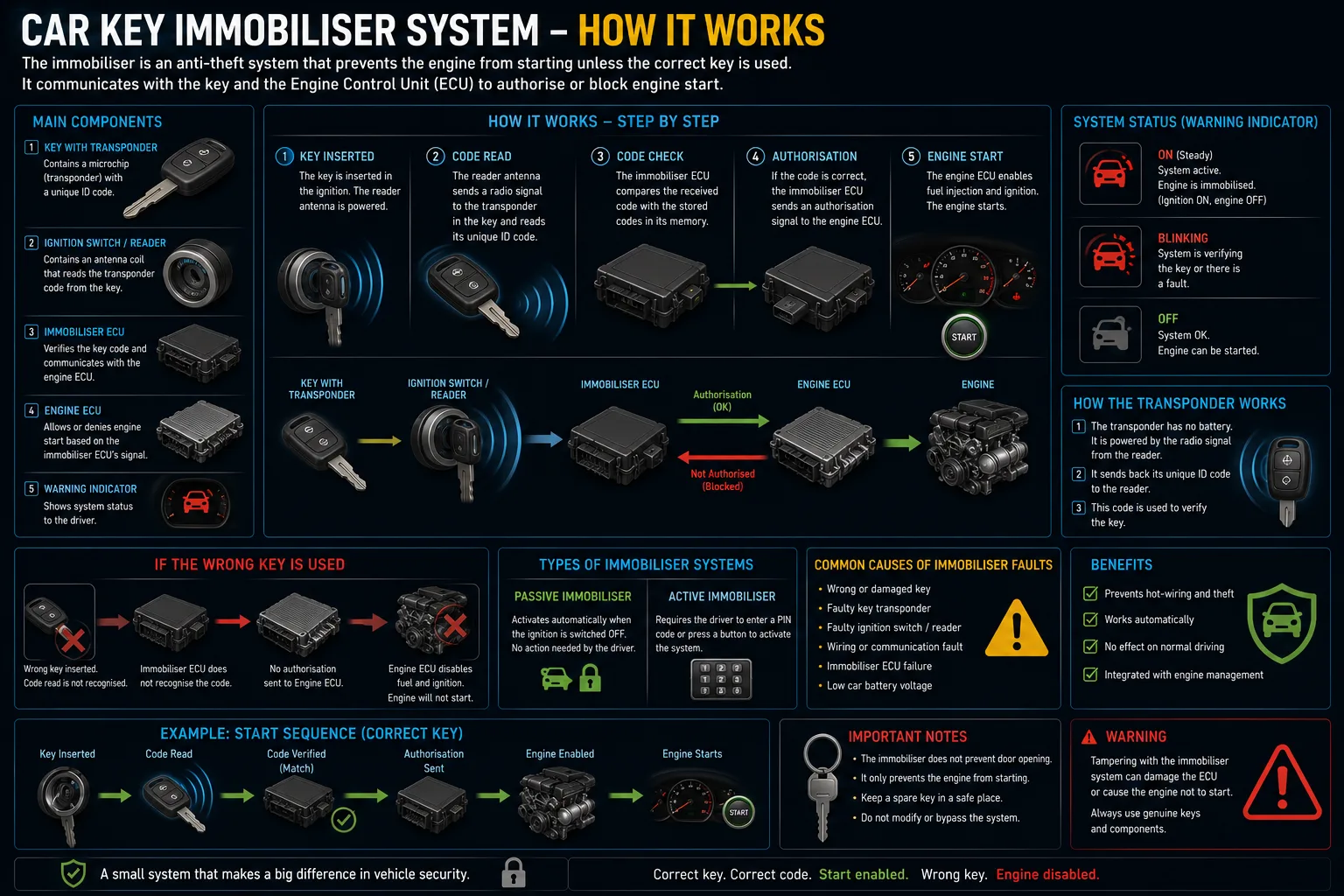
Every car built after the mid-1990s has an immobiliser — a system that checks whether the key in the ignition contains the right transponder signal before it'll let the engine start. In earlier systems this was a fixed code; in modern cars it's a rolling cryptographic handshake, with the key and the car exchanging unique tokens every time. Get it wrong and the ECU simply refuses to energise the fuel system, no matter how enthusiastically you crank it. There are two routes to a spare. Cloning copies the transponder data from your existing key onto a compatible blank — quick, and it means both keys carry identical signatures. Some modern encrypted systems (particularly newer VAG, BMW and Mercedes platforms) don't allow cloning because the rolling code can't simply be duplicated; in those cases we use manufacturer-grade diagnostic tools to connect to the vehicle's immobiliser and add the new key as an additional paired device — a process called key learning or EEPROM programming depending on the generation. Remote/fob functions (central locking, boot release) are a separate layer programmed on top, and smart proximity keys add a third layer with a UHF radio frequency that also needs pairing. All of this is done at your location, connected to the diagnostic port and — on modern vehicles — sometimes to the manufacturer's online servers for the encrypted seed key exchange.
“Inside that battered plastic fob is a transponder chip that talks to your car's immobiliser on a rolling encrypted code.”
Sound familiar?
So what's behind it?
What we do — at your door
We come to you — driveway, car park, roadside, office, wherever the car has ended up — with manufacturer-grade programming equipment, a stock of compatible transponder blanks and fob shells, and no interest whatsoever in charging you dealer rates for the privilege. For cloneable systems we read the transponder from your existing key and write it to a new blank on the spot, checking start function before we pack up. For systems requiring live immobiliser programming we connect to the vehicle's diagnostic port, identify the immobiliser generation and security protocol, and add the new key to the vehicle's accepted key list — or in all-keys-lost situations, reset the accepted list and program fresh keys from scratch. Remote and proximity fob functions are programmed and tested as part of the same visit. We don't charge for a separate return trip if we've diagnosed upfront what's required. You end up with a working spare, your car's immobiliser knows about it, and you can go back to your day.
What affects the price
What drives the cost of spare key programming in the UK is primarily the vehicle make, model and year — a basic transponder clone on a straightforward system is a very different job to adding a proximity smart key on a current-generation German vehicle that requires an encrypted online session with the manufacturer's servers. Key generation matters too: older fixed-code transponders (pre-2005 roughly) are usually quick and inexpensive; more recent rolling-code and crypto-based systems take longer and require pricier tooling. Shell and blade supply adds cost on vehicles using proprietary cut profiles — laser-cut or internal-cut keys cost more to source than standard edge cuts. All-keys-lost scenarios carry a premium because the process is substantially more involved: the immobiliser often needs a full re-initialisation rather than a simple add-key procedure. Remote fob programming is typically included in the same visit cost rather than charged separately. We'll give you an honest quote upfront, broken down clearly, before any work begins — because the last thing you need on top of having lost your keys is a surprise invoice.
Random knowledge you didn't ask for
Questions you're probably asking
Can you make a spare key without me having the original?
Yes, in most cases — this is an all-keys-lost scenario and it's a more involved job, but entirely doable. We access the immobiliser via the diagnostic port and in some cases the vehicle's onboard memory, reset the accepted key list, and program one or more fresh keys from scratch. On vehicles requiring manufacturer server access we arrange that as part of the process. The car ends up with working keys it's happy with, and the old lost key is permanently locked out.
Why is dealer key programming so much more expensive?
Partly genuine overheads, partly because they can. Main dealers hold the same programming access we do for most vehicles, but they also charge labour rates calibrated to having a showroom, a coffee machine, and seventeen people in matching polo shirts. Mobile key programming skips all of that. The key itself is the same blank, the programming is the same process, and the result is the same working key — just done on your driveway rather than in a service reception.
My fob buttons have stopped working but the car still starts — is that a programming issue or just a dead battery?
Almost always the battery first — CR2032 or CR2025 depending on the fob, available everywhere. Replace it and try again. If it still doesn't work, the fob may have lost its radio pairing when the battery went completely flat, which happens on certain makes. That's a quick re-pairing job rather than a full key program. If a new battery and re-pairing don't fix it, the fob's circuit board may have failed, in which case we supply and program a replacement shell.
Will a cloned key cause any problems — will the car think two identical keys are being used?
On systems where cloning is appropriate, the car doesn't distinguish — it simply sees a valid transponder signal and starts. Problems arise only if you try to clone a rolling-code system that's designed to prevent exactly that, which is why some modern vehicles can't be cloned and need the add-key procedure instead. We identify which method applies to your car before we start, so you're not getting a clone that'll cause immobiliser confusion down the line.
How long does spare key programming take?
A straightforward transponder clone is typically 20–30 minutes from arriving at your car. A full add-key procedure on a modern system with online server access runs 45–90 minutes. All-keys-lost on a high-security vehicle can take two to three hours in some cases. We'll give you a realistic time estimate when you book, not an optimistic one that leaves you standing in a car park wondering where we are.
My key fob has stopped locking the car — what's going on?
Nine times out of ten it's a dead CR2032 battery — two quid from any supermarket, sorted in thirty seconds. But if a fresh battery doesn't fix it, the fob's likely lost its sync with the car's ECU, or the receiver module itself has given up. Replacing and reprogramming a fob is not a DIY job unless you fancy expensive trial and error; a mobile diagnostic and programming visit is far quicker and usually works out cheaper than a main dealer will quote you.
Spare Key Programming — sorted at your door
Stop procrastinating. Get a transparent quote and we'll come to you.