Car Key Replacement: Because Your Dealer Wants £400 for a Bit of Plastic and a Chip
There are two types of car key problems: the kind where you've lost your only key and you're standing in a car park in the rain making that specific face, and the kind where you've had one too many brushes with the first kind and you're sensibly getting a spare cut before it happens again. Either way, the dealership's solution is the same: hand over a truly heroic sum of money, wait four to ten working days, and resist the urge to ask why a key costs more than some people's first car. SOSCarFix takes a different view. We come to wherever your car is — your driveway, your workplace, a supermarket car park, the roadside — with the kit to cut, code and program a new key on the spot. The same job, minus the showroom marble flooring you'd be paying for.
See our upfront pricingLost your car key or locked out? SOSCarFix programs transponder keys, smart fobs & keyless entry on-site — no dealer faff. Get a quote today.
How it actually works
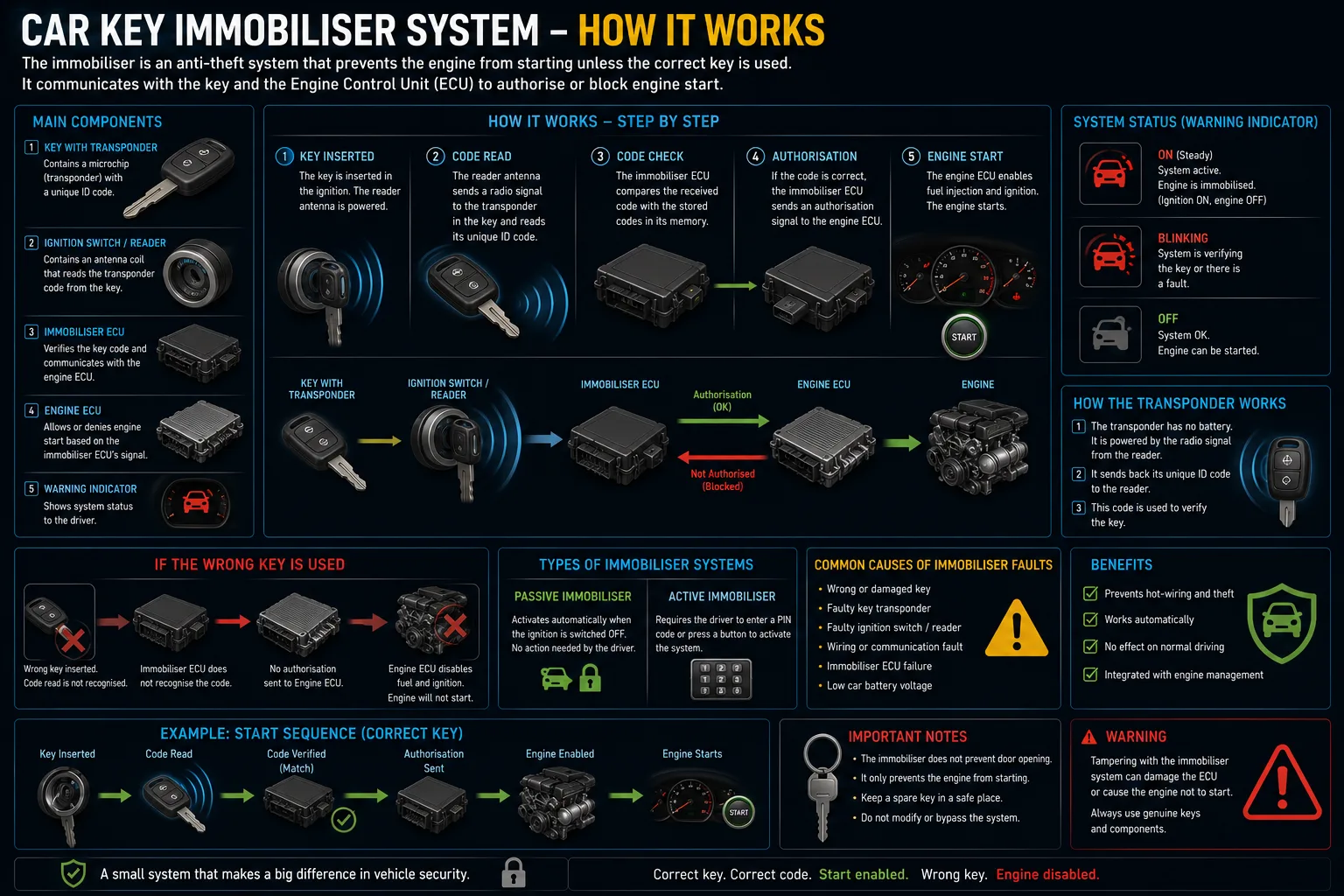
Modern car keys are not keys in any meaningful mechanical sense. They're small computers. Inside a transponder key is a microchip that broadcasts a unique rolling code to your car's immobiliser control unit every time you turn the ignition. If the car doesn't receive the right handshake — because the key is wrong, unprogrammed or simply not present — the immobiliser cuts the engine circuit and the car won't start. The mechanical cut of the blade handles the physical ignition barrel; the chip inside handles whether the engine is actually allowed to fire. Smart keys (keyless entry, proximity keys, push-button start) go further: they communicate with the car constantly while in your pocket and use encrypted rolling codes that change with every use. Programming a new key means connecting to the car's OBD-II port (or sometimes the BCM directly) with specialist automotive key programming software, authenticating with the vehicle's security system, and registering the new key's unique ID. On an all-keys-lost job — where there's no original key to authenticate with — the process is more involved, often requiring PIN extraction from the immobiliser or ECU before any new key can be enrolled. This is why all-keys-lost costs more than a spare: it's a different, harder job, not an excuse to inflate a bill.
“The same job, minus the showroom marble flooring you'd be paying for.”
Sound familiar?
So what's behind it?
What we do — at your door
We come to your car — not the other way round, which is the only logical approach when the problem is that the car can't be driven. Our auto locksmith arrives with a multi-make key cutting machine and professional-grade key programming software covering the vast majority of UK makes and models, plus a stock of transponder key blanks, smart key shells and proximity fobs. We assess the job on arrival: whether you need a spare cut and programmed, a replacement for a lost key, or a full all-keys-lost procedure where we extract the PIN security data before enrolling new keys. If the ignition barrel is the problem rather than the key itself, we diagnose that too. The whole thing is done roadside, on your driveway or in your car park — no recovery truck, no dealer waiting times, no sitting in a showroom being offered a coffee while someone generates a four-figure invoice.
What affects the price
The cost of car key replacement in the UK depends on several things, none of which dealers tend to explain before presenting the bill. The make and model matters enormously — a basic key for an older Ford or Vauxhall with a straightforward transponder chip is a very different job to programming a proximity smart key for a premium German manufacturer that requires a direct dealer tool connection. Whether you have any original keys left makes a significant difference: cutting a spare while you have a working key is the cheapest option; losing your only key tips you into all-keys-lost territory, which requires additional security interrogation steps and costs more to reflect the extra labour and risk. The type of key — basic transponder, flip-key fob, proximity smart key, or proximity key with additional encrypted functions — affects both parts cost and programming complexity. What you won't get from SOSCarFix is the dealer's habit of bundling a two-hour "security diagnostic" onto the invoice because someone had a Monday morning to fill.
Random knowledge you didn't ask for
Questions you're probably asking
Can you replace a car key when I have no keys at all?
Yes — this is called an all-keys-lost job and it's more involved than cutting a spare. Without an original key to authenticate with, we need to extract the vehicle's security PIN data via the OBD port or directly from the immobiliser module before we can enrol any new keys. It takes longer and costs more than a standard spare, but it's considerably cheaper and faster than a dealer, and we come to the car rather than you needing to recover it anywhere.
Will a replacement key affect my car's immobiliser or void my warranty?
No. Programming a new key registers it with the existing immobiliser system — it doesn't alter the immobiliser itself. Your car's warranty is unaffected. The key is simply added to the list of authorised keys the immobiliser will accept, the same process the dealer uses. If you want an old lost key removed from that list so it can no longer start the car, we can do that too during the same visit.
My key fob stopped locking the car but it still starts the engine — is that a dead battery?
Most likely yes. In a combined transponder/fob key, the remote locking functions run off the coin cell battery, while the transponder chip that talks to the immobiliser is passive and draws power from the car's own ignition field. So a flat battery kills the fob but not the start function. A CR2032 replacement is a two-minute job — though if a new battery doesn't fix it, the PCB inside the fob may have failed or the fob may need resyncing to the car.
How long does mobile car key programming take?
A straightforward spare key cut and programmed on a common UK vehicle typically takes 30 to 60 minutes on-site. Smart or proximity keys can take longer depending on the make and the programming method required. An all-keys-lost job takes longer still — allow one to two hours as a rough guide. We'll give you a time estimate when you book based on your specific vehicle.
My key blade snapped in the ignition — can you fix that?
We can extract broken key blades from ignition barrels and assess whether the barrel itself has been damaged. If the barrel tumblers are intact we can cut a new key to the same code; if the barrel is damaged it may need replacing, which is a separate but manageable job. Don't try to extract a snapped blade yourself with pliers — you'll usually push it deeper and make extraction harder and more expensive.
Car Key Replacement — sorted at your door
Stop procrastinating. Get a transparent quote and we'll come to you.