ECU Remapping: Your Car Is Deliberately Slower Than It Should Be, and We Can Fix That
Manufacturers build one engine and sell it in six different trims. The 115bhp base model and the 150bhp Sport are often the same block, the same turbo, sometimes even the same injectors — separated only by what the factory programmed into the ECU. That's not a conspiracy theory; it's cost accounting. Hitting multiple power outputs from a single platform saves tooling money, and deliberately undertuning the cheaper variants protects the premium ones. What this means for you is that your car almost certainly has headroom the factory left untouched — headroom that a remap can access cleanly, safely, and without bolting on a single new component. SOSCarFix remaps your ECU at your location, no garage visit required, on a laptop connected to your OBD port. More power, sharper throttle response, sometimes improved fuel economy on diesels, and a drive that finally feels like the car was trying. Full Stage 1 and custom work available.
See our upfront pricingYour car is deliberately hobbled from the factory. ECU remapping unlocks what's already there — more power, torque, sharper throttle, sometimes better MPG. Mobile remap, we come to you. Get a quote.
How it actually works
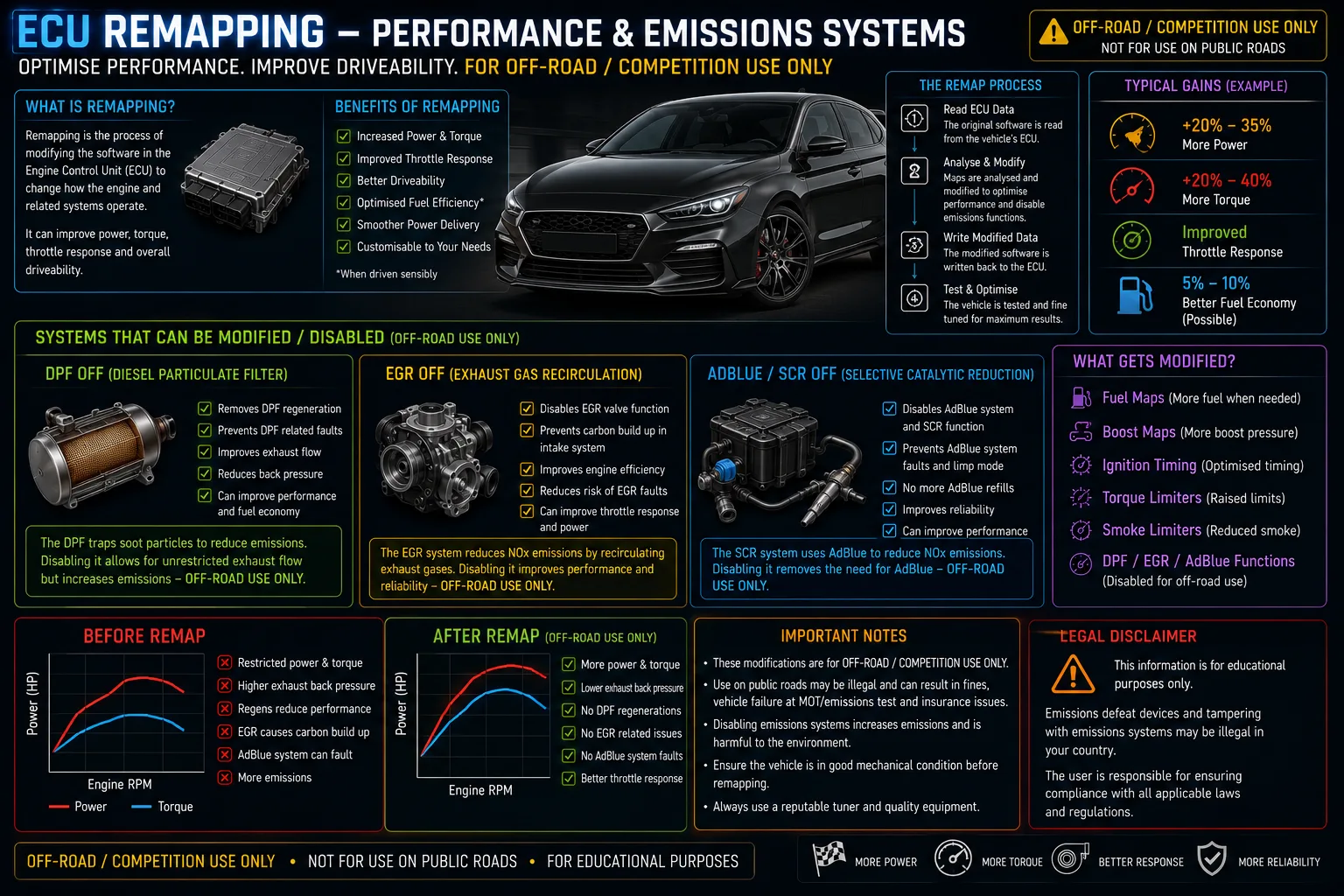
Your car's ECU — Engine Control Unit — is the brain that runs the show. It controls fuel delivery, ignition timing, boost pressure on turbocharged engines, throttle mapping, rev limits, torque limiters, and a dozen other variables that collectively determine how your engine performs. The factory calibration is a compromise: it has to pass emissions at every ambient temperature across every market, cope with 95-octane supermarket fuel and premium stuff equally, survive owners who never change the oil, keep warranties viable, and satisfy insurance actuaries who'd rather you didn't have too much fun. The result is a map that's safe for everyone and exciting for no one. A remap replaces that factory calibration — either with a proven off-the-shelf Stage 1 map developed specifically for your engine variant, or with a custom calibration adjusted to your specific car, fuel grade, and desired outcome. On turbocharged engines, the biggest gains come from increasing boost pressure within the turbo's safe operating range, advancing ignition timing, and optimising fuelling to match. Naturally aspirated engines have less dramatic headroom, but throttle response, redline, and mapping dead zones can still be meaningfully improved. Typical Stage 1 gains on a turbocharged diesel or petrol range from 20–40% extra power and 30–50% extra torque — figures that transform how the car drives rather than just moving numbers on a dyno sheet. The remap is written to the ECU via the OBD-II port (or occasionally via the bench for older vehicles), takes one to two hours on-site, and leaves no physical trace beyond your car suddenly driving considerably better.
“SOSCarFix remaps your ECU at your location, no garage visit required, on a laptop connected to your OBD port.”
Sound familiar?
So what's behind it?
What we do — at your door
We arrive at your address — driveway, workplace car park, or wherever the car is sitting — with a laptop, a quality MPPS, Alientech KESS, or similar professional-grade interface, and a calibration sourced from a tuner with genuine dyno-developed maps for your specific engine variant. We do a quick pre-remap health check: scan for existing fault codes, check boost sensor readings, verify the engine is in a state worth remapping (there's no point tuning a sick engine — we'll tell you if something needs sorting first). Then we read the existing ECU file, write the new map, verify the flash completed cleanly, and take the car for a test drive to confirm everything feels right in the real world rather than just on a screen. The whole process takes one to two hours on-site. We cover Stage 1 petrol and diesel remaps for turbocharged vehicles, throttle response optimisation for naturally aspirated cars, and can arrange custom dyno-refined maps for modified vehicles where a standard off-the-shelf file won't be accurate enough. And because we're contractually obliged to be honest: Stage 1 remapping is intended for road use on a standard or lightly modified vehicle. Off-road and competition applications sit outside that bracket. Disclose the remap to your insurer — it's a material modification and they will ask, and more insurers than you'd think are fine with it.
What affects the price
ECU remap pricing in the UK varies based on several genuinely meaningful factors, none of which involve plucking numbers from the air. The vehicle type matters significantly — a common turbocharged Ford, Vauxhall, or VW Group engine has well-developed, thoroughly tested Stage 1 maps available and is quicker to work with than a rare or unusual platform that needs more preparation time. The ECU variant matters too: most modern vehicles are straightforward OBD port jobs, but some require bench reading (ECU removed from the car) or have additional security layers that increase the session time. Whether you want a simple Stage 1 power increase or a custom multi-stage calibration factoring in hardware modifications like a downpipe, intercooler upgrade, or fuelling changes affects the scope of work considerably. Naturally aspirated remaps command slightly lower prices simply because the gains are more modest and the engineering headroom is smaller — you're paying for a better result, but the ceiling is lower. What we don't do is charge separately for reading the original file, writing the new one, and calling them different services — that's a trick, and you'll spot it if you see itemised quotes structured that way. Ask us for a bespoke quote based on your specific vehicle and what you're trying to achieve.
Random knowledge you didn't ask for
Questions you're probably asking
Will a remap void my car's warranty?
Potentially, yes — and it's important to be straight about this. If your car is within manufacturer warranty, a remap that a dealer can detect could give them grounds to decline warranty claims related to the engine or drivetrain. Some remaps are marketed as 'undetectable', but relying on that for warranty purposes is legally murky territory. If you're out of warranty, it's a non-issue. If you're within it, weigh that up honestly before proceeding.
Do I need to tell my insurance company about a remap?
Yes. A remap is a material modification — it changes the performance characteristics of the vehicle, and insurers consider it relevant information. Failing to disclose it doesn't just risk an increased premium; it risks your policy being voided if you make a claim. The good news is that a growing number of UK insurers treat remaps matter-of-factly and the premium uplift is often less dramatic than people expect. Declare it, get it in writing, drive with peace of mind.
How much power will I actually gain from a Stage 1 remap?
On a turbocharged diesel, gains of 30–50bhp and 80–120Nm of torque are realistic at Stage 1, with some popular engines doing better. Turbocharged petrols typically see 20–40bhp gains with a corresponding torque increase. Naturally aspirated engines are more modest — throttle response and driveability improve meaningfully, but raw power figures move less. These are honest ranges, not marketing maximums. Your specific engine variant determines the ceiling, not our ambition.
Is ECU remapping safe for my engine?
A Stage 1 remap from a reputable tuner — one using maps developed on a calibrated dyno for your specific engine variant, not a generic file renamed for your car — operates well within the engine's mechanical limits. The factory has genuine headroom built in. Where remapping goes wrong is with aggressive maps pushed beyond the platform's tolerance, cheap maps not properly matched to the engine variant, or remapping engines that already have underlying faults. We check the car's health before we map anything — a healthy engine remapped sensibly is a happy engine.
Can a remap improve my fuel economy?
On turbocharged diesels, yes — genuinely, not as a marketing line. A remap that sharpens torque delivery at lower revs means you need less throttle to maintain speed and can change up earlier without the engine labouring. Real-world economy improvements of 5–15% are credible on diesel applications, though driving style determines whether you actually realise them. On petrol engines the picture is more mixed — if you use the extra power enthusiastically, economy stays flat or drops. Physics is consistent on this point.
ECU Remapping — sorted at your door
Stop procrastinating. Get a transparent quote and we'll come to you.