ECU & Module Coding / Programming
You've just fitted a brand new part. The old one was definitely duff — you checked twice. The new one is genuine, the right part number, and it cost a small fortune. Yet the car sits there like a sulking teenager, throwing faults, refusing to start, or pretending the new component simply doesn't exist. The part isn't faulty. The car just hasn't been introduced yet. Modern vehicles run a closed club of control modules that all know each other by name. Fit a stranger — even an identical one from the same factory — and the immune system kicks in. It gets rejected, like a transplant the body hasn't accepted. That's not a fault. That's what ECU and module coding is for.
See our upfront pricingYour new part works fine — your car just refuses to acknowledge it exists. SOSCarFix does mobile ECU & module coding across the UK. No garage, no faff, we come to you.
How it actually works
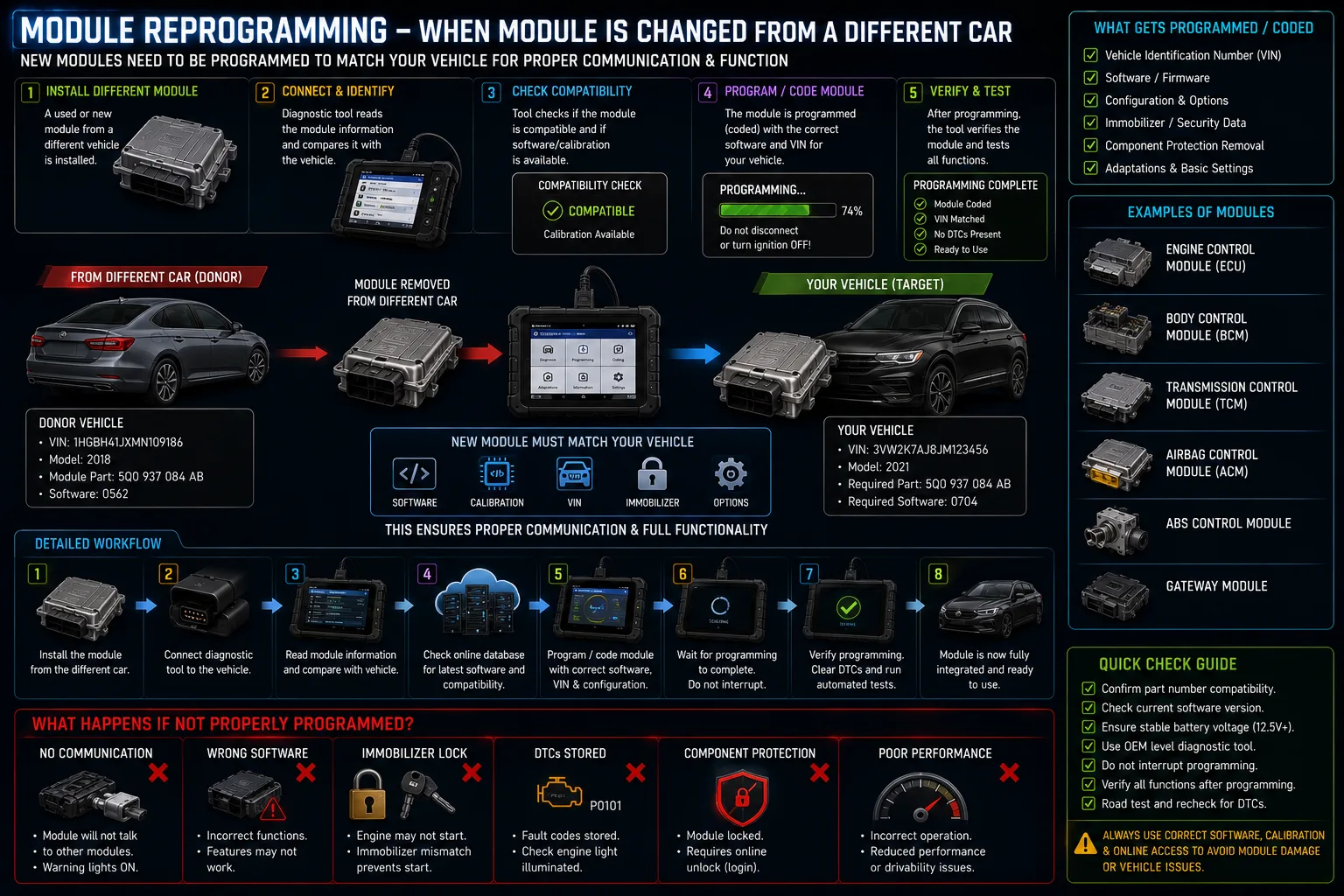
Every control module in a modern car — the ECU (engine brain), TCU (gearbox brain), BCM (body control), ABS unit, airbag module, instrument cluster, and a queue of others — is personalised to the vehicle it was fitted to at the factory. It knows the car's VIN, its immobiliser security codes, its neighbours on the CAN bus network, and what configuration it's supposed to be running. Swap one out and the network does a roll call. The new module either isn't on the list, or it's still carrying the identity of the last vehicle it lived in. Neither situation ends well. ECU coding is the process of configuring a module's parameters — telling it which options the vehicle has, what market it's in, which systems are active. Think of it as filling in the new recruit's HR paperwork so the rest of the team knows what they're dealing with. ECU programming goes a layer deeper: rewriting the firmware itself — the actual software the module runs on. This is what happens when a manufacturer issues an updated calibration, or when a replacement module arrives blank and needs a full set of instructions loaded before it can do anything at all. Both jobs require specialist diagnostic tooling connected to the vehicle's OBD port, genuine or high-quality professional software, and a working knowledge of what each manufacturer's system actually expects. It is not a job for a generic code reader and optimism. We connect, we identify the module, we supply the correct coding data or software file, we push it through, and we verify the network is happy. The car stops sulking. Everyone gets on with their lives.
“Fit a stranger — even an identical one from the same factory — and the immune system kicks in.”
Sound familiar?
So what's behind it?
What we do — at your door
We come to you — home, work, or roadside — with professional-grade diagnostic and programming equipment covering the major manufacturers. We identify exactly which module needs coding or programming and what data it requires. Where a module needs VIN writing, variant coding, or immobiliser matching, we handle that through the correct manufacturer-level process. Where a software update or fresh firmware load is needed, we source the correct file and flash it properly. Once the work is done, we clear the fault codes generated by the mismatch, run a full network scan to confirm every module is communicating correctly, and verify the vehicle starts and operates as it should before we pack up. No guesswork, no \"try turning it off and on again\", no sending you to a dealer and wishing you luck.
What affects the price
The cost of ECU and module coding varies depending on which module needs work — coding a BCM is a different job to fully programming a blank ECU with new firmware. The vehicle make and model matters significantly, because manufacturer tooling licences, software access costs, and the complexity of the security protocols vary enormously between brands. Whether the module needs simple variant coding, a full VIN write and immobiliser matching, or a complete firmware flash affects the time and tooling involved. Sourcing a donor module that then needs virginising and re-coding is a more involved process than coding a new blank unit. We assess what's actually needed for your specific vehicle and give you a straight quote — no surprises on the day.
Random knowledge you didn't ask for
Questions you're probably asking
Can I just swap in a secondhand ECU from the same model of car?
You can try. The car will almost certainly refuse to start, because the secondhand ECU still holds the security credentials of the vehicle it was originally fitted to, and your immobiliser won't recognise it. On most modern vehicles, a used ECU needs to be virginised — its previous identity wiped — and then properly coded and matched to your car before it'll do anything useful. Without that process, you've spent money on a paperweight.
Does every module need coding when it's replaced?
Not every single one, but more than most people expect. Anything involved in engine management, transmission, body control, ABS, airbags, or the instrument cluster almost always does. Some simpler components are closer to true plug-and-play. The safest assumption when replacing any electronic module is that it will need some form of coding or adaptation — and the safest thing to do before buying a replacement is to check what that process involves for your specific vehicle.
My car was fine before, the part is new, why is this so complicated?
Because your car was built in an era when manufacturers decided that making modules interchangeable would make theft too easy. They were right — it did. The side effect is that legitimate repair now requires the same level of access as theft prevention, which means specialist tools, software licences, and someone who knows how to use them. It is annoying. It is also the reason your car hasn't been nicked.
Can you program any make and model?
We cover the most common makes on UK roads — the majority of European, Japanese, and Korean manufacturers, and a solid range of American-market vehicles sold here. Certain highly specialised or rare platforms may need manufacturer dealer tooling that isn't commercially available outside the network. We'll always tell you upfront if a vehicle falls outside what we can handle rather than have you find out after the fact.
ECU & Module Coding / Programming — sorted at your door
Stop procrastinating. Get a transparent quote and we'll come to you.